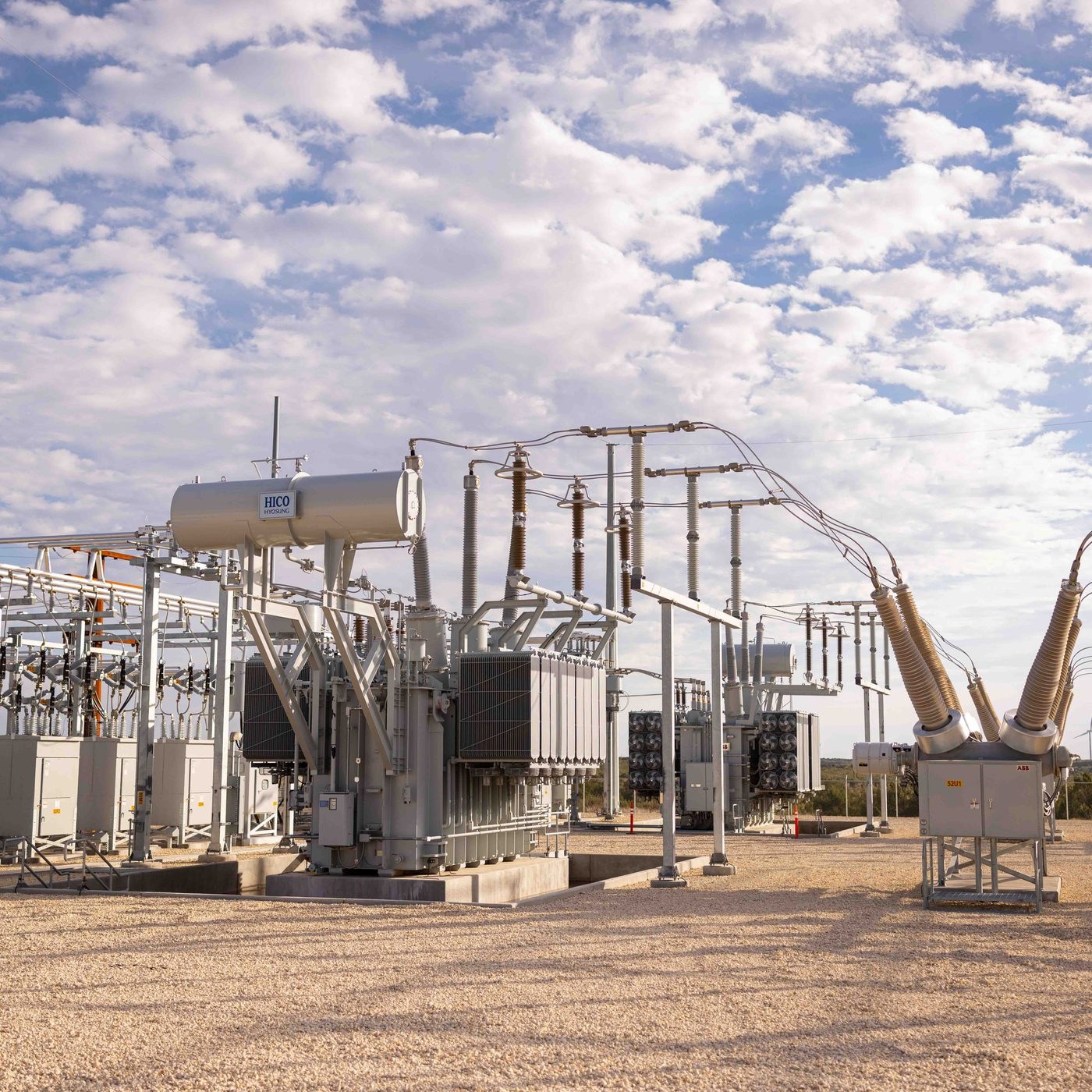
In Haskell County, Texas, Intersect has put an unusually literal proposition on the ground. Its Quantum facilities began operating in June 2026: 640 megawatts of solar generation and 1.3 gigawatt-hours of battery storage. A Google data center is being built alongside them. The electricity arrived first. For a business accustomed to thinking about computing speed, this is a useful change of subject.
- Build new power alongside the computers that need it.
- Google acquired Intersect in March 2026; the grid-tied carve-out became IPX Power.
- The model combines renewables, batteries, and, at some sites, gas.
The problem is the journey
We generally imagine electricity as something waiting inside a socket. Building a data center means discovering everything behind that socket: generation, transmission, interconnection studies, equipment, and permissions. In his 2023 essay on the grid, Intersect founder Sheldon Kimber argued that large electricity users would increasingly move toward generation. When moving the power becomes difficult, reconsider where you put the customer.
That is Intersect’s proposition. It develops the land, generation, storage, and infrastructure around large industrial electricity demand. Google is the named anchor customer. A household cannot download Intersect or subscribe to a cheaper electricity plan. Its usefulness reaches ordinary people through the computing infrastructure they use; its direct work happens at the scale of campuses and power plants.
A developer who had done the homework
Kimber and Luke Dunnington founded Intersect in 2016. Both had worked at Recurrent Energy. Kimber had been its chief operating officer; Dunnington had overseen development. Before that, Kimber worked on gas-fired projects at Calpine and in finance and consulting. His background helps explain why Intersect’s answer involves contracts and construction schedules as much as energy technology.
He also taught project finance at Berkeley’s Haas School for about a decade. It is an appealing detail: the person explaining tomorrow’s electricity supply had spent years explaining how to pay for things. Intersect’s expertise spans siting, engineering, procurement, energy markets, financing, and operations. Its distinction is the coordination of those disciplines around a large customer’s demand.

Follow the money, then the assets
The capital arrived in different forms. In 2022, Intersect announced $750 million in growth equity led by TPG Rise Climate. In July 2024, it secured $837 million in financing commitments for three Texas battery projects, combining debt and tax equity. That second number financed infrastructure; it was not another startup equity round.
December 2024 brought Google into a deeper relationship. A partnership with Google and TPG set a target of catalyzing $20 billion in renewable infrastructure investment by decade’s end. Intersect separately announced more than $800 million in funding. The $20 billion was an ambition, not cash raised that afternoon. Google would provide offtake as an anchor tenant in co-located industrial parks.
Alphabet announced a purchase agreement in December 2025 for $4.75 billion in cash plus assumed debt. The transaction closed on March 10, 2026. Alphabet’s subsequent filing reported approximately $5.9 billion after purchase price adjustments. Those figures describe different stages and measures of the deal. Neither is a price tag for a single power plant.
The acquisition also divided the business. Google acquired Intersect’s digital-power platform, team, and relevant development projects. A substantial grid-connected portfolio became IPX Power, backed by existing investors. IPX launched with 4.4 gigawatts of solar and 8.8 gigawatt-hours of batteries operating or under construction. Those assets belong in IPX’s column when assessing today’s Intersect.
Flexible gas supports reliability at hybrid sites.
Schematic only; connections vary by project.
The circuit breaker test
There is a less glamorous example of Intersect’s method. At Oberon, its California solar-and-storage project, the company says it accelerated procurement and installation of a critical 500-kilovolt circuit breaker. The facility entered service in 2023 ahead of schedule and below budget, according to Intersect. Oberon now belongs to IPX, but the execution lesson travels.
Find the component that controls the schedule. Buy it early. Align suppliers before construction makes delay expensive. Intersect’s relationships with First Solar and Tesla support that approach. An outsider can copy the discipline without copying the balance sheet: map dependencies, secure scarce inputs, and plan the customer’s arrival alongside the supplier’s delivery.
“I’m paid to build things, not wait around for someone else to solve my problems.”Sheldon Kimber / April 2025
The gas in the clean-energy story
Co-location does not make intermittency disappear. Meitner, under construction in Gray and Roberts Counties, pairs a Google data center with more than a gigawatt of wind, solar, and battery systems. A minority of demand is intended to be met by on-site firming gas. Intersect’s October 2026 Roman case study likewise describes renewables and batteries backed by flexible gas engines.
That design accepts combustion to support reliability. Roman’s emissions reductions remain company projections. The approach depends on suitable land, strong renewable resources, fuel access, permissions, equipment, and capital. A customer that cannot relocate, or requires electricity without fossil generation in every hour, presents a different problem. Utilities and separately contracted power remain alternatives. Geography and operating requirements determine which arrangement earns its keep.

The neighbors get a vote
The computing campus also has neighbors. On October 14, 2026, Intersect and Google announced $50 million in long-term community investment across three Texas counties. Planned oversight includes the Amarillo Area Foundation and a local advisory council, with an initial grant cycle in early 2027. It is a commitment whose execution will matter beyond the announcement.
Intersect’s lesson is practical: treat the power supply, the customer, and the place as one development problem. Quantum offers an early physical result. Its energy facilities are operating; the neighboring data center has its own construction timetable. Even when the destination is artificial intelligence, the work proceeds one real dependency at a time.