James McWalter called farmers with a question about carbon and found himself hearing about wind developers. He was exploring agricultural decarbonization, a reasonable interest for someone who had grown up on an Irish farm. The people answering his calls had another subject in mind: the renewable energy companies contacting them about their land. Somewhere inside those complaints was a different business.
The turn is a useful introduction to McWalter, now the co-founder and CEO of Paces. His company helps developers assess land for energy infrastructure, bringing together information about grid connections, environmental constraints and permission to build. The origin contains no laboratory revelation. It contains someone listening while his original idea became less interesting than the answers.
A field can be spacious, accessible and available for sale. It can also be a poor place for a power project. Ownership, electricity and local approval each have their own logic. McWalter has made a company out of helping people understand how those logics collide, preferably before the collision becomes expensive.
A philosopher learns to sell
His preparation was circuitous. McWalter studied philosophy and psychology at Galway, then took an MLitt in Philosophy at the University of St Andrews. Those are qualifications for asking awkward questions, though their usefulness in a utility meeting might require some explanation. His next professional world supplied a more commercial vocabulary: financial data.
At FactSet, he sold data and portfolio analytics to financial institutions. Later came business development at Hello Vera, an AI startup where he was employee number one, and operations at Respondent, a market research marketplace. His responsibilities at Respondent included analytics, sales, customer success and security. The job description had apparently declined to choose a lane.
He also founded Hale. His own account of earlier ventures includes co-founding Miscellany Theatre Productions, a London theatre company. The combination resists a neat founding legend. Before Paces, he had already worked across the business of information, the mechanics of a marketplace and the rather different problem of putting on a show.
The common experience was getting people to do something with an idea: buy it, use it, respond to it. That background helps explain why the next company began with conversations rather than a finished product looking for an audience.
The farm came before the software
McWalter grew up in County Mayo, Ireland, and also spent part of his upbringing in upstate New York. The farm was organic. He has recalled its conversion in 1997 and his mother’s work leading organic standards in Ireland. Changing agricultural practice was something he had watched happen, with all the practical implications that disappear from a distant view of a field.
His earlier work included cooking, butchery and forestry management. Land had supplied jobs before it supplied a software market. When he began looking seriously at climate businesses, agriculture offered a familiar starting point. In 2021 he was publicly discussing a venture called WolfDe, focused on decarbonizing food supply chains.
He was also hosting Carbotnic, speaking with people building climate businesses. One early guest was Rheaply co-founder Garry Cooper, discussing the reuse of assets and the dynamics of a marketplace. McWalter’s climate education was taking place in public, one working business at a time. The microphone offered access to people whose answers could complicate a tidy theory.
A map cannot grant permission
By 2022, McWalter and Charles Bai had founded Paces. Bai, the CTO, had worked on machine learning at Meta, including AI efficiency. Their partnership paired experience selling and operating data businesses with experience building the systems behind them. Paces joined Y Combinator’s Summer 2022 batch.
McWalter described a substantial research effort behind the decision: more than 1,000 LinkedIn approaches and roughly 150 short calls. Four customers helped shape the first product. The numbers give some scale to an unromantic activity. Before the company could shorten anybody else’s workflow, its founders had to understand what people were doing all day.
The answer involved far more than finding empty land. Paces evaluates the conditions that can make development possible or stop it. A place with room for solar panels still needs a workable route to the grid. A willing seller cannot supply a permit. Environmental and design constraints remain attached to the location, however attractive it looks on a screen.
In its later risk framework, Paces divided early development into five categories. The practical idea is to investigate the uncertainty that matters most before committing more money. A disappointing answer can be valuable if it arrives while walking away is still affordable.
What has to work before construction?
- 01Site controlCan the developer secure the land?
- 02InterconnectionCan the project connect to the grid?
- 03PermittingCan it obtain the necessary approvals?
- 04EnvironmentalWhat constraints does the site contain?
- 05DesignCan the proposed infrastructure fit and work?
Eleven million dollars, then back to work
On July 24, 2024, Paces announced an $11 million Series A led by Navitas Capital. Participants included Suffolk Technologies, MCJ Collective, Resolute Ventures, Soma Capital and Y Combinator. The money would support better data and wider availability of its Permitting Predictor across the United States.
By then, the company named EDF Renewables, AES and Third Pillar Solar among its customers. Its tools brought spatial, zoning, permitting, environmental and interconnection information into the same development process. These are less glamorous nouns than a funding announcement usually contains. They are also the nouns a developer has to deal with after the announcement is over.
“We have built 1% of Paces.”
James McWalter, July 2024
That was McWalter’s assessment when he shared the financing news. The small percentage turned a milestone into a reminder of the work remaining. By July 2026, Paces was reporting its selection to showcase at the Permitting Innovators Expo. The company had taken an interest in county-level friction into a wider conversation about how permitting technology should work.
The cloud needs somewhere to stand
AI gives McWalter’s story an unusually practical twist. Paces uses it to help evaluate and advance energy projects. The data centers running AI also need electricity and land. Both sides eventually arrive at a location where somebody must build something.
In December 2024, McWalter co-authored Fast, scalable, clean, and cheap enough with Kyle Baranko of Paces, Duncan Campbell of Scale Microgrids, and Zeke Hausfather and Nan Ransohoff of Stripe. They examined whether off-grid solar microgrids could help meet AI’s electricity requirements quickly, at sufficient scale and at an acceptable cost.
The analysis made tradeoffs explicit. Its proposed systems combined solar, batteries and backup generation; the argument did not depend on pretending that continuous electricity was easy to provide. Speed, reliability, cost and emissions had to be considered together. A project that performs beautifully on one measure can still fail a buyer’s actual requirements.
For McWalter, this expanded an existing question. The same software concerned with the supply of renewable power could help evaluate the places where large amounts of power would be consumed. The farmer’s parcel and the data center campus belong to a shared physical system, however differently their occupants might describe their work.
A very small company with a very large to-do list
His next argument pushed the staffing question further. In an essay originally written in September 2025 and updated in January 2026, McWalter imagined a one-person power development company supported by AI agents, data and outside partners. He proposed a 2030 scenario in which such a business could advance 500 megawatts of pipeline a year.
A forecast about development capacity, not a claim that one person constructs or operates every project.
The distinction matters. Moving a pipeline forward leaves plenty of work for engineers, builders, utilities, investors and communities. In his February 2026 writing, McWalter acknowledged that relationships, community engagement and trust remain personal. Regulators also have to accept what automated systems produce. A rapidly prepared submission still needs somebody willing to approve it.
His broader essay, Hyperscaling Atoms, makes the ambition plain: use AI to accelerate energy development, then use more available energy to enable physical industry. The language grows expansive. Its everyday obligations remain wonderfully specific. Land records must be collected. Grid questions must be answered. Somebody still has to call the county.
Still asking the next question
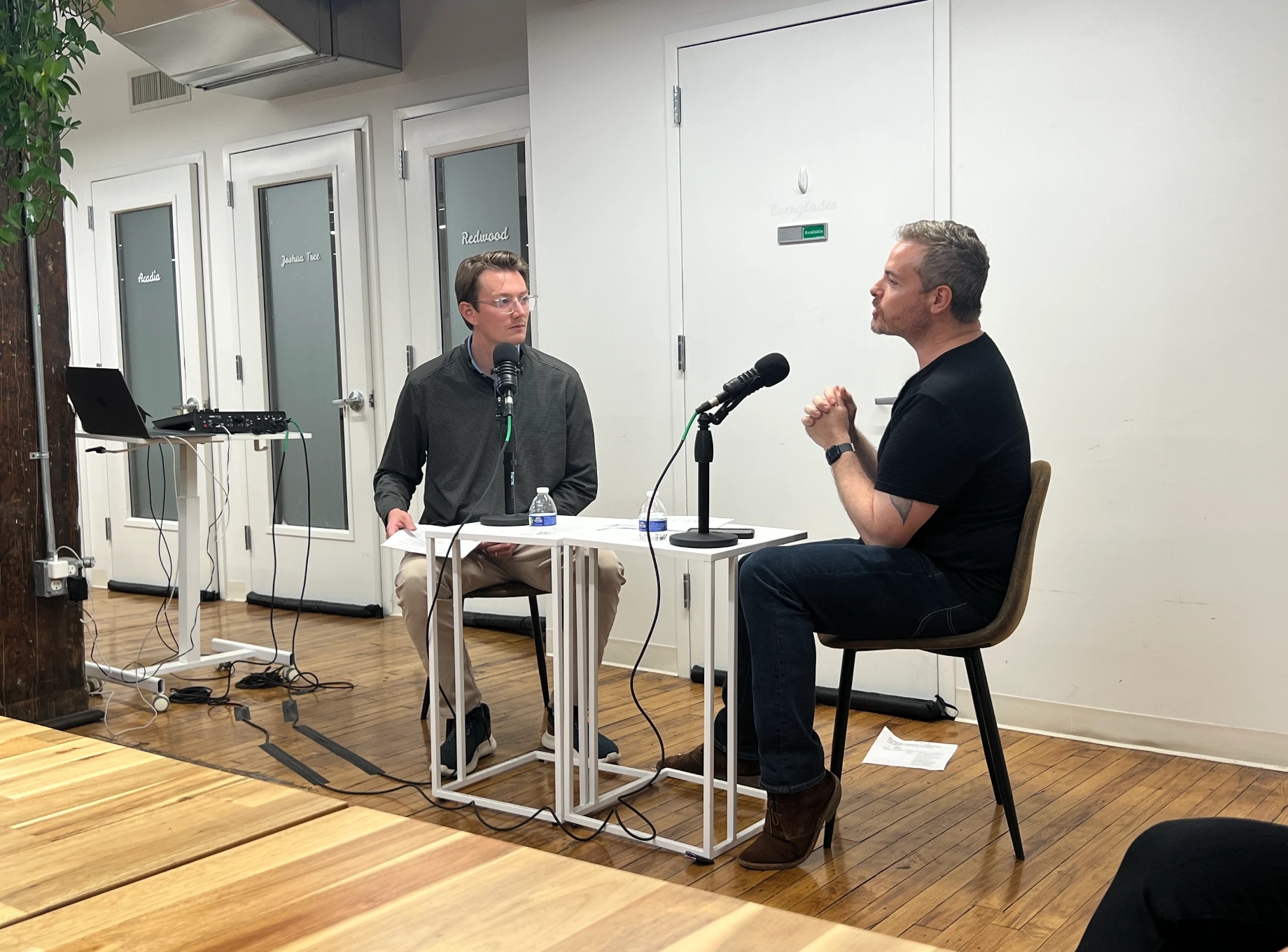
The interviewing continues. Carbotnic developed into Build, Repeat., where McWalter talks to people working on energy deployment. An October 2026 episode featured Claire McConnell of Redwood Materials discussing battery storage and data centers, recorded during Climate Week at the Paces office. The conversation had followed the business further into the details of building.
He also co-hosts America Needs This with investor Kyle Treige. In September 2026, they recorded its first live episode in New York, hosted by the Paces team. The premise is to examine a problem in American life and discuss a startup idea that might help address it. McWalter’s interest in the question before the company has acquired another venue.
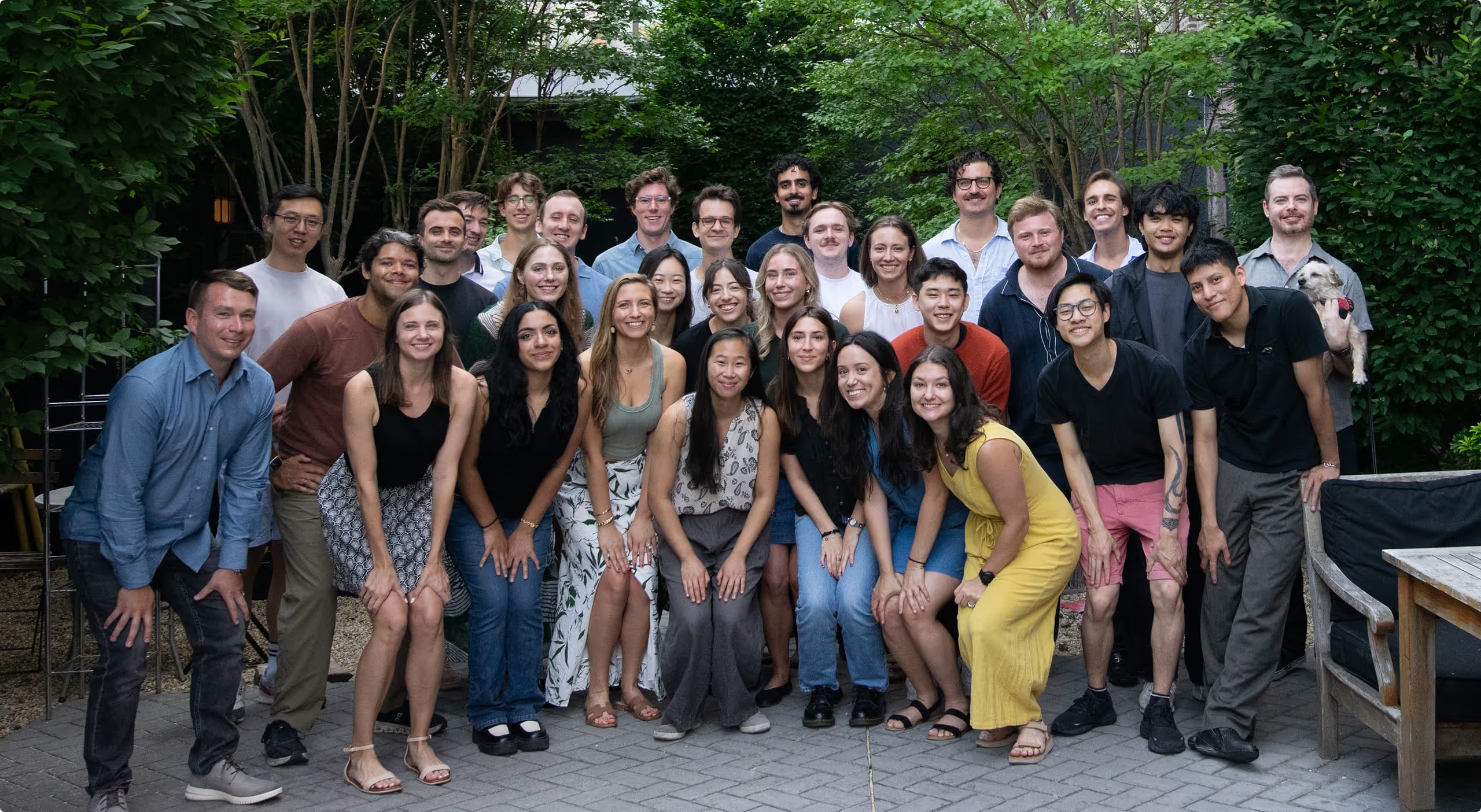
There is ordinary office life alongside these ambitions. Paces describes karaoke offsites, employee talks on subjects ranging from espresso to Capoeira, and a Brooklyn office with a dog calendar. The team picture contains a reminder that building a company involves assembling people who can spend a working day together, as well as assembling a persuasive explanation of the future.
For McWalter, the recurring subject is land: the farm he knew, the parcels developers investigate, the sites on which his forecasts depend. His career has brought philosophy, sales, operations and interviews to bear on that subject. The test of Paces arrives when someone can make a better decision about a real place. A perfectly good field deserves a few questions before anyone orders the panels.
Read, watch & listen
- James McWalter’s website · Paces
- LinkedIn · Twitter / X · Instagram · GitHub
- The early customer research, in McWalter’s words
- The farmer calls and the origins of Paces
- His conversation with Cody Simms on Inevitable
- The July 2024 Series A announcement
- A closer look at Paces’ development-risk framework
- The one-person power development company essay · His February 2026 follow-up
- Build, Repeat. · America Needs This
- Watch an earlier interview on YouTube · The 2021 Polymath conversation and links
- His career profile on Wellfound · Education and background