Somewhere inside an excavator, generator set or municipal truck, a small sealed box is doing diplomacy. One wire delivers an analog signal. Another device speaks SAE J1939 over CAN bus. A camera wants gigabit Automotive Ethernet. The hydraulic valve only cares whether it receives the right current at the right moment. The machine is large enough to flatten a shed, yet its working day can be ruined by a disagreement measured in millivolts.
This is Axiomatic Technologies Corporation's territory. Founded in 1991 and based in Mississauga, Ontario, the privately held company designs and manufactures rugged electronic controls for machines that vibrate, get wet, run hot and remain in service long after a phone would have become museum material. Its range runs from I/O modules and signal conditioners to valve drivers, motor controls, power converters, battery chargers, inclinometers, laser receivers and protocol gateways.
Calling it a component company is accurate but incomplete. Axiomatic sells a way for original equipment manufacturers to avoid clean-sheet engineering. Start with an off-the-shelf control. Have it factory-programmed. If the fit is still wrong, engage the design team for custom hardware, embedded software, mechanical packaging, validation and production. The box is the visible product; accumulated decisions about isolation, connectors, heat, vibration and communication are the valuable part.
The business is translation, not magic
Machine automation sounds futuristic until you inspect the wiring harness. Then it looks like a family reunion organized by rival standards committees. Axiomatic's catalog sits in the middle. A signal converter can turn voltage, current, PWM, frequency or a sensor reading into something a controller understands. A gateway can move information among CAN, CANopen, SAE J1939, Modbus, RS-232, RS-422, RS-485 or Ethernet. An isolated I/O module can keep electrical trouble in one circuit from infecting another.
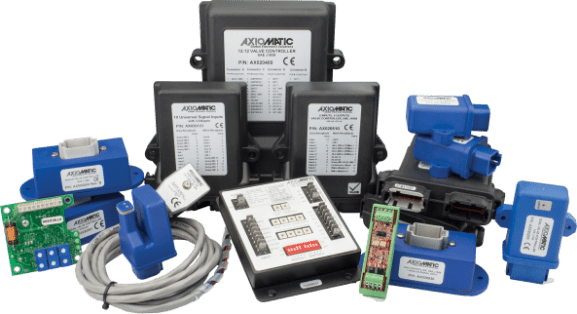
The practical outcome is not “digital transformation.” It is a loader arm that follows a joystick predictably, a generator that reports exhaust temperatures before something expensive cooks, or a legacy subsystem that can join a newer vehicle network without forcing the OEM to redesign the whole machine. Axiomatic's 2026 AX030355, for example, connects RS-232 devices such as satellite phones or printers to an SAE J1939 CAN network. Its AX141510 switch connects three 1000BASE-T1 Automotive Ethernet ports to conventional gigabit Ethernet for camera, radar and LIDAR interfaces.
The machine-language phrasebook
The harsh environment is the feature
A controller that works on a laboratory bench has completed the easy part. On a mine vehicle it meets dust, water, voltage spikes, electromagnetic interference, brutal temperature swings and vibration that treats every solder joint as a personal challenge. Axiomatic says its controls are tested for functionality, electromagnetic compatibility, vibration and environmental performance. Many products carry IP ratings, CE or UKCA markings, marine approvals or other specific compliance - but the relevant datasheet, not the logo wall, decides what a buyer can claim.
That qualification work is part of the moat. The company describes an introduction process with controlled gateways, schematic and multilayer board design, 3D mechanical work, thermal modeling, mean-time-between-failure analysis and third-party testing. It also responds to OEM approval methods such as FMEA, APQP, first-article inspection and production-part approval. None makes a punchy product launch. Together they make a part number easier for an engineering team to approve twice - once for the prototype and again for production.
The first thing to fail is often the interface: the wrong signal, the wrong protocol, the wrong protection or the right component in the wrong enclosure.An industrial rule of thumb, and Axiomatic's chosen neighborhood
This also explains the culture visible from outside. The public language is heavy on collaboration, validation, safety, ethical conduct and long relationships with customers and suppliers. Production-ready controls are manufactured in-house at the ISO 9001 facility in Mississauga; design work also happens in Finland. The tone is less “move fast and break things” than “move carefully because the broken thing has a hydraulic boom.”
A catalog with an engineering department attached
Axiomatic's commercial model has three layers. First come standard products, discoverable through selection charts, datasheets, manuals and 3D models. Then comes configuration: many controls can be factory-programmed for an application, and the company's Electronic Assistant software handles setpoints on supported controllers. Finally comes custom development when a standard device cannot meet the electrical, software, packaging or timeline requirements.
The website has a shopping cart, but it is used to request quotations. Credit-card buyers submit an order form and receive a secure payment link after review. That small procedural detail tells you what kind of business this is. Public list prices would pretend that ten pieces, a thousand pieces, a custom program and a qualification plan are the same purchase. They are not. The cost is quote-dependent, shaped by the part, volume, programming, testing, approvals and commercial terms.
Customers are machine OEMs and integrators across construction, mining, agriculture, power generation, marine, trucks and buses, rail, material handling, energy and factory automation. Most are not publicly named. Distribution and representation extend the reach: the company's current locator includes firms in the United States and Australia, plus representatives in China, India, Israel, Singapore, South Korea and Sweden.
A 2017 partnership with Bailey International shows how the pieces can assemble into a larger offer. Bailey brought hydraulic components and joystick controls; Axiomatic brought electronic controllers and power management. The result aimed at an end-to-end electro-hydraulic package instead of a customer stitching two vendors together. It is a sensible partnership template: join adjacent specialists where the integration burden normally lands on the buyer.
The market moved. The bridge stayed useful.
The catalog tells a quiet story of changing machinery. Analog signals and serial links did not vanish when CAN networks arrived. CAN did not disappear when Ethernet entered vehicles. Cameras, radar and LIDAR now demand bandwidth, while pumps, valves and temperature sensors continue doing physical work at their own pace. Axiomatic has kept adding the connective tissue instead of betting on one clean generational reset.
Its competition is serious. Danfoss PLUS+1 offers a large controller-and-software environment for mobile machines. Bosch Rexroth's BODAS spans controllers, sensors, connectivity, hydraulics and automation. Parker Hannifin, HydraForce and Finland's Epec cover overlapping territory. Large rivals can sell broader ecosystems, safety platforms and hydraulic stacks. An OEM's own engineering group is another alternative.
Axiomatic's difference is narrower and practical: a broad menu of rugged building blocks, unusually wide protocol coverage, factory programming and a willingness to design the odd-shaped last mile. That can be attractive when the machine builder wants control over the total architecture and needs a specialist component rather than an entire vendor ecosystem.
Where it fits
- Low-to-medium volume OEM machinery
- Mixed legacy and modern interfaces
- Harsh electrical and physical environments
- A standard base needing application-specific changes
Where it may not
- Commodity devices bought on lowest unit price
- Cloud-first products with little machine-side I/O
- A buyer demanding instant public checkout pricing
- Restricted safety-critical uses without written approval
What changed in 2026
The product cadence accelerated across several edges of the catalog. Axiomatic announced an isolated 20-channel thermocouple scanner for generator-set temperature data, ten-output CAN valve controllers, 50-watt and 720-watt DC/DC converters, magnetic-pickup input modules and the gigabit Automotive Ethernet switch. It also showed a 10-amp H-bridge controller at Conexpo and exhibited at the iVT Off-Highway Vehicle Technology Expo in Chicago.
The larger change was geographic. In July, the company announced Axiomatic Technologies Inc., a sales office and warehouse in Farmington Hills, Michigan. The new operation supplies US customers while working with the Canadian design team. For buyers, that can mean more convenient ordering, inventory and support. For Axiomatic, it is a way to reduce the distance between a Mississauga production floor and a large American base of vehicle and equipment manufacturers.
The part worth stealing
- Map interfaces before features. List every signal, protocol, voltage and environmental constraint.
- Build reusable blocks. Isolation, communications, power stages and enclosures should compound across projects.
- Customize the last mile. Change software or I/O around a proven core before starting from zero.
- Publish the boring proof. Datasheets, manuals, models, approvals and ordering rules shorten a buyer's internal argument.
- Put inventory near the customer. In hardware, lead time can be a feature.
The playbook does not transfer everywhere. It works when failures are expensive, requirements vary, buyers have engineers and repeat production can repay the original design effort. It works poorly when customers want a disposable commodity, when certification responsibility is ambiguous, or when every “custom” request becomes a one-off that never reaches production. Discipline is the difference between a platform of reusable blocks and a consultancy with a crowded parts drawer.
Axiomatic is interesting because it occupies a layer modern technology stories often skip. Autonomy needs cameras and algorithms, but it also needs a switch that survives the vehicle. Electrification needs batteries, but it also needs clean power at the right voltage. Smarter machines need more data, but the thermocouple still begins with heat. The company has spent 35 years turning those awkward boundaries into products. The boxes stay small. The consequences do not.