The useful clue in Amanda Wilkins's career is not a campaign slogan. It is a revision note. Open an Axiomatic Technologies manual from October 2008 and her name appears beside a change to the documented power-supply range. In later manuals, she turns up beside clarified isolation specifications, a revised pinout, vibration compliance, certification updates and dimensional drawings. These are small entries in small type, but they tell you where this chief marketing officer learned to work: close to the product, where one number can determine whether a controller belongs on a machine.
Axiomatic makes electronic controls for equipment that works far from the calm conditions of a desk. Its modules sit in construction and mining vehicles, commercial trucks, power generator sets and industrial machines. The environment may bring dust, water, shock, vibration, wide temperature swings and ugly electrical transients. The language surrounding those products is correspondingly exact: voltage ranges, inputs and outputs, connector types, ingress ratings, CAN protocols, Ethernet standards.
Wilkins's job is to bring that specificity into the buying conversation without sanding it down into generic technology copy. Her public trail shows the work from several angles. She has been named on product announcements since at least 2010, interviewed about the spread of CAN networking, credited in technical documentation, listed on conformity declarations and quoted more recently on automotive Ethernet. The title changed from sales and marketing manager to chief marketing officer. The underlying task stayed recognizable: translate between the people who design the electronics and the people who must decide whether to put them on a machine.
The customer knows the direction, not the map
In a 2014 trade interview, Wilkins described a revealing kind of customer request. Equipment makers were arriving with the conviction that they needed CAN in their machines, even when they did not yet know much about it. They could see the industry moving toward networked controls. They still needed help understanding how the protocols, messages and hardware would fit their own application.
“We are in the middle of a growth spurt with CAN adoption. Some of our customers tell us they need CAN in their machines but they don't know much about it.”Amanda Wilkins, speaking as Axiomatic's marketing manager
That is a useful description of technical marketing at its most practical. The customer is not empty-handed. They bring a machine, an operating problem and a sense that the architecture has to change. But there is a gap between direction and decision. Someone has to explain the difference between SAE J1939 and CANopen, show how a controller can be configured, and make clear which details are standard and which must be tuned.
Wilkins said Axiomatic was offering standard hardware with custom software. A generic system could not simply ignore the messages an engineer wanted to monitor. The machine imposed its own logic. So the explanation had to make room for both repeatability and adjustment. The marketer's role was less like a megaphone and more like an interface: accept the customer's terms on one side, map them to the product on the other, and preserve the meaning in between.
The manual is part of the product
The manuals make the scope of Wilkins's work unusually visible. In one temperature-controller document, the revision history follows her contributions across a decade: power range in 2008; technical specifications in 2010; hardware revision in 2011; millivolt input information and isolation clarification in 2012; marine approvals in 2012 and 2015; vibration, hazardous-location and enclosure updates later on. Another manual credits her with changes to quiescent current, response time and a pinout. A 2023 automotive Ethernet manual records additions involving CE marking, an off-highway electromagnetic-compatibility standard and a mating cable.
These are not biographical details in the conventional sense. They are working details, and perhaps more revealing for that reason. A wrong pin assignment or an outdated voltage range can create a real integration problem. A certification claim must match the tested configuration. A rugged enclosure has meaning only when the rating and conditions are documented. In this market, precision is not merely a tone of voice. It is a customer service.
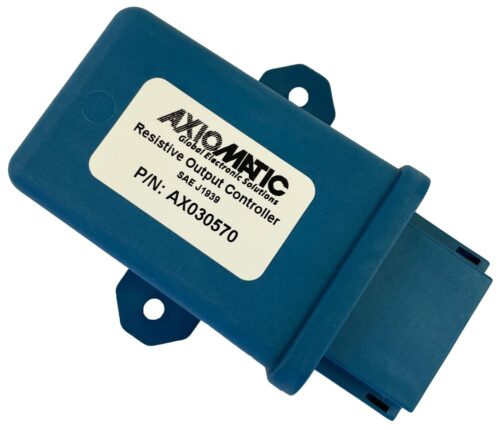
This proximity to documentation also changes the meaning of “product knowledge.” It is easy to memorize a list of features. It is harder to understand how the feature list changes when a test passes, a connector moves or a new firmware version alters behavior. The revision tables show Wilkins participating in that slower loop. Marketing is present when the product's public description is corrected, expanded and kept in step with the hardware.
From four wires to fast data
The technology story around her has moved. CAN networking reduced the heavy bundles of point-to-point wiring inside equipment and let controllers exchange messages over a shared bus. More recently, machine builders have begun adding cameras, radar, lidar and displays that produce or consume far more data. Automotive Ethernet brings higher bandwidth into the same rough operating world.
In 2025, Wilkins told Power Progress that Axiomatic offered automotive Ethernet converters in multiple forms and was developing a version with 16 inputs. Her explanation of the product process was as important as the port count. The company begins with what a customer asks for, often as a custom OEM design. It then reviews the request for a wider market need. Because Axiomatic owns the intellectual property, it can adapt the firmware and features into a generic version.
“We do first whatever our customers ask for - a lot of custom designs for OEMs - and then review what is needed for a generic market requirement.”Amanda Wilkins on Axiomatic's development loop
The sequence contains a small operating playbook. Start with a real constraint. Solve it closely enough to learn what matters. Look for the part of the need that repeats. Package that part without pretending every application is identical. For a focused manufacturer, this is a way to let customer work compound. The custom project becomes market intelligence; the reusable design becomes a product; the product creates a clearer starting point for the next customer.
Stay near the evidence
Specs, tests and revision records keep the message attached to what the hardware can support.
Translate the decision
Explain the protocol only as far as needed to help a customer choose, integrate or compare.
Listen for repetition
A specific OEM request may contain a product need shared by a wider set of machine builders.
Document the change
Reliability claims become useful when the conditions, ratings and revisions are visible.
A career visible in layers
Public profiles rarely capture how long industrial knowledge takes to accumulate. Wilkins's does, indirectly. A manual edit in 2008 leads to product announcements in 2010, an industry conversation about CAN adoption in 2014, compliance documents in the following years, the CMO title by 2022, and current explanations of gigabit networking for autonomous and off-highway equipment. Each layer adds a new vocabulary while retaining the old one.
A manual revision records her update to a controller's power-supply range.
Product releases identify Wilkins as sales and marketing manager for Axiomatic.
She explains the growing demand for CAN, including J1939 and CANopen systems.
An Axiomatic announcement identifies her as chief marketing officer.
She discusses validation and field reliability for off-road automotive Ethernet switches.
There is another line on her public LinkedIn profile that widens the frame. Wilkins formerly served as a vice president, board member and Environment Committee chair with the Federation of Ontario Cottagers' Associations. The record does not spell out the projects or dates, so it would be easy to overread it. What can be said is narrower: her organizational work has extended beyond the factory and into a province-wide association concerned with Ontario's cottage communities.
At Axiomatic, the latest chapter is geographic as well as technical. The company says its design and manufacturing base remains in Canada, with firmware development in Canada and Finland and sales offices now spanning Canada, Finland, Australia and the United States. Its 2026 newsroom includes products for railway equipment, power generation, valve control and high-speed vehicle networking. Wilkins remains a public contact on that expanding record.
What the machine demands
In May 2026, Wilkins described Axiomatic's six-port automotive Ethernet switch as an expression of an engineering philosophy: solve real connectivity problems in harsh environments. She emphasized validation and the need for components that designers can trust in the field. The language is consistent with the manual entries that came before it. First establish the operating reality. Then make the claim answerable to that reality.
This is why her story is useful outside industrial electronics. Many companies sell products whose complexity is mostly hidden from the buyer. Axiomatic's customers cannot afford that distance. They are choosing components that have to communicate with other components, withstand a specified environment and fit an architecture that may stay in service for years. The marketing has to respect the engineer's questions because the machine will eventually test every answer.
Wilkins's career offers a quiet standard for that work. Learn the nouns. Track the revisions. Notice what customers are trying to do before they know how to describe it. Carry the engineering evidence into a clear decision. When the technology shifts from CAN messages to gigabit data, repeat the process. The machine keeps changing, and the translator stays close enough to hear what changed.