An elevator earns very little applause when it works. The doors open, the car arrives, someone presses a button. Everyone gets on with the day. Its maintenance company operates in this peculiar economy of attention: success is frequently rewarded by being taken for granted. Elroy Gust has spent years investing in businesses that live there, doing the recurring work beneath the ordinary expectations of a building, a customer or a community.
The founder, President and CEO of Newlook Capital is based in Mississauga; his firm is based in Burlington. Its industrial investments extend across Canada and the United States. In a financial world with plenty of appetite for novelty, Gust has given continuing obligations a place in an investment portfolio. The service visit matters because another one will follow. There is something pleasingly literal about it. An elevator cannot be persuaded to accept a compelling presentation in place of maintenance.
The service calendar
Newlook’s industrial mandate describes recurring technical service revenue associated with code compliance, positive operating cash flow and experienced management. Senior technical talent is also on the list. Those requirements put the people carrying out the work beside the numbers used to evaluate it. A business needs both a reason for customers to return and the ability to serve them when they do.
This makes the service calendar a useful way into Gust’s working world. Recurrence has practical consequences: appointments, equipment, staff and customer relationships must be managed over time. The investment case rests partly on those continuing needs. The operating job remains specific to each company.
Newlook also looks for partners who retain equity and investments between $1 million and $25 million. The approach connects ownership with people who know the business. An investor may find a category attractive; an operator still has to understand the next assignment. Gust’s industrial strategy keeps those two perspectives in the same conversation.
Three criteria in Newlook’s industrial mandate. A schematic, not a forecast.
Before the first fund
Gust’s route into private equity included commercial lending positions at several banks, followed by senior roles at a multinational logistics company. He also held a Senior Vice President role at real estate investment firm Clear Sky Capital. Banking, logistics and real estate place different demands on an executive, but each brings him close to businesses that must finance and organise actual operations.
Newlook dates its inception to 2013. In recalling the period before the firm, Gust described investing his family’s money and then finding that larger transactions required more partners. The relationships became more formal as the deals grew. His account makes the organisational problem feel quite ordinary: a way of working that suited one stage needed to change for the next.
He put it succinctly: “We started to do bigger and bigger deals.” Newlook’s first official fund followed in 2016. The firm took shape around investments and relationships already being developed. The date on a fund marks a beginning for investors; for its founder, there was work on either side of it.
“This is exactly the type of businesses we are looking for.”Elroy Gust, on the Direct Elevator investment, 2016
Counting the elevators
The Ontario elevator portfolio offers a concrete chapter in that development. Newlook began building it in 2015, working with operating partners to increase monthly maintenance revenue and the number of elevators under management. By its sale in 2021, the portfolio covered 2,200 elevators.
when the portfolio was sold in 2021
A December 2016 announcement described an investment in Direct Elevator Services, a maintenance and modernisation company serving the Greater Toronto Area. Its 95 employees worked from offices in Scarborough and Etobicoke. Existing management would remain and have a continuing financial interest in the business. Here was the strategy in particulars: equipment requiring service, a workforce that could provide it, and managers staying involved.
The sale to a strategic buyer closed on May 26, 2021. Gust described the decision as following considerable growth and being made for investors’ benefit. His colleague Abbas Osman, Newlook’s Chief Investment Officer, described agreement with management teams on the timing.
Recurring service gives a business continuity. An investment in that business can still have an ending. The elevator chapter contains both ideas: years spent building an operating portfolio, then a decision to transfer it to another owner.
The people after the purchase
Gust’s public biography gives particular attention to building leadership teams. At Newlook, that interest has an organisational shape: investment, finance, legal and operating responsibilities sit with different colleagues. The founder’s job takes place among those roles, rather than hovering somewhere above the practical work they do.
He has also taken the interviewer’s chair. In a 2019 recording, Gust spoke with Rob Wagner, the operating partner for True Canadian Elevator. In a 2020 video, he interviewed Bryan Pate of InSite Engineering and Tyler McKeller of Living Water Services. These conversations place portfolio-company operators in front of investors as people with knowledge of their own businesses.
There is a useful change of scale in that format. A fund groups investments together; a conversation returns attention to a particular company and its operator. The listener can hear the business discussed by someone involved in running it. Gust’s participation makes that connection part of his visible work as CEO.
For a firm built around services, those individual relationships belong near the centre of the account. A category can explain why a business attracts attention. People explain how its work gets done.
A microphone in Kelowna
At the 2024 Pinnacle Wealth Brokers Conference in Kelowna, Gust took part in a market overview panel. The question he addressed concerned Canadian investors’ home-country bias and whether it helped or harmed markets. That subject reaches beyond any one maintenance company to the choices investors make about where their capital goes.
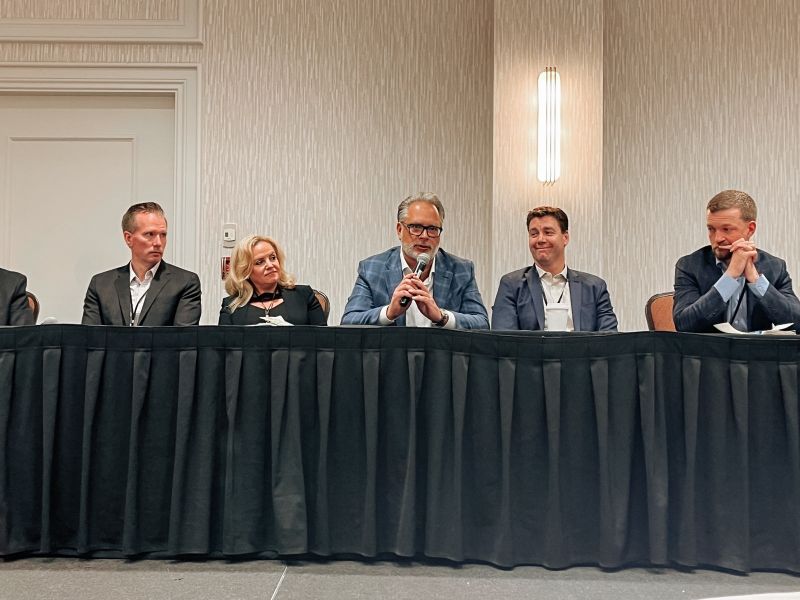
The photograph is a modest scene: a table, a microphone, several panellists, a room arranged for conversation. Gust is seated in the middle, speaking. It captures one part of an investment executive’s job that the transaction announcement leaves out: appearing before people who want to understand the market and the thinking behind a firm.
His own firm’s cross-border work gives the question a practical setting. Newlook invests in industrial businesses in both Canada and the United States. Gust therefore has an investment story that begins in Ontario and repeatedly leads into discussions with partners, operators and investors elsewhere.
Capital with a longer conversation
In February 2024, Fort McKay Landing made an investment in Newlook’s Industrial and Infrastructure Services Fund III. Wholly owned and controlled by Fort McKay First Nation, the investor brought its own business history and objectives to the relationship. The partnership concerned regulated commercial services in Canada and the United States.
Gust described an opportunity for reinvestment over years. Fort McKay’s history included building oilfield service companies and later developing joint ventures and a private equity investment business. The connection brought together organisations with experience of service businesses, as well as capital to deploy.
That distinction gives the partnership substance. Money arrives with an institution behind it, its own priorities and a view of where it wants to grow. Gust’s role includes finding room for those aims within Newlook’s industrial strategy.
His industry involvement extends to the Private Capital Markets Association of Canada. In 2023, the association named him among seven newly elected directors. Alongside running a firm, he has participated in the organisation through which private-capital professionals meet and address their shared industry.
Barbecue, then cash flow
In November 2025, Newlook’s operating partners gathered in Birmingham, Alabama. The summit ran from November 3 to 6, with meetings at The Valley Hotel in Homewood. Living Water Utilities hosted the opening reception, and the meal included barbecue from Jim ‘N Nick’s. Private equity, on this occasion, made room for dinner before returning to the accounts.
The programme centred on the relationship between gross profit, earnings and valuation, and on managing cash flow during challenging periods. Gust joined Osman and Chief Financial Officer Tony Diab for portfolio updates; he and Osman also led a capital-markets discussion. Breakout groups worked through the implications for individual businesses.
The gathering provides a view of what follows an acquisition. Operators and investment colleagues compare experience, discuss performance and take ideas back to their companies. The meeting has an agenda because the partnership has continuing work to do.
The next service visit
By August 2026, Newlook had announced two dedicated US water investment vehicles. Their strategy focused on acquiring and scaling regulated water utilities in the southeastern United States. The firm planned to work with partners it had collaborated with for over eight years. Commitments included life insurance companies, infrastructure investors and family offices.
Later that month came an investment in a Texas plumbing and restoration business. Existing founders would retain a significant ownership stake. The announced plan combined their customer relationships and operational expertise with Newlook’s capital and resources, aiming to develop a platform across Texas and neighbouring markets. That ambition remained work ahead.
These announcements continue a recognisable thread in Gust’s career: attention to essential services and to the partners who operate them. The geography and investment structures develop. The practical question persists. Tomorrow, someone will expect a utility to run, a repair to happen or an elevator to arrive. Gust’s business depends on taking that expectation seriously, including on the days when nobody thinks to applaud.