Before the investment funds and the board seats, Pascal Tremblay co-founded Laserpro with Stéphane Yelle. The business recycled laser-printer cartridges. It was a practical way into technology: take something offices used, find a reason for them to buy from you, and build a company around that need. The distance from a cartridge to a private equity fund is considerable. The customer’s question remains wonderfully stubborn: what can you do for me?
That question is a useful way into Tremblay’s career. He is now President and CEO of Novacap, with responsibility as Managing Partner for Technologies and Digital Infrastructure. His work concerns companies that already have products, customers, and managers, and want the resources to attempt something larger. The interesting decisions begin where the announcement ends.
A business before a buyout
Originally from Gaspésie, Tremblay studied at Université de Sherbrooke, and spent a year at the University of Connecticut. His education includes a BBA in finance and accounting and an MBA from McGill. His early working life eventually took him through CDP Capital’s private equity division and a partnership at Argo Global Capital. At Argo, he participated in technology and telecommunications investments across North America, Europe, and Asia.
The sequence matters. Operating a company and financing one give a person different responsibilities. A founder has to make the business work with the resources available. An investor has to decide which businesses deserve resources, and what sort of involvement will help. Tremblay occupied both positions before taking on the task of expanding an investment firm.
His public explanation of Novacap’s work is grounded in recognizable business problems. Companies may want to acquire a competitor, buy out a shareholder, or address an internal operating need. He has described the firm as helping professionalize businesses alongside their partners. It is a less theatrical account of private equity than the language of conquest, and a more useful one for understanding what happens on Monday morning.
Four years to a second strategy
Tremblay joined Novacap as a partner in 2003. The firm had been founded in 1981, so he was entering an established institution. In 2007, he launched its Technology, Media and Telecommunications strategy. He became CEO in 2017. The financial services strategy followed in 2019; digital infrastructure became a separate strategy in 2023, while TMT was renamed Technologies.
This chronology gives his career a second subject: the organization doing the investing. A firm needs a way to turn individual interests into repeatable work. Separate strategies give teams a field in which to develop knowledge, assess businesses, and build relationships. The growing list of strategies also changes the CEO’s assignment. There are more kinds of expertise to accommodate, and more people whose decisions have to fit together.
Today the firm’s four strategies cover Technologies, Industries, Financial Services, and Digital Infrastructure. That arrangement provides a map of its interests. Two businesses, Syntax and Nuvei, provide a closer view of the work behind the map. Each shows a different way that an existing company can acquire new possibilities.
Syntax adds a new vocabulary
Novacap invested in Syntax in 2016. The Montreal company’s business includes implementing and managing the applications that other companies depend on. In his account of the partnership, Tremblay emphasizes profitable B2B technology businesses, recurring revenue, defensible positions, and opportunities to grow within specialized markets. These are fairly concrete preferences. They direct attention toward systems customers continue to need.
Syntax’s subsequent acquisitions put that approach into practice. In January 2019, it announced an agreement to acquire Freudenberg IT, adding SAP expertise and a broader international presence to its existing capabilities. The combination linked different technology strengths and opened further geographic possibilities. Buying another business can be a way to acquire knowledge that would take years to assemble person by person.
There is a pleasingly unglamorous quality to this part of the story. Enterprise applications do not need to entertain anyone. Their customers need them to function. For an investor, that makes the operating details central: the skills available to serve customers, the markets in which those skills can be offered, and the organization’s ability to support a larger set of relationships.
The sequence continued. In November 2023, Syntax completed its acquisition of Beyond Technologies, another Montreal business specializing in SAP integration and business performance. At that point, the combination reported more than 2,800 experts, over 900 clients, and 26 offices across the Americas, Europe, Africa, and Asia. These figures describe that transaction’s moment, rather than a claim about today’s headcount.
Syntax + Beyond Technologies, November 2023
Tremblay has expressed an intention to keep supporting Syntax’s development as an integrated global technology platform. The acquisitions give that aspiration a specific shape. Additional expertise and locations bring new opportunities, while leaving the company with the everyday task of making the pieces work together. A purchase agreement can be signed in an afternoon. A larger organization has to be operated every day.
Nuvei keeps the founder in the picture
Nuvei presents another side of the partnership idea. In 2017, Novacap and CDPQ acquired a majority stake in the payments business. Founder Philip Fayer and the management team retained 49.9%. The arrangement gave the investors a substantial position while keeping the people who had built the company financially involved in its future.
Novacap’s contribution included supporting changes in the management team and strengthening Nuvei’s internal capacity for acquisitions. Tremblay’s colleague David Lewin describes a philosophy of transferring expertise alongside capital. That distinction helps explain what a founder might seek from a partner: additional ability inside the business, as well as additional money available to it.
“trust, alignment, and a shared long-term vision”
Pascal Tremblay, on the Nuvei partnership
Nuvei completed its Toronto Stock Exchange IPO on September 22, 2020. Four years later, the ownership arrangement changed again. Its take-private transaction, led by Advent International, closed on November 15, 2024. Fayer continued as chair and CEO. Novacap and CDPQ also remained investors, alongside the new ownership participant.
The closing announcement described approximate ownership interests of 46% for Advent, 24% for Fayer, 18% for Novacap, and 12% for CDPQ. Those percentages make continuity visible. Novacap’s involvement had passed through a private investment, a public listing, and a return to private ownership. The founder was still there.
46% Advent · 24% Fayer · 18% Novacap · 12% CDPQ
Approximate interests in the purchaser at closing, November 2024In 2025, Novacap’s Nuvei investment received the CVCA Private Equity Deal of the Year award. It was recognition of a firm transaction, involving a founder, investment colleagues, and institutional partners. Keeping those participants visible makes the account more accurate, and gives Tremblay’s preference for partnership some actual company.
The machinery behind the screen
The digital infrastructure strategy takes Tremblay’s technology interests into a different operating setting. Novacap announced the final close of its first dedicated fund on January 22, 2025. It raised more than US$1 billion in primary commitments and co-investments from investors across several regions. The capital belonged to a distinct platform within the firm.
A week earlier, Novacap and H5 Data Centers had announced a joint venture focused on North American data center facilities. Its stated priorities included developing and repositioning locations to meet demand for colocation space. Ted Mocarski, Novacap’s head of digital infrastructure, connected the initiative to the need for power and computing capacity.
The connection with software investing is easy to follow without treating the businesses as interchangeable. Applications need somewhere to run, and companies need reliable connectivity. Dedicated teams allow the firm to approach those needs with different operating knowledge. Tremblay’s responsibilities span both strategies; the people leading individual investments bring their own expertise to each.
Capital needs colleagues
Tremblay’s career also includes board work at Stingray. His earlier governance experience includes chairing Creaform’s board and serving on the boards of ViXS and Tenrox. These roles belong to the less photogenic portion of business life: oversight, decisions, and continued involvement after the first burst of excitement.
Inside Novacap, a November 2023 round of appointments and promotions extended across New York, Toronto, and Montreal. It included new digital infrastructure colleagues and technology partners. Tremblay linked those changes to attracting and developing talent. Expanding a firm requires people who can carry responsibility, rather than simply a larger collection of investments.
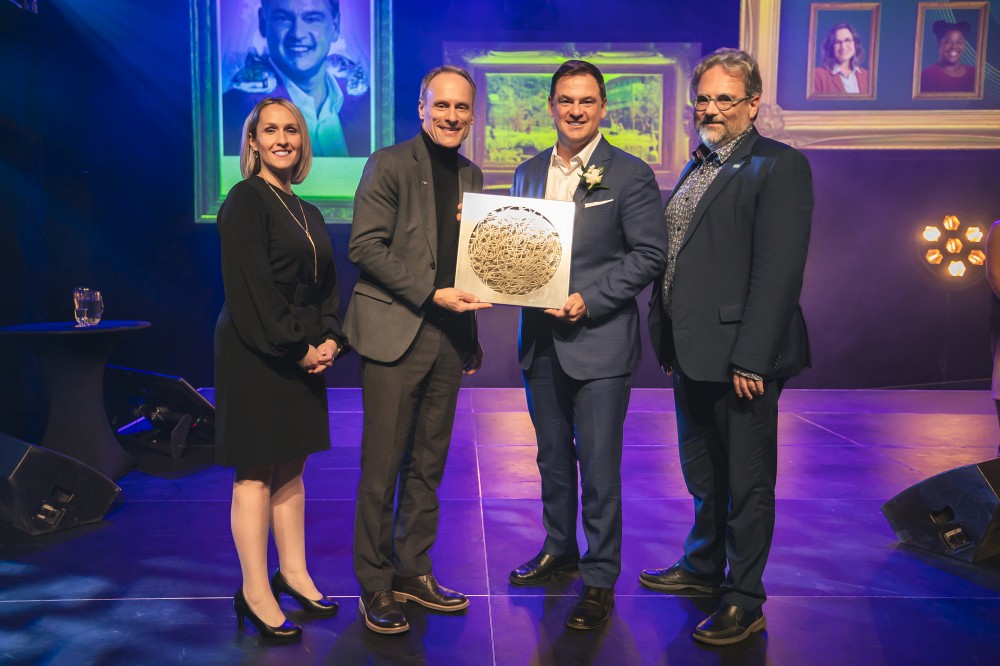
Recognition has come from both his industry and his university. Réseau Capital presented him with its Grand Bâtisseur tribute award in September 2022. Sherbrooke named him its School of Management Ambassador at the April 2024 alumni gala. At the latter event, a performance of Jean Leloup’s “1990”, one of his favourite songs, supplied a welcome change from the vocabulary of finance.
The next cheque comes with work attached
On February 25, 2026, Novacap announced that Tech Fund VII had closed with nearly US$3.8 billion in commitments, including affiliated vehicles. The stated focus was profitable, growing North American B2B software and technology-enabled services businesses, with cross-border acquisitions part of the approach. The firm also reported more than US$12 billion in assets under management.
Another chapter closed in June 2026, when Novacap completed the US$1.45 billion sale of Eddyfi Technologies to ESAB. The firm had first partnered with Previan in 2020, supported its expansion, and later backed the separation of Eddyfi and NDT Global into independent businesses. Eddyfi’s existing leadership continued with its new owner.
Read together, these events show capital being raised for new work while earlier investments reach another stage. Tremblay’s career runs through both sides of that cycle. The figures have become much larger than a printer-cartridge business could suggest. The next assignment is still practical: help an existing company do something it could not readily do alone.