A trade show display has an unforgiving deadline. The doors open when they open. Its graphics, fabric, metalwork and fittings must turn up together, ready to make somebody else’s idea look convincing. For Lee Skandalaris, who led display manufacturer Tectonics through expansion and investment in production technology, that combination offered a useful business problem: how do you make complicated, custom work repeatably dependable?
His route to that question began in automotive corporate development. It passed through a printing venture founded in 2008, acquisitions, new production locations and software designed to connect a customer’s order to its delivery. Today he is CEO and Managing Partner of Quantum Ventures in Auburn Hills, Michigan. The job title sits at the investment end of the story. Much of the interesting work happened closer to the machinery.
A useful lesson from the automotive business
Before joining Noble International in 2006, Skandalaris worked in corporate development at Lear Corporation. At Noble, he arrived as a manager in May and became director of corporate development that November. It was a career in the transactions that change the shape of companies, in an industry where the shape of the supply chain matters a great deal.
There was a family connection. Robert Skandalaris, Noble’s chairman at the time of Lee’s hiring, is his father. Noble’s account of the appointment says its chief executive recommended the hire, the board approved it, and the compensation committee reviewed his later pay increase and bonuses. The relationship belongs in the story alongside the work. Family businesses come with both an opportunity and a surname that enters the room before you do.
One lesson from those early years would become central to his next move. Businesses could become vulnerable when they depended heavily on a single technology or market. Printing appealed because the same underlying capabilities could serve different customers. A company could build expertise without tying its future to one narrow destination for that expertise.
Printing with more than one door open
Skandalaris founded Quantum Digital Group in 2008. Its outputs crossed the business and consumer divide: building wraps, trade show exhibits and point-of-purchase displays, along with graphics for boats, all-terrain vehicles and other products. A printer does not particularly care whether the next image is destined for a shop or a boat. The commercial possibilities around it can be quite different.
“Printing allows us to be diversified.”
Lee Skandalaris, 2014
The attraction lay in scope and relatively modest capital requirements. As the group grew, acquisitions broadened what it could make. Meteor Photo joined in 2011; Tectonics Industries followed in 2013. By the time Skandalaris received the 2014 DBusiness recognition for executives in their thirties, the group combined design, engineering, metal fabrication, installation and warehousing.
That combination changes a customer conversation. A graphic is one item to purchase. A finished display brings a series of purchases and dependencies with it. Providing more of the chain gives an operator more work to coordinate, while giving the customer fewer separate arrangements to make. Growth becomes a question of which capabilities fit together.
The businesses also produced things that had to work in public. An exhibit can look impressive in a drawing and become awkward when it must be transported, assembled and taken down. There is little glamour in warehousing, until the thing you need is missing. Skandalaris’s printing years brought those unglamorous requirements into the same business as the visual effect.
Put the factory closer to the customer
In May 2015, Skandalaris announced a Tectonics facility in North Las Vegas, scheduled to open that June. Its planned 50,000 square feet included printing, sewing, fabrication, engineering and installation capabilities. The location put production near the city’s convention business and offered western customers a closer point of service.
The building’s 30-foot ceilings were a fitting detail for a business making things intended to occupy space. The announcement also described finishing services, including mounting, laminating and CNC cutting. The expansion reproduced a range of capabilities, giving the western operation more to do than simply receive work made elsewhere.
Distance has a habit of appearing in the accounts under several names: freight, time, coordination, responsiveness. The Las Vegas plan addressed it geographically. With existing facilities in Michigan and Georgia, Tectonics was extending the places where it could produce and support its customers’ projects.
The next chapter arrived in March 2016 with the purchase of TenFab Design, a nine-year-old Chicago-area display manufacturer. TenFab became a fourth regional production hub. Its contribution included expertise in snap-tube and pillowcase-style construction, plus pre-engineered displays offered for sale or rental.
Skandalaris described an acquisition with two useful dimensions. TenFab had products and construction skills Tectonics could build upon. It also brought the group closer to Chicago-area clients. He discussed faster responses and opportunities to put more products into that market. The deal connected something the company could learn with somewhere it could serve.
There is a practical test hidden in that combination. An acquisition announcement can celebrate size easily enough. Explaining how a customer benefits requires more thought. Here, the answer involved both a broader product offering and a nearby production operation. The map and the catalogue were changing together.
The quote has to reach the loading dock
By April 2018, Tectonics was preparing another move, this time to new headquarters in Auburn Hills. It reported nearly 200 percent growth since 2014, alongside new locations in Chicago and Las Vegas and a manufacturing footprint in Atlanta that had more than tripled. Those were historical company figures, describing the expansion during Skandalaris’s leadership.
The announcement did not specify the measure.
The headquarters announcement described two years of work on proprietary software and research into manufacturing technologies. A single platform would connect quoting and delivery with engineering, equipment, file management and logistics. A customer project could be followed across activities that otherwise risked becoming separate little kingdoms.
That is the less photogenic side of expansion. More sites and more services create more handoffs. Someone must keep the drawing, the price, the parts and the delivery aligned. Software was being developed to give those functions a shared view of the project.
Quote→02
Engineer→03
Make→04
Deliver
A subsequent account of Tectonics’ manufacturing work described Skandalaris’s early printing business as a garage venture applying patterns to consumer products. Its digital approach became a starting point for the group’s later operations. At Tectonics, the ambitions extended into engineering and fabrication, supported by his colleague Mike Toribio and the wider team.
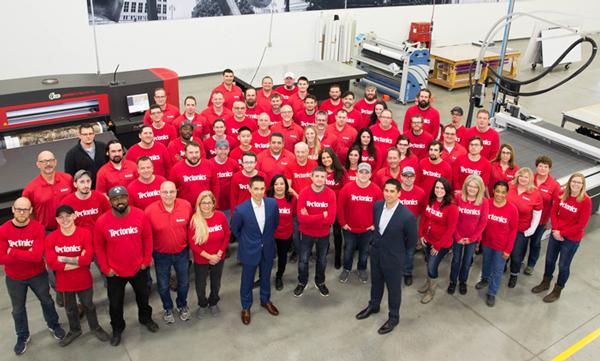
Skandalaris’s comments about additive manufacturing captured a particular way of approaching equipment. He discussed redesigning a component around what a new process made possible. That asks more of a company than substituting one production method for another. The design itself becomes open to reconsideration. His operating history gives the technology language in his investment career a physical setting.
Number 27 comes back to the field
Another part of the biography begins with a roster. Duke’s 2004 men’s lacrosse team lists Skandalaris as a senior midfielder, number 27, from Bloomfield Hills, Michigan. His previous school was Detroit Country Day. The roster places him in a specific team and season, before the investment titles and company announcements.
He studied economics at Duke. The university also included him in its 2004 ACC Academic Honor Roll, where he was listed among the lacrosse players. An athlete’s biography often stops with competition. This one has a useful academic detail beside it, and a later return to the sport through coaching.
His volunteer history includes head coaching at Warriors Elite Lacrosse, beginning in March 2018, for boys in the under-10, under-12 and under-14 programs. Before that came youth flag football coaching. He describes an interest in teaching children lessons learned through athletics. That is a sustained commitment with age groups and responsibilities attached.
Stealth LC now lists him as a co-founder, alongside a staff that includes co-founder and coach Jack Aigner. Coaching places a college player in a different relationship with the game. The next generation gets the playing time; the adult gets the responsibility of helping them use it. The connection to teams continues in a form that is both familiar and changed.
Time to build, urgency to work
Quantum Ventures’ history places Skandalaris’s appointment as CEO in 2020. He now leads a firm whose stated investment flexibility comes from operating without fund requirements or outside investors. Its growth resources cover software, automation, information technology, finance, marketing and acquisitions. The operating work has become part of what it offers investment partners.
That structure allows a longer view of company building. It also makes the daily choices inside a business consequential: which capability to add, which process to improve, which people to support. Time is useful when an owner has a purpose for it.
For Skandalaris, there are other uses of time too. He lists weekends with his wife and children, fishing, being on the water, coaching and following Duke and Michigan State sports. His published motto closes with three brisk words: “Live life urgently.” Set beside a longer investment horizon, it offers a pleasing tension. There can be time to build a business and still good reason to get on with today’s work.