At three in the morning, the distance between Boston and India can be measured in telephone calls. Richard Garnick described taking them at home outside Boston, just as he described answering at eleven at night while traveling in India. By five in the morning, another region was starting its business day. His term for this arrangement was wonderfully economical: “I’m time zone agnostic.” A clock, apparently, was entitled to its opinion.
That was Garnick in 2004, serving as Wipro Technologies’ chief executive for the Americas. The anecdote gives an unusually concrete view of a career often described in the abstract language of transformation. Before the investment structures and board appointments, there was someone making himself available when colleagues on another continent were awake. Global delivery had a domestic address and an inconvenient ringtone.
“I’m time zone agnostic.”Richard Garnick, on managing across continents, 2004
Today, the Boston-based founder of ConJoin Group works at the meeting point of capital and company operations. His route there runs through electronics businesses, a wireless startup, a large Indian technology services company and a contentious departure from a Boston employer. Follow that route and a recurring question comes into view: how do you make a business capable of doing more than it did yesterday?
A departure lounge with a business plan
In May 2000, Garnick was president and CEO of Global Digital Media.com, a privately held technology startup pursuing wireless internet access for business travelers. Its proposed network used Cisco equipment. Airports, hotels and convention centers were the intended territory: places full of people whose work had followed them out of the office.
The company called its public internet stations Becon. The announcement described a terminal with a large plasma screen and wireless connectivity around it. Deployments at Boston’s Logan International and Philadelphia International airports were scheduled for that spring. Garnick’s stated ambition was a wireless broadband network serving business travelers worldwide.
There is something pleasingly period-specific about the proposition. The traveler would use the network to change reservations, look up the weather or check the market. A departure lounge could become a temporary office. The announcement described a plan and technical capabilities; it was an expression of ambition, rather than a verdict on what the venture ultimately achieved.
In retrospect, the interesting part is the customer. Garnick was selling a way to remain connected while moving between places. A few years later, his own working day would illustrate the same premise, with rather less regard for the distinction between office hours and everything else.
The hardware years behind the services executive
Garnick’s earlier work had taken him through Texas Instruments, Innovoice, Arrow Electronics and Avnet. A Wipro-era speaker biography lists regional management at Texas Instruments, chief operating officer at Innovoice, North American sales leadership at Arrow and a vice presidency at Avnet. These were different seats around the same table: technology, customers and the machinery of running a company.
His education combined a bachelor’s degree in Commerce and Engineering from Drexel University with an MBA from Loyola College in Baltimore. Commerce and engineering make an apt pairing for this particular career. One asks whether something can be built; the other asks whether anyone will buy it. Garnick’s subsequent responsibilities repeatedly required attention to both questions.
By the time he joined Wipro in 2001, he had worked in entrepreneurial businesses and established technology companies. The move brought that experience into a services organization operating across countries. The problem was larger than moving a product through a distribution channel. Customers had to trust people, processes and delivery teams they might encounter across several locations.
The sale was only the beginning
An early marker came in 2002, when Best Buy gave Wipro its Bravo IT award. Garnick received it on behalf of the company, alongside colleagues including relationship manager Srinivas Pallia, onsite manager Bhaskar Madari and program manager Hariprasad Shetty. Best Buy was recognizing its technology partner in only the second year of their relationship.
The cast matters. Sales leadership appears alongside relationship management and delivery. An award presented to a team is a useful corrective to the tidy biography in which every number belongs to one executive. Garnick’s work took place within an organization, with colleagues responsible for turning a commercial promise into something a customer could use.
He could also be cautious when asked to predict the next sale. On Wipro’s January 2003 earnings call, he said market activity was increasing but declined to forecast when particular projects would close. His answer stopped short of making a busy pipeline equivalent to completed business. In a conversation about future revenue, that is a meaningful restraint.
By the conference call covering the quarter ended December 2004, he was explaining the importance of existing customers. Wipro, he said, historically drew more than 95 percent of its business from that base. The commercial task involved expanding the services offered and deepening those relationships. Growth could come from returning to a customer with a broader proposition.
In the same discussion, he described consulting as an entry into more extensive implementation work. He also resisted the idea that the company could simply raise prices substantially. The details are mundane in the useful sense: service mix, customer relationships, implementation and pricing. They put working parts inside the much grander word “growth.”
Boston offered a bigger brief
Keane announced Garnick’s appointment as president of North American Services in August 2005. He would report to Brian Keane and take responsibility for sales strategy and delivery execution. The two halves of that brief belonged together: win the business, then organize the work.
At the time, Keane credited him with helping Wipro’s Americas business grow from $150 million to $1 billion in US revenue. It separately described growth in global Enterprise Application Services from $10 million to more than $200 million in annualized revenue in less than four years. Those are historical claims about two business scopes, rather than a single interchangeable growth figure.
Annualized revenue at the endpoint; less than four years. Keane credited Garnick with helping grow the business.
The invitation to Keane rested on this operating record. Garnick was being hired to help a services firm connect customer needs with a global delivery network. A signed contract establishes an obligation. Execution determines whether the customer comes back. His new role placed both under the same executive remit.
A witness, then a disputed exit
On February 9, 2006, Garnick appeared before the House Committee on Government Reform for a hearing on American competitiveness. He represented Keane’s North American Services business. Other witnesses included AMD chief executive Hector Ruiz and Council on Competitiveness president Deborah Wince-Smith. Technology services had become part of a national argument about work and economic capacity.
Garnick urged the United States to double its number of science, technology, engineering and mathematics graduates over the following decade. He also called for industry participation through scholarships, mentorships and internships. Companies had a role in helping young people see worthwhile careers ahead. The operator accustomed to managing global teams was making an argument about how the next generation would enter them.
That September, his Keane tenure ended abruptly. The company announced that it had dismissed him for cause, citing compliance with its travel-expense policy and unauthorized communications inconsistent with company interests. These were Keane’s stated grounds. By February 2007, reporting on Keane’s sale said Garnick had sued the company for wrongful dismissal.
The disputed exit belongs in the career alongside the appointment. The employer’s account and the existence of a lawsuit are distinct facts; neither makes a judicial finding. A professional life can contain strong operating credentials and a contested employment ending. Smoothing the latter away would make the chronology easier to admire and harder to understand.
Taking the operating brief into investing
ConJoin became the next substantial chapter. Garnick created it with Jefferson Partners, a Toronto-based private equity firm. Its proposition joined business investment to operational change: improve how a company sells, organizes delivery and performs. That approach drew on the work he had already done inside technology businesses.
Avotus, a communications-management company, provides a concrete connection. Its business includes expense management, call accounting and usage reporting. Garnick is listed as vice-chairman on its leadership page, which also describes him as an adviser to private companies and private equity firms. The territory is familiar: technology made useful through the management of everyday business activity.
A November 2010 account described ConJoin’s work with Avotus as a turnaround and reported a $10 million improvement in EBITDA over three months after back-end work was outsourced. That remains a reported historical result. It offers an example of what ConJoin sought to change inside a business, without making a three-month outcome a universal recipe.
The connection between an operator and an investor is easy to state and demanding to practice. Capital can finance a change; managers still have to carry it out. In Garnick’s career, sales, delivery and operational responsibility preceded the investing chapter. ConJoin gave those experiences another setting, with the company itself becoming the object of the work.
A different audience for technology
A later public listing places Garnick on the team page of Deep Science AI Foundation, a nonprofit devoted to making AI education accessible to rural students. Founded by Sathvika Jothi in October 2023, the organization describes coaching and mentoring as part of its mission. Garnick appears among a group connecting industry and education.
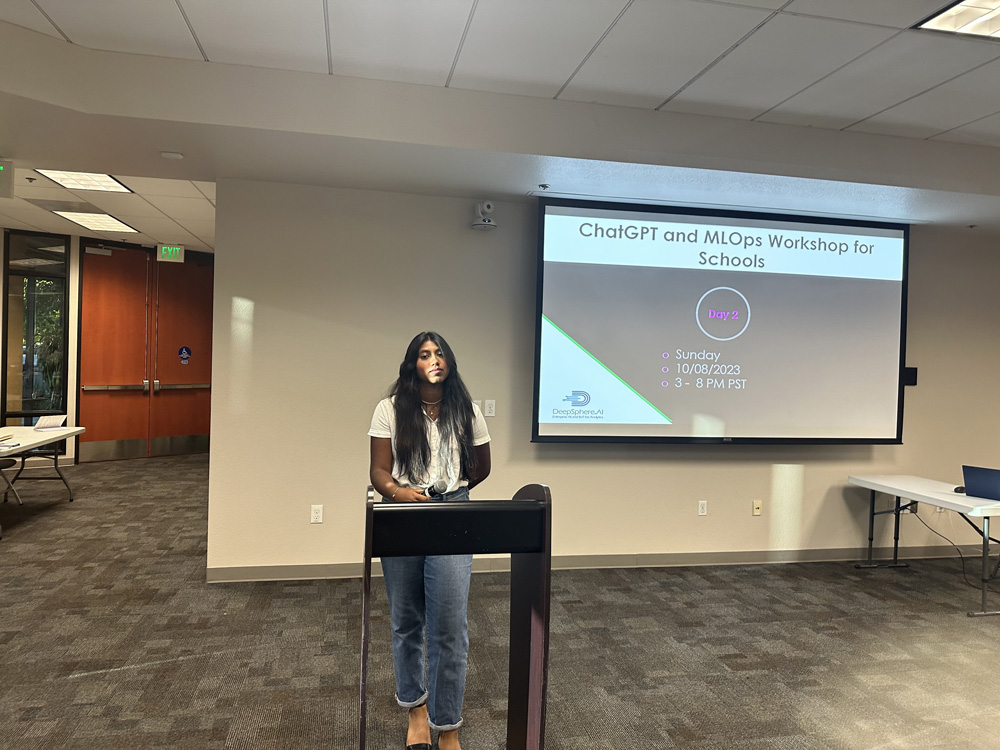
The foundation also documents an October 2023 workshop for middle and high school students in Rancho Cordova, California. Its curriculum included generative AI, coding and machine learning. This is a different audience from the enterprise customers and business travelers of Garnick’s earlier chapters. The task starts with introducing people to a technology they can learn to use.
Across these settings, Garnick’s career has stayed close to the point where technical capability meets a practical assignment. An airport connection. A customer relationship. A services operation. A company needing change. An education initiative. The scale varies, and so does his role, but the technology always has someone on the other end.
The three-a.m. telephone call remains the most human detail. It makes the geography tangible. Someone in Boston answers because someone elsewhere has work to do. For all the language attached to international business, a surprising amount of it still depends on that small, ordinary act.
Continue the conversation
- ConJoin Group
- Richard Garnick on LinkedIn
- ConJoin on X
- Long-distance leadership interview
- The airport wireless announcement
- Wipro’s investor call archive
- Keane appointment announcement
- Congressional hearing
- Keane dismissal announcement
- The subsequent lawsuit reporting
- Avotus leadership
- Deep Science AI Foundation