A window is an odd place to begin the story of an operating partner. In 2007, Kent Davies was president of CPFilms, a business whose products went onto glass. One of them had a particularly discreet selling point: it could help stop information escaping through a window. Almost transparent, it was intended to reduce the leakage of wireless signals. The office could still have a view. Its electronic conversations would have rather less of an audience.
Davies was taking a technology previously supplied to government customers into the commercial market. That meant explaining an unfamiliar purchase to people accustomed to thinking of windows as things to look through. For a company president, the question extended beyond what the film could do. Someone had to understand its value, specify it, buy it and arrange its installation. A clever product still needed a working business around it.
That episode supplies a useful entrance to Davies’s career. Based in Boston, he now works with ARCHIMED as an operating partner and portfolio company board chair. Before that came sales assignments, product roles, division leadership, chief executive jobs and responsibility for company operations. The titles changed. The recurring business problem was how to turn an opportunity into something a company could actually deliver.
The view from the sales floor
Davies earned a bachelor’s degree in history at the University of California, Berkeley, then an MBA in marketing at the University of Minnesota. He also completed finance coursework at Wharton. Those are three distinct subjects: what happened, what customers want and how the numbers work. His subsequent jobs brought him into contact with all three, though a degree list is no licence to invent a private philosophy.
His early career included sales and sales management at General Mills. At 3M, he worked in global product strategy, development and introductions. Kimberly-Clark brought general management and marketing responsibilities. He later became senior vice president for marketing, research and development, and regulatory affairs at United Industries, whose businesses included consumer lawn, garden and household products.
It is a varied apprenticeship. A salesperson sees the moment a customer agrees or walks away. A product manager works further upstream, where features, positioning and launch plans take shape. General management adds responsibility for how the pieces fit together. Davies moved through these assignments before becoming president of a business. His route gives the later board roles a practical commercial background.
A thin film, a substantial job
In February 2006, Solutia appointed Davies senior vice president and president of CPFilms. He reported directly to chief executive Jeff Quinn. CPFilms made aftermarket window films, including the LLumar brand, for homes, vehicles and commercial buildings. His assignment put him in charge of an established operation with brands, manufacturing capabilities and a distribution network already in place.
There was a predecessor to work alongside, too. Ken Vickers, the previous president, became chairman emeritus and was expected to help Davies develop the business. Executive succession is often compressed into the arrival of a new name. Here the arrangement explicitly retained the experience of the outgoing leader. The company’s next chapter had someone available who knew the earlier ones.
The signal-defence product made the commercial challenge unusually vivid. Its purpose involved things customers could not see, using a film they were scarcely supposed to notice. Davies discussed applications in commercial buildings and financial-sector conference rooms. The attraction was privacy without turning every meeting into a gathering inside an opaque box. Glass, that habitual office optimist, could keep its place.
Other work was more familiar to the dealer network. In 2008, CPFilms promoted new products and marketing tools at the SEMA trade show in Las Vegas. The company planned tools to help dealers develop their businesses and reach more customers. In a separate initiative, Vista window films received independent energy-performance certification. Product benefits, evidence and selling support belonged in the same commercial conversation.
“Energy savings is front page news”
Kent Davies, discussing Vista window films in 2008
That short remark captures the task of connecting a technical offering to something a buyer already cares about. Certification gave dealers a way to substantiate a claim; marketing tools gave them help presenting it. Neither required every buyer to become a materials specialist. The president’s work included making the product easier to understand and the distribution network better equipped to sell it.
The relationship before the price tag
Davies left Solutia effective May 1, 2009. By August 2010, he was CEO of Gaymar Industries when Stryker announced an agreement to acquire the privately held company for approximately $150 million in cash. It is the kind of number that travels readily. The background takes a little more room, and explains why the transaction was more than a buyer discovering a company on a spreadsheet.
Gaymar and Stryker’s Medical division already had a ten-year original-equipment-manufacturer relationship. Gaymar recorded approximately $77 million in sales in 2009, with around $14 million related to that arrangement. The prospective acquirer was already connected to the business. There were products and commercial relationships to examine, rather than an entirely new acquaintance to make.
The company had also refocused its management and business strategy after the economic contraction of 2008 and 2009. The acquisition announcement described a subsequent recovery. That puts Davies’s CEO role into a period when a business had to respond to changed conditions while considering its next ownership chapter. The sale price gives a scale; the prior relationship and strategic reset give the episode its texture.
A public recommendation he wrote for consultant Jim Buccini adds a personal connection. Davies recalled meeting Buccini in 2008. After taking a CEO job in the middle of 2009, he thought of Buccini and his colleagues at Redding Consultants. They examined the business, its growth opportunities and strategic alternatives. Davies credited their roadmap with helping lead to a strategic sale.
“They challenged us in a collegial way that made us better managers and leaders.”
Kent Davies, recommending Jim Buccini
He also said he remained in regular contact and looked forward to hiring the team again. That is a concrete account of a working relationship surviving the immediate assignment. His praise singled out questions, analysis and constructive challenge. In a career full of executive titles, the recommendation makes room for other people’s contribution to a decision.
Across the ownership line
Before his next public-company appointment, Davies was CEO of RoundTable III Platform Development Corporation. The job concerned identifying and developing investment opportunities. After running a company through a sale, he was working on the formation of potential investments. His career had crossed into another part of the ownership process.
Haemonetics announced in April 2014 that he would join as president of global markets, effective May 12. Its chief executive, Brian Concannon, described experience spanning the United States, Europe and emerging markets. The following April, Davies became chief operating officer, with worldwide oversight of commercial operations, including product development and product management. Responsibility again ran across functions and borders.
PDI appointed him president and chief operating officer in October 2017. The remit included enterprise-wide commercial strategy and overall operational and financial performance. Zachary Julius remained chief executive. For Davies, it was another senior partnership, with the company’s commercial plans and operating results placed together in his brief.
Growth hires people
During Davies’s presidency, PDI announced several changes to its leadership team. In 2018 it strengthened management across its three market-facing businesses. In 2020 it added a new chief financial officer role. By 2021, another appointment put a vice president in charge of quality. These are specific examples of a company adding responsibility and expertise as its organisation developed.
The announcements make growth visible through jobs rather than through an abstract arrow pointing upwards. Division managers needed authority. Financial processes needed attention. Quality operations needed dedicated leadership. Davies welcomed the additional perspectives and capabilities. The changes show the administrative work that accompanies expansion, even when it receives less attention than a purchase or a product launch.
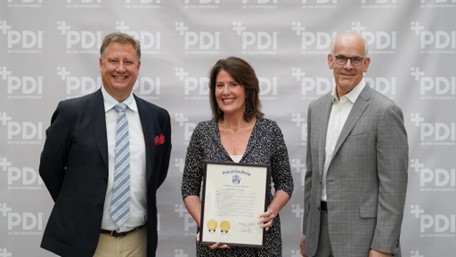
There was a community calendar as well. PDI’s annual Be The Difference Day marked its tenth anniversary in 2021, with employees contributing time and resources to nonprofit organisations. Davies spoke about giving back to the places where colleagues lived and worked. In 2022, he and Julius accepted a New Jersey proclamation recognising the event. The photograph puts him beside his chief executive and Senator Holly Schepisi, with a framed document doing the ceremonial work.
Another office, the same review
At ARCHIMED, Davies’s public account of a visit to Lyon describes time on site with colleagues for monthly portfolio reviews and preparations for an annual meeting in Berlin. The itinerary is international; the activities are quite ordinary. Review the companies. Finish the preparation. Meet the investors. Those recurring appointments are part of how an ownership strategy becomes a working relationship.
His current board responsibilities include chairing Irrimax’s board and serving on ZimVie’s board. They extend a career that has included running individual businesses and considering investment opportunities. The operating partner role brings those experiences into conversations with management teams. It places someone who has held the executive brief on the owners’ side of the table.
Return to the window film and the career has a recognisable shape. Davies was helping a specialist product reach customers, with dealers, evidence and commercial explanations around it. Later came established customer relationships, a sale, executive partnerships and new management roles. Today there are portfolio reviews and boards. Across those settings, the work has repeatedly depended on people agreeing what needs doing, then making a company capable of doing it.