Rob DeMento had reached an awkward conclusion for an intellectual property lawyer: the interesting work appeared to be happening on the other side of the table. He was practicing at a large New York firm, advising clients whose jobs he would rather have been doing. There is no especially elegant billing code for that realization. Eventually, he left law and moved toward building products and running businesses.
A legal career is a substantial thing to put down. DeMento had spent nearly five years practicing before making the change. He later described the decision as difficult and the business career that followed as more rewarding. The appeal is understandable: an adviser can help a client choose a route; an operator has to travel it, with colleagues, customers, and a payroll along for the ride.
That crossing provides a useful way into his story. DeMento has repeatedly taken work that puts him closer to the workings of a company. His current appointment, CEO-in-Residence at The Brydon Group, carries that impulse into business acquisition. The assignment is to help find a company, buy it with a partner, and then take responsibility for what happens next.
Three degrees, several ways to see a problem
His academic background spans engineering, law, and business. He holds an engineering degree from Duke University, a JD from Villanova, and an MBA from Northwestern’s Kellogg School of Management. Those subjects make an interesting collection. One examines how a system works, another how obligations are defined, and another how an organization makes choices with limited resources. A business can produce all three kinds of question before lunch.
At Kellogg, his connection to investing was already taking shape. The university’s historical Venture Lab records pair DeMento with Ceres Venture Fund in fall 2008. The entry is small, but it places him inside an investing environment well before his arrival at Brydon. His route to an acquisition role includes both operating experience and an earlier encounter with the people who supply capital.
Northwestern also identifies him as an alumnus of its MMM program. Years later, at Chicago’s Techweek in 2015, he crossed paths with the university’s design community while exhibiting Mira. It is a pleasing loop: the alumnus returns, though this time the object under discussion is a company and a product rather than an assignment. Engineering and business have acquired a booth.
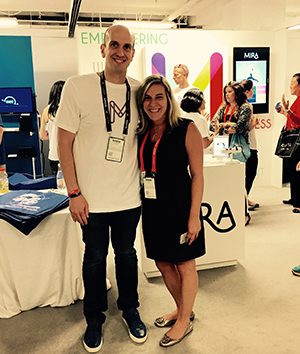
The bracelet had to leave the building
As Mira’s CEO, DeMento led a Chicago company making wearable technology with a deliberate emphasis on design. Its January 2016 CES announcement named Deborah Brown as director of engineering and Lindsay Slutzky as director of channel strategy. The product combined a physical accessory with software. That meant the business had to make several disciplines cooperate, and eventually persuade a customer to care.
The collection included bracelets in finishes with names such as Heart of Gold and Rosé All Day. Even the color chart was having more fun than the average engineering specification. Behind that surface sat a practical problem: how to bring a designed object, its electronics, its application, and its distribution into the same working business. Each piece could be attractive on its own. Customers would experience the combination.
DeMento’s public recommendations for colleagues offer a more granular picture of that work. Writing about Molly, a Mira teammate, he described responsibilities ranging from everyday tasks to complicated supply-chain problems. Her team was called “special ops.” His appreciation was concrete: she changed contexts repeatedly while keeping the operation moving. It is a revealing choice of detail for a CEO to remember.
In his recommendation for Brown, he emphasized her manufacturing and engineering experience, practical judgment, and ability to spot product-development problems and address them in order of importance. For Marie Maloney, he singled out calm responses to customer inquiries and a willingness to fill gaps in a busy team. These are small acts with substantial consequences. A product launch consists of rather more than the moment someone unveils it.
Read together, those acknowledgments suggest how DeMento evaluates the people around him: by the work they make possible. The supply chain, the engineering judgment, the customer’s question answered without drama. An organizational chart gives these activities separate boxes. A customer’s experience folds them back together. His accounts keep returning to the people responsible for those connections.
A closing chapter, kept open for learning
Mira’s independent business was merged into its investor’s operations in March 2016. In May, DeMento published a retrospective about the experience. The team held two company-wide reviews: one addressed accomplishments, disappointments, and gratitude; the other organized lessons around what to stop, start, and continue. He credited Thea Polancic with helping the leadership team learn the review process before extending it across the company.
He also described a culture where colleagues could debate decisions respectfully and still commit to executing them. The idea has a practical edge. A room of agreeable people can make a meeting pleasant while leaving an inconvenient assumption untouched. Allowing disagreement creates work for a leader: listen, decide, explain, and keep the team capable of working together afterward.
“Test and Learn”
A Mira team principle recalled by DeMento
The retrospective gives that principle an ending as well as a beginning. Learning continues when a company changes form and teammates depart. Reviewing the work preserves something useful from an experience that cannot simply be repeated. There is a modesty in the exercise: achievements and disappointments occupy the same conversation. Both have something to say about the next decision.
The long apprenticeship inside a business
By June 2018, the trade publication Quirk’s recorded DeMento’s appointment as senior vice president of product at InCrowd. Product leadership put him in another business where technology and customer needs had to meet. A product title can sound neatly bounded. In practice, decisions about what to build reach into sales, engineering, delivery, and the economics of serving a customer.
His later Konovo responsibilities broadened across strategy, product and technology, and operations. Brydon’s biography describes an operating career in growth businesses and companies financed by private equity. The accumulation matters more than the changing labels. Different seats expose different constraints: the feature a customer wants, the resources available to build it, the capacity to support it, and the consequences for the whole company.
When announcing that departure, he thanked colleagues for the relationships formed during his tenure and acknowledged his investment partner. The farewell reads like someone taking stock of an apprenticeship with a broad remit. His next move asked him to combine that experience in a single business, rather than continue collecting functional responsibilities within the same organization.
Buying a company means joining its history
Brydon’s model gives the operator a role before an acquisition closes. Its CEOs-in-Residence work with a sourcing team to identify companies and with an investment team on transactions. After a purchase, they lead the business with access to advisers and operating resources. DeMento’s stated ambition follows that sequence: identify, acquire, and lead. The verbs become progressively more personal.
The firm’s published acquisition targets include initial platform revenue of $5 million to $25 million, recurring revenue, and limited customer concentration. These are selection criteria, rather than results attributed to DeMento. They describe the kind of commercial foundation the firm looks for. They also make clear that the task concerns businesses already serving customers, with employees and routines already in place.
Brydon selects six operators a year for the program and advertises direct mentorship and peer support. Its published target is more than $30 million of equity behind each platform. That is a program target, with no implication that DeMento has personally deployed that amount. The structure pairs a leader’s operating experience with a team and capital intended to support a business over time.
For someone crossing from executive roles into acquisition entrepreneurship, the arrangement changes the unit of responsibility. A functional leader can become very good at a portion of the organization. A CEO buying into an existing business inherits the relationships between its portions, along with its reputation. The seller’s past and the buyer’s plans have to share a calendar.
Boston, with a few sporting complications
DeMento’s ties to Kellogg continued after graduation. The school’s fall/winter 2019 magazine listed him as the newly elected president of its Boston alumni club. That year’s club activities included community volunteering and consulting engagements for area nonprofits. The presidency placed him in a different sort of organization, where connection and participation were the purpose of the work.
Outside the office, his interests include live music and exploring Boston restaurants with his wife. Brydon’s introduction describes a household with two sons and a dog named Moose, plus hiking, skiing, and youth soccer sidelines. The sports loyalties reach beyond Massachusetts: Duke basketball and Philadelphia teams. Boston offers many opportunities for an animated conversation about that particular combination.
The family details bring the career back to an ordinary scale. There are businesses to evaluate and teams to build; there are also games to watch and a dog to take outdoors. DeMento’s public account leaves room for both. The lawyer who once wanted his clients’ jobs has made a career of stepping into the work. At Brydon, the next crossing will be into a company someone else has spent years building.