Nine months before the stock market crashed, Graybar’s employees bought the company. The price was $9 million. They put down $3 million; Western Electric accepted the balance in nonvoting preferred stock. A business selling the equipment of modern life had acquired an unusual set of owners: the people answering its phones, filling its orders and running its branches.
- Electrical products, industrial controls and connectivity equipment, backed by logistics.
- Employee-owned since 1929; $12.9 billion in 2025 net sales.
- The useful idea: measure the work around a purchase, as well as its price.
Nine months before the crash
Western Electric had struggled to find a buyer willing to preserve employee benefits. Employees stepped forward. About 1,700 of the company’s 2,300 workers bought shares, with installment plans stretching as long as five years. Imagine making that commitment, then watching the economy collapse.
By 1932, sales were down 67 percent from 1929. Graybar continued paying dividends and maintaining benefits, even as it lost money. Its own household appliance line disappeared in 1934; distributing other companies’ appliances continued. The distinction mattered. Graybar could help other manufacturers reach buyers without carrying the advertising burden of its own consumer brand.
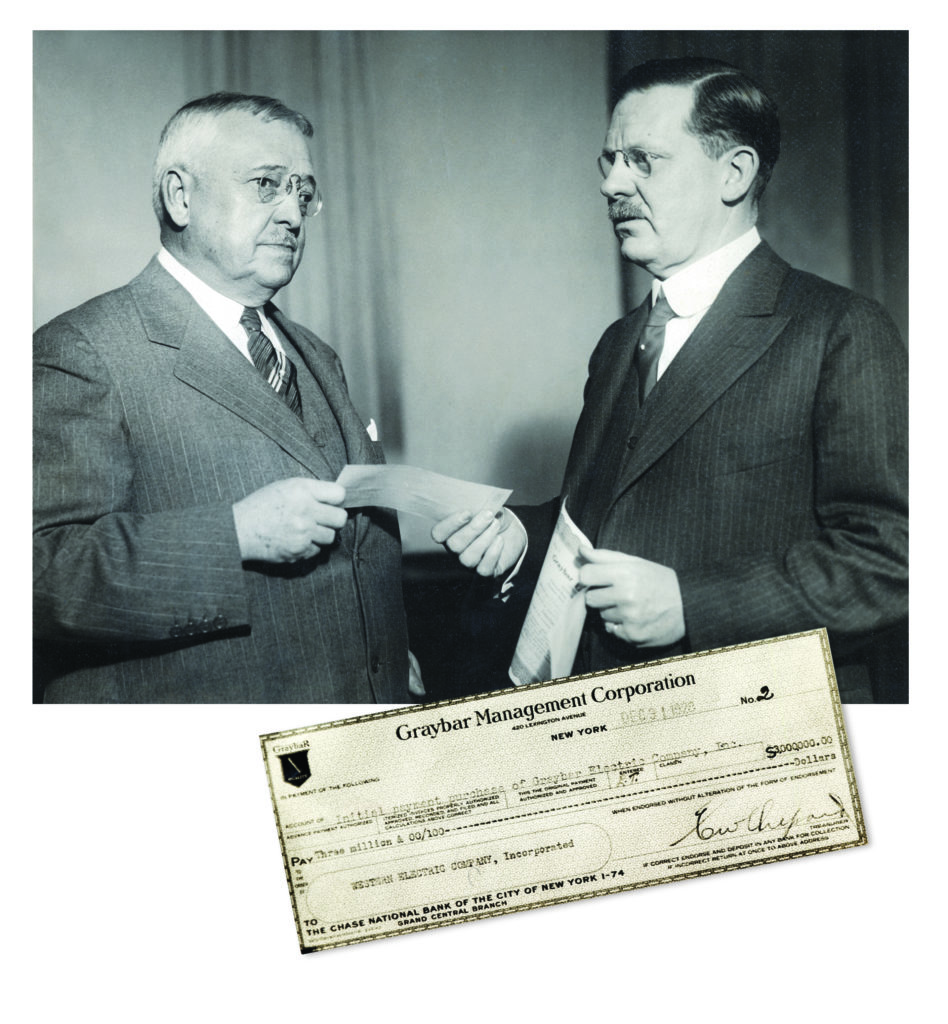
The company’s name reaches further back, to Elisha Gray and Enos Barton, whose electrical business began in 1869. The separate Graybar corporation arrived in 1925. Its history contains inventors and telegraphs, but its enduring commercial problem is wonderfully ordinary: someone needs a particular thing somewhere else.
The expensive part is the waiting
Consider a construction job. A cable has a price. So does the time spent finding it, moving it, unpacking it and discovering that the next component has not arrived. The invoice captures one transaction. The installation absorbs everything surrounding it.
Graybar works in that surrounding space. It sells wire and cable, power equipment, lighting, networking products, security equipment and industrial controls. It also stages materials, assembles kits, labels packages and arranges deliveries around project requirements. A contractor can buy supplies and ask for help organizing how those supplies reach the people doing the work.
For a buyer, the starting point is a conversation about the job: which materials repeat, where they will be stored and when crews will need them. Graybar’s service menu includes storeroom management and technical specialists. Those services give a facilities team or contractor something specific to evaluate against its own purchasing and handling routines.
That makes its customers a more interesting collection than the word “wholesale” suggests: electrical contractors, factories, utilities, government agencies, institutions and equipment manufacturers. Graybar’s published construction examples include helping two electrical contractors working on U.S. Bank Stadium. A stadium is a useful reminder that a building is also a coordination problem.
- 01Source
- 02Stage + kit
- 03Deliver
- 04Install
A very physical kind of technology
One revealing Graybar offering has wheels. SmartReel is a portable wire payout system marketed for one person to move reels weighing up to 5,000 pounds. Its appeal is immediately comprehensible to anyone who has tried moving something heavy while three other things urgently need doing.
The qualification matters: Graybar specifies flat surfaces and makes the claim subject to jobsite conditions. A useful tool has operating limits. Buyers still need to match the equipment to the route, load and working environment.
SmartStock addresses a quieter irritation: replenishing inventory. The mobile app lets users scan Graybar QR labels, enter quantities and submit orders. Account holders can also check product pricing and availability, review orders and turn quotes into purchases. Procurement systems can connect through punchout catalogs. The point is to reduce repeated handling of information alongside repeated handling of boxes.

Big sales. Narrow room for error.
At the end of 2025, Graybar reported 355 locations, about 150,000 customers and approximately two million products sourced from more than 6,000 manufacturers and suppliers. This is the middle of the market in a literal sense: between the companies making equipment and the organizations putting it to work.
Its business model is wholesale distribution, with related services. Merchandise margin must help pay for the people, inventory, buildings and systems that make the network useful. In 2025, net sales rose 10.6 percent to $12.9 billion, while net income attributable to Graybar rose 2 percent to $431.4 million. Gross margin fell from 20.1 percent to 19.3 percent, primarily because of competitive pricing pressure.
More volume does not translate evenly into profit. Both bars use the same scale.
Wesco, Sonepar and Rexel offer buyers substantial alternatives. Graybar ranked third in MDM’s 2026 electrical, data and security list. Its case rests on the combination of product access, local service, technical knowledge and coordinated logistics. Customers should compare quotes and service scope against their actual job. A simple, predictable purchase may need little orchestration; a complicated project can make those extra services consequential.
The next delivery starts years earlier
Ownership gives the story another dimension. Speaking to The Conference Board in 2026, CEO Kathy Mazzarella described the company’s priorities this way:
“it really is about the long-term viability of the organization.”Kathy Mazzarella / Chairman, President and CEO
Her account of Puerto Rico after Hurricane Maria makes the idea less abstract. The operation had been struggling, and leaders had considered selling or closing it. After the hurricane, Mazzarella said, keeping employees able to rebuild became the deciding concern. The company stayed and gave employees a raise. She recalled that the operation had a record year afterward. That is her account of a particular decision, rather than evidence that staying through every disaster will pay.
There are concrete investments behind that view. Graybar’s history records a $100 million ERP investment after the dot-com slowdown. It completed another ERP upgrade in 2025. That September, it announced STAR Centers, short for Storage, Transport, and Readiness, with the first planned facilities in Reno, Dallas and Atlanta totaling 500,000 square feet. Their assignment: support large construction projects, including data centers, manufacturing plants and healthcare facilities.
By the second quarter of 2026, quarterly sales had reached a record $3.8 billion. The practical lesson remains smaller than the numbers: count the time a product spends waiting, being searched for or being moved twice. Ask which of those steps a supplier can remove. Agree on quantities and delivery windows before expecting logistics to fix a schedule. Graybar’s business starts with a part number. Its value depends on what happens next.