Austin Mac Nab’s first sales territory was a Cedar Rapids neighborhood, and the product was his mother’s homemade egg rolls. He was ten. He also pushed a lawnmower from house to house, turning other people’s grass into money he could bring home. Long before a payment terminal entered the picture, he understood the distance between having something to sell and persuading somebody to buy it.
His mother had immigrated from Vietnam and worked as a seamstress. His father served in the Marine Corps. Childhood took him between California and Iowa; by thirteen, he and his mother were heading back to California together. These are experiences he has spoken about publicly, without dressing them in the tidy language usually reserved for a founder’s biography.
The egg rolls have since become a recurring detail in his account of himself. They deserve the attention. A child selling food after school has a fairly immediate understanding of revenue: somebody must open the door. The later business grew more complicated, but the transaction retained that human requirement. A person had to listen before a machine could take a payment.
A salary, a telephone call, a different bet
Mac Nab was born in San Diego. As a young adult, he worked in retail, including management roles at GameStop and Best Buy. He met Malisa, his future wife, while working in Ames as she attended Iowa State University. California drew them back for a time; in 2008, they returned to Iowa to raise their family.
Payments arrived through an online résumé. A company called, offering work as an independent contractor selling processing services to local businesses. He was about eighteen and a half. The offer meant commission instead of the salary he already knew. His mother had encouraged him to find dependable work, which made the decision rather less obvious than it might appear in retrospect.
His career included Card Payment Solutions from 2004 to 2006, followed by Central Payment from 2006 to 2017. At Central Payment, he became an executive sales director, managing sales representatives and independent contractors across the country. Eleven years gave him time to learn the machinery behind the pitch - and develop objections to how some merchants were being sold to.
- 2004Card Payment Solutions
Regional manager - 2006Central Payment
Executive sales director - 2017VizyPay
Co-founder & CEO
April Fools’ Day, with real money
VizyPay opened on April 1, 2017. Mac Nab, Frank Pagano and a third founding partner put $197,000 of their own money into the company. Pagano was his neighbor and brought experience as a small-business owner. Between them, they could consider the processing arrangement from both sides of the counter. The calendar supplied the joke; the savings supplied the seriousness.
Mac Nab returned to selling in person. During the first three or four months, he says he signed roughly twenty clients a month by going door to door. Then he took on underwriting, support and recruiting. A founder can have a generous collection of job titles when the alternative is leaving the job undone.
He had tried other businesses before VizyPay. One publicly documented venture, Digmaa, launched in 2015 with co-founder Mana Thongvanh to improve communication between homebuilders and buyers. Mac Nab had found the process of following his own home’s construction frustrating. The proposed solution brought photos, videos and updates into one place. Even outside payments, the irritation was familiar: a customer wanted to know what was happening.
Bootstrapping gave the VizyPay founders control, alongside the obligation to make their money last. The early lesson Mac Nab later shared was practical: allow much more starting capital than you think you need. There is a certain elegance to a business plan. Payroll is usually less interested in elegance.
Small towns have a counter, too
The customer he kept returning to was an independent business owner. VizyPay’s focus included rural shops and restaurants, places where the owner might also handle the books and answer the phone. Its core demographic was described in 2023 as independently owned businesses with fifty employees or fewer. The scale of the customer shaped the service.
In an early interview, Mac Nab pointed out that small businesses lack the legal resources available to a retailer such as Target or Home Depot. Processing costs and complicated terms can therefore demand attention from precisely the person who has the least spare time. His pitch centered on clearer pricing and choices that would let merchants manage those costs.
VizyPay developed cash discount services, alongside other payment options. In a cash discount arrangement, pricing accounts for processing costs and customers receive a discount for paying cash. That distinction matters: the cost has to be accounted for somewhere. The appeal to a merchant lies in understanding the arrangement and deciding whether it fits the business.
By 2022, the company processed $1.7 billion in payments, compared with $1.2 billion in 2021. Those are transaction volumes, rather than VizyPay’s revenue. The distinction is less glamorous than a very large dollar sign and considerably more useful. In 2023, the company reported revenue of $21.5 million.
VizyPay annual payment volume · USD
Payment volume measures transactions processed, rather than company revenue. Figures published in 2023.
The résumé can wait
Mac Nab’s hiring approach carries the same interest in the person across the table. In 2022, he described a final interview that concentrated on a candidate’s childhood, relationships and formative experiences. Education and an established payments career were not his starting point. He wanted to understand character before deciding whether someone belonged in the company.
That year, he said at least 95 percent of employees had come from outside payments. Recruiting that way required more training, and he acknowledged that it could slow growth. A forklift driver or a recent graduate would need time to learn the industry. He was prepared to spend that time rather than limit the search to people already fluent in its habits.
His approach to leadership is similarly personal. In his own writing, he argues for managers who build relationships through ordinary interactions and shared activities. He dislikes the status implied by the CEO title, preferring to describe himself as a partner. The title remains on the company page, of course. Even a hierarchy skeptic needs somebody to sign things.
The interesting question is what happens after the interview. Teaching newcomers makes the company responsible for turning its philosophy into competent service. Listening, training and clear expectations have to survive the daily work. Mac Nab’s account makes that investment central to how he wants the business to operate, rather than an occasional recruitment exercise.
“I can teach them fintech and payments.”
Austin Mac Nab, 2022
A snack cart outranks a corner office
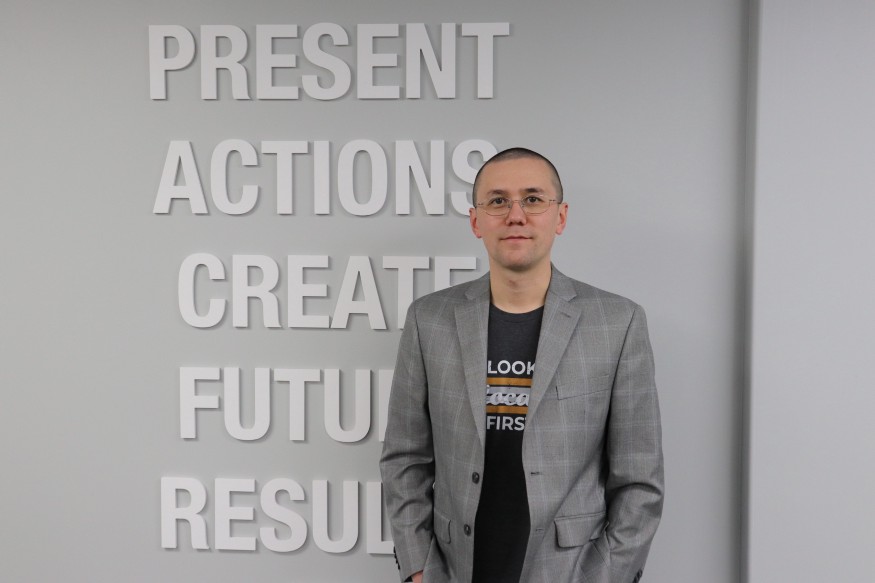
For an example of the intended atmosphere, consider the snack cart. In a 2022 podcast conversation, Mac Nab described taking one around the office every other day and greeting employees with morning fist bumps. He also kept in touch with employees working elsewhere in rural America. His purpose was simple: people should feel connected to a human being at the company.
The gesture is funny because executive presence is so often imagined as an entrance. Here it comes with refreshments. It also suits a founder who spent his early months doing support and operational work himself. A conversation across a desk offers something a staff announcement cannot: the possibility of an answer.
Look Local First extends that interest beyond the office. Through the initiative, VizyPay has used its social channels to promote small businesses and encourage people to shop nearby. An independent shop can benefit from attention even before a processing discussion begins. The approach gives Mac Nab’s small-business advocacy a public expression outside the sales contract.
There have been formal acknowledgments, too. In 2022, the Technology Association of Iowa named him CEO of the Year at its Prometheus Awards. He was also an EY Entrepreneur Of The Year Heartland finalist. Those honors placed a business built in Waukee into a wider conversation about who gets to build technology companies and where.
“We didn’t have to move to a big Silicon Valley or a tech hub.”
Austin Mac Nab, 2022
A larger company, the same unfinished job
VizyPay reached No. 45 on the Inc. 5000 in 2021. It continued appearing on the list, ranking No. 4,024 in 2026 with reported three-year growth of 59 percent. The changing ranks are a reminder that a company’s story does not stop at its most photogenic number. Continuing to run it requires a different sort of stamina from launching it.
In June 2026, VizyPay announced a partnership with Jaris to let merchants apply for business loans within its platform. Instant payouts were described as a subsequent development. For Mac Nab, the expansion keeps the focus on the independent operator while moving beyond the original payment-processing relationship. The same merchant may need both a way to accept money and access to capital.
His public interests also extend to LFG Sports AI, a sports betting app he was developing in 2025. Meanwhile, his MacMinute posts move between business, family and personal priorities. He has described wanting more spontaneity in his private life alongside the structure of his work. The subject changes; his preference for speaking personally remains.
Fatherhood gives that voice a different register. A parent of three, he has written about wanting his children to become good people, learn from his mistakes and understand responsibility. It is a more intimate ambition than a growth ranking, and one that cannot be settled by an annual list.
On VizyPay’s ninth anniversary in April 2026, Mac Nab thanked the 301 people who had been part of its history, including former employees and interns. That number described everyone who had passed through, rather than the current workforce. His attention had turned to the people who made the years possible. The boy at the door had built a company. He was still counting the people who answered.