Ashley McEvoy’s business education began in a household where soup could lead to a conversation about human behavior. Her father spent 25 years at Campbell Soup, and visitors brought questions about what consumers wanted to the family dinner table. Long before she had a budget to manage, she had something useful to consider: why does a person choose one thing over another?
It is an unusually domestic beginning for a career that would eventually include responsibility for 60,000 employees. It also makes the career easier to understand. McEvoy became president and chief executive officer of Insulet on April 28, 2025, after a long rise through Johnson & Johnson. The titles grew more elaborate. The interest in other people’s decisions remained remarkably plain.
Listen to her discuss leadership and the customer keeps appearing. So does the colleague who needs encouragement, the team that needs room to act, and the family whose calendar has opinions of its own. Her version of executive life leaves space for these other characters. A corporation, after all, is a rather crowded place to attempt a solo performance.
The dinner-table apprenticeship
McEvoy grew up outside Philadelphia and attended the University of Pennsylvania, as her father had. She played field hockey and lacrosse. Advertising came next, with work in New York and Europe and experience at Grey Advertising and J. Walter Thompson. Before she was responsible for running businesses, she was learning how businesses presented themselves to people.
Advertising is an interesting preparation for management because it makes understanding someone else part of the assignment. A person has choices. A message must give them a reason to pay attention. The business may be very pleased with itself; the audience has other plans for the afternoon. That gap between institutional enthusiasm and ordinary attention is excellent material for a future executive.
McEvoy has described herself as a marketer by trade. The description has survived a considerable expansion in her responsibilities. It suggests a practical starting point: work outward from the person making the choice. An organization can become absorbed in its own departments, while the customer experiences the whole thing at once. Remembering that difference is useful at almost any size.
“Whatever your business or field, treat everyone like a customer.”
Ashley McEvoy, advice she shared with her children
She offered that advice in 2013. It carries an expectation of attentiveness: find out what matters to the person across from you. Applied inside a company, it raises an awkward but worthwhile question. Does a colleague leave an interaction better able to do the work, or merely better informed about who outranks whom?
An assistant brand manager’s long climb
In 1996, McEvoy joined J&J as an assistant brand manager. The word “assistant” deserves its place in the story. The eventual executive began in a junior role, inside an established organization, with plenty left to learn. Her path offers a counterweight to the business biography that seems to start halfway up the building.
By 2003, she was vice president of marketing and general manager at McNeil Labs. She became McNeil’s president in 2006 and worldwide president of Ethicon Products in 2009. Company group chairman assignments followed. In 2018 she became executive vice president and worldwide chairman of J&J MedTech, a role she held through 2023.
The sequence matters because these jobs demand different kinds of judgment. Brand work puts a particular proposition under examination. Running a business adds responsibility for how the promise gets delivered. Leading across businesses brings questions about investment, priorities, and the people entrusted to make decisions. A promotion can preserve familiar skills while exposing the limits of relying on them alone.
- 1996Assistant brand manager
Johnson & Johnson - 2006President
McNeil - 2018Worldwide chairman
J&J MedTech - 2025President & CEO
Insulet
Her later seat on Procter & Gamble’s board fits the consumer experience in that history. She joined in December 2023 and serves on its Compensation & Leadership Development and Innovation & Technology committees. Those assignments put people and investment on the same professional calendar. Both require judgments whose consequences can take time to become visible.
A team large enough to disappear into
At J&J MedTech, McEvoy’s former remit encompassed an organization with about 60,000 employees and more than $30 billion in revenue. These are historical measures of the business she led. They help explain the distance between the person with ultimate responsibility and much of the work happening under that responsibility.
J&J MedTech - the former remit described at her Insulet appointment in April 2025.
At that scale, attention has to travel through people. The executive cannot inspect every decision or personally explain every priority. Someone else must understand the intention well enough to act. Developing colleagues becomes part of how an organization operates, with consequences far beyond whether the annual training presentation was attractive.
McEvoy’s public vocabulary for this is servant leadership. In a 2024 conversation with executive Martha Shadan, she emphasized curiosity about what motivates people and a leader’s responsibility to see possibilities in them. She urged listeners to pay close attention, prepare carefully, and invite colleagues into the work of innovation. Her advice gives leadership a substantial listening component.
“Listen with big ears and an insatiable curiosity”
Ashley McEvoy, 2024
The phrasing has a welcome lack of boardroom varnish. Big ears are easy to picture. They also imply a little restraint from the mouth. Listening requires the person with authority to leave room for an answer that may complicate the plan. Otherwise, a question can become an announcement wearing a question mark.
The calendar refuses to balance
There are five children in McEvoy’s family story. In 2012, Working Mother named her one of its Mothers of the Year. A year later, she discussed the importance of being able to bring her whole self to work. The detail belongs in a career profile because the career was lived alongside those responsibilities, rather than in a separate universe with better diary management.
In a 2021 conversation with Scott Whitaker, she described a household with two parents working full time. She rejected the idea of perfect balance. Some stretches involve travel; other moments belong to a parent-teacher conference. Her account makes room for changing demands, a more credible description than a permanently level pair of scales.
A parent-teacher conference has a useful indifference to an executive title. There is an appointment, and somebody needs to be there. Such obligations return the discussion of work and family to its actual units: hours, arrangements, choices, and help. The elegant diagram can wait. Tuesday is approaching.
Her reflections also give support a place in the story. At the 2024 interview, she acknowledged help received across her professional and personal life. That acknowledgment broadens the cast of a success story. It allows ambition and dependence on other people to occupy the same sentence, which is closer to how most careers actually happen.
The appointment after the long goodbye
J&J announced McEvoy’s departure in October 2023 after 27 years with the company. Tim Schmid succeeded her. The announcement said she would remain into the first quarter of 2024 to support the transition. When a career has lasted that long inside one organization, leaving is a significant event even before the next role has a name.
In thanking her, J&J chief executive Joaquin Duato singled out her commitment to developing people. It was a fitting detail at a handover: the organization was announcing both a departure and a successor. Leadership development acquires a particular meaning when the person occupying the role leaves and someone else has to carry the responsibility.
That year also brought an industry milestone: McEvoy became the first woman elected chair of AdvaMed’s board. She later stepped down, and Peter Arduini was elected her successor in November 2023. The distinction sits within a wider network of relationships, discussions, and responsibilities extending beyond one employer.
Insulet’s appointment arrived in April 2025. She succeeded Jim Hollingshead, who entered a consulting arrangement to support the transition. McEvoy’s stated priorities included international expansion, innovation, and a closer understanding of customers. It was a new executive assignment with a recognizable connection to the interests she had developed much earlier.
The advertising background soon had a concrete echo. During her early period at Insulet, McEvoy discussed sharpening brand activation and direct-to-consumer strategy. That emphasis placed the work of reaching and understanding an audience alongside the work of operating the company. The former assistant brand manager had another occasion to use her first professional language.
A factory for the next generation
In her public commentary at Insulet, McEvoy has expressed an ambition for the company to become a “leadership factory.” It is a phrase with a useful demand built into it. A factory has to produce something. For a leader, the equivalent would be colleagues who grow into judgment, responsibility, and the ability to develop someone else.
That ambition remains a proposition to be tested through everyday decisions. Who gets the next assignment? Who receives time and feedback? Who can disagree without losing the opportunity to contribute? A company’s answer will be easier to see in the careers of its people than in a statement about its culture.
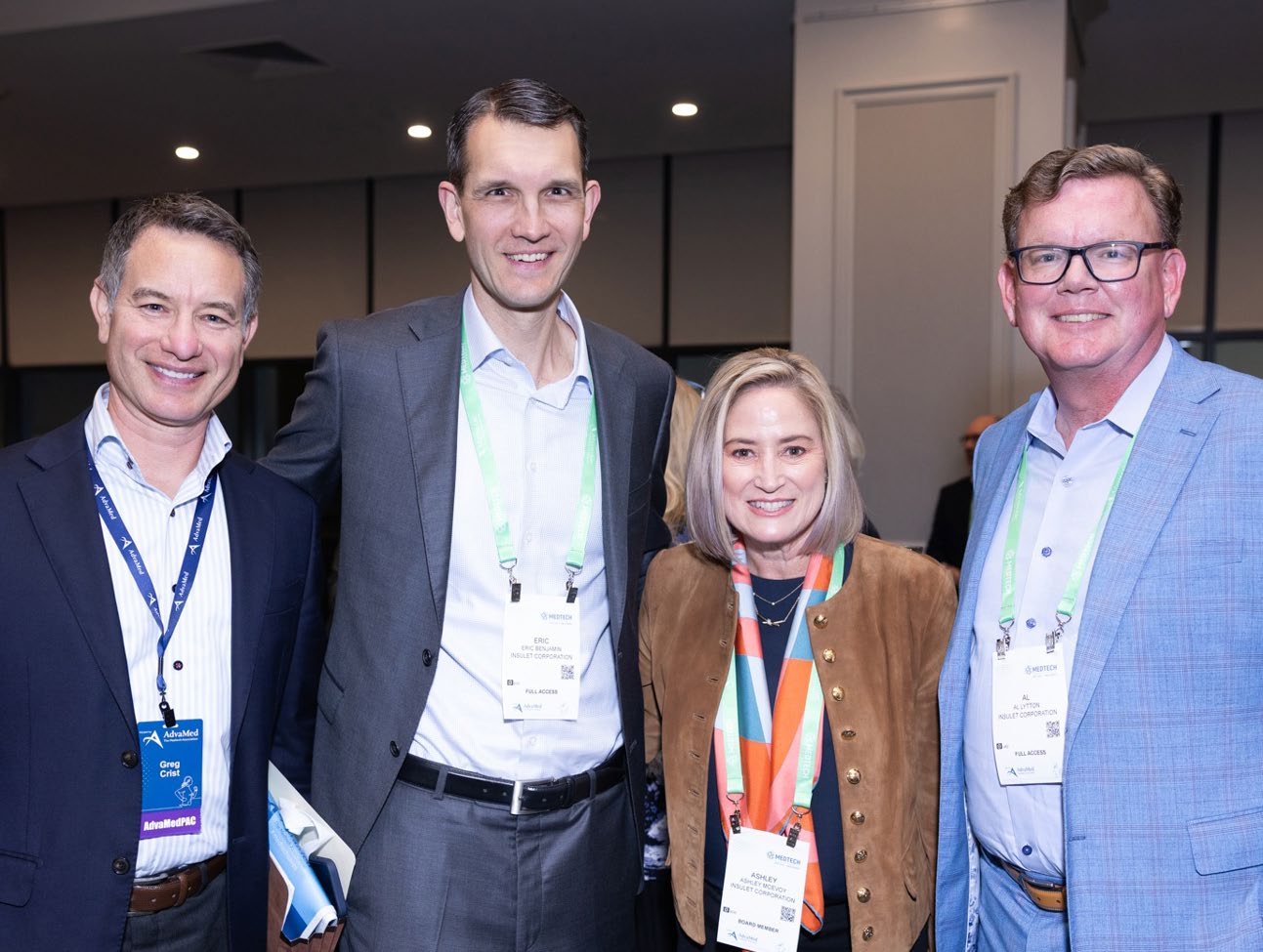
She continues to participate in industry conversations. The MedTech Conference’s October 21, 2026 recap included a video interview with her. The public stage has become part of her work, but the earlier scenes remain useful company: an advertising assignment, a team sport, an employee with an idea, a family appointment.
Those scenes keep the biography at human scale. They also return it to the question that made the dinner table interesting in the first place. What matters to the other person? McEvoy has spent a career carrying that question into larger rooms. The next answer still has to come from someone else.