Asadullah Khan began 2026 by proposing an unusual personnel decision. “I’M FIRING MYSELF AS CEO THIS YEAR,” he announced. The dismissal would be symbolic. He wanted his team to give him an exit interview, and he made his return conditional on showing that he had listened and changed. A founder was volunteering to become the subject of the conversation usually reserved for the person leaving the building.
His argument was that founders can obstruct their own companies. Familiar policies become comfortable; the business changes around them. The proposal put the question of progress uncomfortably close to the boss’s desk. It also gave a personal turn to a career spent around business systems: who does the work, how information moves, and what happens when an arrangement stops being useful.
Khan is the CEO of WareGo, which makes warehouse management software, and the founder of Trango Tech. He also leads Eplanet Global, the business whose history reaches back to outsourcing in 2003. His working life connects customer service, online shopping and software development. Behind those different activities sits an unglamorous concern: getting a company’s moving parts to agree with one another.
The sale that still needs shipping
One revealing episode predates WareGo’s Gulf launch by years. At an event called Grow with Goto, Khan, then president and CEO of the Pakistani online marketplace Goto.com.pk, described lessons from inventory and order-fulfillment setbacks during the Great Online Shopping Festival. The account, published in January 2018, concerned the company’s adoption of Oracle’s cloud business systems.
Goto wanted its online catalogue to reflect products actually available. It also wanted stock, orders and financial information to become easier to coordinate. Khan said the festival experience had made the need for automation clear. The decision placed warehouse and financial software behind the shopfront. A sale might begin with an attractive product page, but completing it required records that kept up.
This is the awkward arithmetic of retail. A customer can buy quickly; an operation must still locate, allocate and dispatch. Extra demand multiplies each of those obligations. An inventory discrepancy that looks small on a screen can become a customer waiting for an explanation. The shopping basket, for all its cheerful little icons, has no authority over the shelf.
Later in 2018, Khan described Goto’s Oracle ERP Cloud decision in practical terms: improved staff experience, less exposure to system failure, more use of mobile technology and lower costs. These were his reported benefits. The emphasis is revealing. Software mattered because of what people could do with it during the working day.
- 01OrderA customer makes a request
- 02InventoryCheck what is available
- 03FulfillmentPrepare and dispatch
A business with several working parts
Khan’s earlier business history begins with ePlanet Communications. His business profile dates his founder and CEO role to August 2003 and records a previous association with Eximpo Cool Chains. It also lists attendance at David Game College. Karachi is his listed base, while the businesses associated with him work across international markets.
Eplanet’s own history starts with business process outsourcing, then expands into digital services, ecommerce, localization and other ventures. That combination puts the group in several places where information has to become a service. A support request must reach someone who can answer it. An online purchase has to become a physical delivery. A software brief must become something a customer can use.
In October 2022, Khan introduced Trango Tech as the next phase of ePlanet’s technology division. He described the work of developing the division as difficult and presented the new identity as a way to take it further. The announcement placed products alongside services, giving the software operation a name of its own.
The following March, he announced the Eplanet Global identity. He framed the change around a broader service range and expansion into further markets. Naming a business is the tidy part. Keeping its activities coherent requires a less photogenic kind of attention, especially when customers, partners and employees experience the same organization from different directions.
In his founder’s note at Trango Tech, Khan explains the original frustration as a gap between technology’s existence and a growing company’s ability to use it. He describes encouraging engineers to experiment, including breaking things as part of learning. The stated ambition is accessibility: making useful technology available to businesses that need it. That connects his account of founding the company to the daily experience of its customers.
There is a practical distinction inside that ambition. A company can purchase software and still struggle to make it part of its routines. Someone has to understand the job, decide what changes and help people use the result. Khan’s businesses operate around that meeting point between a technical product and an organization trying to get something done.
The warehouse enters the picture
WareGo puts Khan back among stock records and shipments. The company identifies him as CEO, while its TechBehemoths listing identifies him as founder. Its cloud software is offered to businesses handling inventory, orders and warehouse operations. The proposition is familiar to anyone who has watched separate records disagree: give the people doing the work a more consistent picture.
A June 2025 launch announcement presented WareGo as a Trango Tech platform for Gulf logistics. It described barcode scanning, automated stock alerts, management of multiple warehouses and permissions for different staff roles. Khan, speaking as Trango Tech CEO, emphasized adapting automation to the region’s daily operating problems. The intended markets included the UAE, Saudi Arabia, Qatar and Bahrain.
There is a recognizable continuity with Goto’s earlier concerns. The retailer needed dependable information behind its catalogue. WareGo offers software to coordinate the stock and fulfillment work itself. That connection does not require a grand conversion story. The operational problem was already there, waiting patiently between the promise made to a customer and the goods going out.
“Our mission at WareGo is to make warehousing effortless.”
Asadullah Khan · February 2026
In a February 2026 company announcement, Khan linked that mission to automation and connections with other business tools. An August announcement described modernization work with TrangoTech and an ambition for increasingly autonomous fulfillment in the GCC. These are the company’s stated plans and reported developments. On the warehouse floor, their usefulness comes down to whether the next task becomes easier to perform correctly.
An agency founder leaves room for no-code
Khan’s approach to software has another interesting wrinkle. In a July 2025 essay, he made a case for early founders using no-code tools to test ideas. As someone running a development agency, he acknowledged the apparent tension. A small prototype can help establish whether anyone wants a product before its creator commits to a larger build.
He also discussed limits: customization, capacity as usage grows, and dependence on a platform’s rules. His argument allowed different tools to serve different stages. An internal tool or an early experiment might call for one approach; more complicated requirements could make custom development worthwhile. The question was what the founder needed the software to accomplish.
That position adds something to the portrait. The choice of software can be a choice about timing. Buying more machinery than an idea needs can be expensive; asking an established operation to outgrow its machinery can be expensive too. Khan’s essay situated the decision in the work at hand, giving experimentation a place alongside the services his company sells.
His public activity also extends to discussions about the wider technology economy. A Sindh government account records a delegation led by Khan meeting Ali Rashid at the Department of Science and Information Technology. The discussion concerned collaboration and development of Sindh’s technology ecosystem. It places the Karachi-based founder in a conversation about the conditions around businesses as well as the systems inside them.
An office opening, with a note of perfume
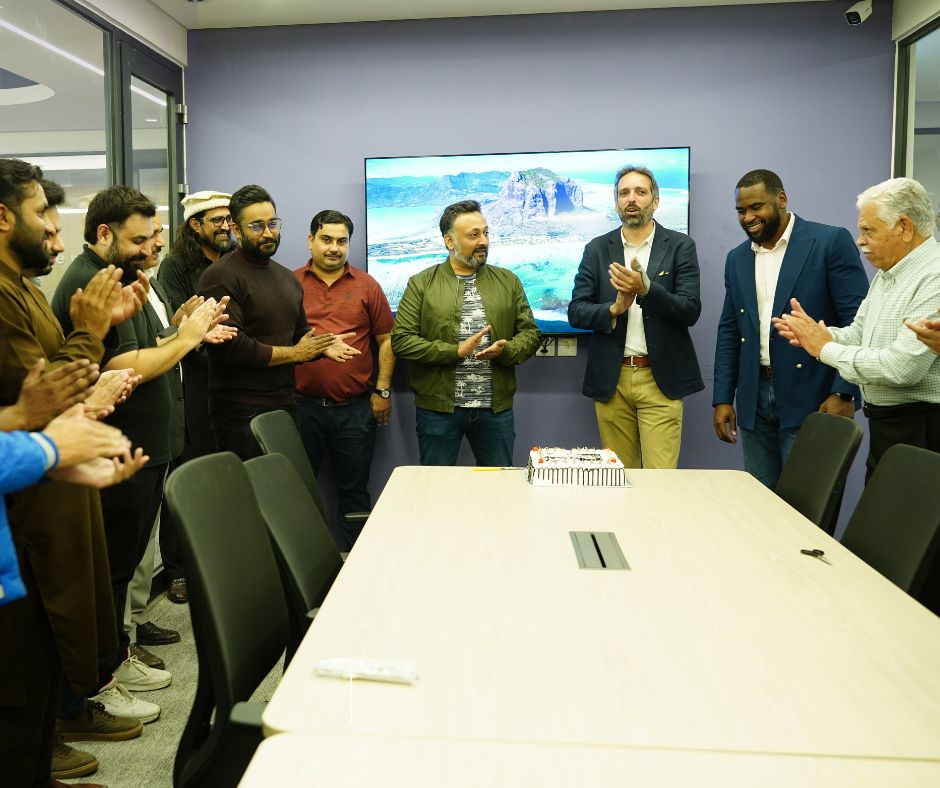
Late in 2025, Eplanet Global opened an office in Lahore. The company’s November announcement placed Khan at the celebration. In the photographs he later shared, there is a meeting table, a laptop and a gathering around a cake. Business expansion has its ceremonies; it also has chairs that need occupants and people who need to work together.
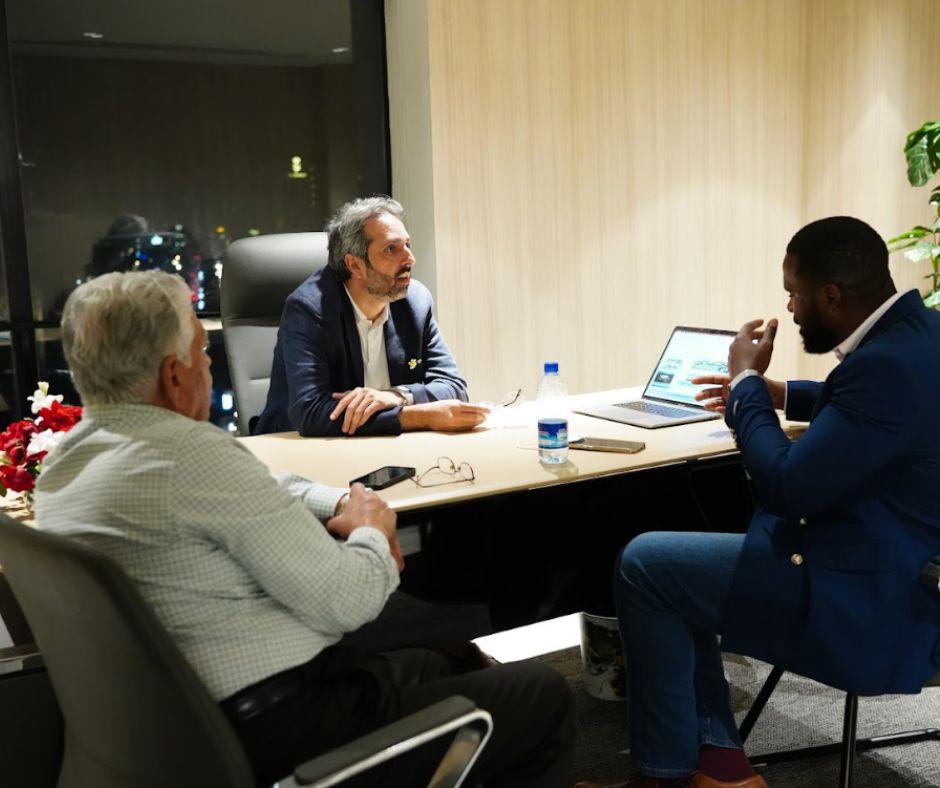
His December reflection returned to the preparation: travel, finding people and getting details into place. Then came an unexpected comparison. Khan said he had been learning perfumery. He connected the need to refine a blend and allow it to settle with the patience required to develop a business, a team and its culture.
“Entrepreneurship, I’ve learned, is very similar to perfumery.”
Asadullah Khan · December 2025
It is a more intimate business metaphor than the usual charts pointing upward. Fragrance makes room for adjustment and waiting. Applied to an office opening, it directs attention toward the preparation rather than the photograph. The finished-looking moment arrives after work whose duration is much harder to put on a sign.
The next system to examine
The Lahore reflection and the proposed exit interview sit close together in time. One concerns giving a team time to develop; the other asks its founder to accept scrutiny. Together they suggest a useful way to read Khan’s public business life: look at the adjustments he says an organization needs, including the adjustments that involve him.
The proposal remains a proposal for a symbolic exercise, rather than an announced resignation. Its practical test would be what employees could say and what changed afterward. For a founder used to looking for friction in business operations, an honest exit interview would bring the inspection to his own desk. This time, the person with the clipboard would be somebody else.
Follow the working parts
- WareGo · warehouse software ↗
- Trango Tech · development business ↗
- Eplanet Global · the group’s history ↗
- Asadullah Khan on LinkedIn ↗
- X profile linked from Khan’s business record ↗
- Facebook profile linked from Khan’s business record ↗
- Read Khan’s essay on no-code and agencies ↗
- Goto’s 2018 inventory and cloud story ↗