A warehouse can lose an order without losing a single box. The merchandise is on a shelf. The customer has paid. Somewhere between the online checkout and the stock record, the two facts have stopped talking to each other. WareGo sells software for that awkward interval: the space between having the goods and reliably getting them out of the door.
The company’s cloud-based warehouse management system connects inventory, orders and fulfillment. Its audience includes retailers and ecommerce businesses, but third-party logistics providers receive particular attention. These are the operators storing and shipping other companies’ goods, with the added complication of keeping each client’s inventory, instructions and charges straight.
WareGo’s slogan is “Less Mess, More Yes!” The more revealing part of its pitch is decidedly less bouncy: purchase orders, allocation rules, stock synchronization, client permissions. These are the small administrative hinges on which a delivery promise turns. Its case studies give that otherwise abstract sales proposition a recognizable shape.
The order was there. The stock record wasn’t.
Consider Oaks, the apparel retailer in WareGo’s published customer account. As Shopify order volumes increased, the company faced processing errors and trouble synchronizing inventory between the storefront and its warehouse system. It also wanted to reduce the expense of holding stock and improve time to market.
The intervention described by WareGo involved master-data management, inventory visibility across locations, dock-door management and real-time synchronization with Shopify. The important detail is the connection between systems. Taking another order was useful only if the warehouse could act on it with the right product information.
WareGo reports that Oaks subsequently processed 55 percent more orders to Shopify and reduced inventory discrepancies by 70 percent. Those are company-published case-study results, best read as outcomes for that customer rather than a forecast for every retailer. The practical lesson is narrower and more portable: fix the handoff that keeps producing errors.
Orders processed
to Shopify
Inventory
discrepancies
Eximpo supplies a second version of the problem. In WareGo’s account, the B2B logistics provider had relied on manual methods, including Excel. Expansion brought processing errors, delays and limited visibility for clients. WareGo describes automating inventory and orders, while connecting inbound and outbound activity through dock-door automation.
The Eximpo case study reports threefold faster fulfillment, 99 percent inventory accuracy and more than 500 items processed an hour. Again, these are the vendor’s reported results. What makes the account useful is its sequence: manual coordination became a constraint, then the business changed the way information moved through the operation.
One client’s stock, another client’s invoice
A multi-client warehouse has an extra audience for every operational decision. The business paying for fulfillment wants to know what arrived, what remains available and what shipped. WareGo’s 3PL client portal is designed to put those answers within the customer’s reach, alongside order submission and reporting.
The portal’s advertised permissions let operators control what users can see and do. That is a substantial distinction from simply giving everyone the warehouse dashboard. A client needs a view of its own business; the operator needs to coordinate the whole facility. A useful portal accommodates both perspectives without requiring a phone call for each update.
WareGo also advertises activity-based billing for 3PL operations. The appeal is straightforward: the warehouse performs work for different customers, and its commercial record should follow that work. Stock separation, customer-specific workflows and billing belong together. This is where the company’s logistics focus becomes more concrete than the familiar promise of better inventory management.
The product’s breadth puts it in several buying conversations. WareGo’s own comparison pages name Extensiv, Logiwa and Camelot for 3PL buyers, and NetSuite WMS, Fishbowl and SAP EWM for broader warehouse evaluations. Its positioning combines warehouse functions, integration options and an accessible entry offer. That is a proposition to test against an operation’s requirements, rather than proof that one package wins every comparison.
The expensive distance between two systems
WareGo’s integration directory spans ecommerce platforms, marketplaces, business applications and shipping carriers. Shopify, WooCommerce and Magento appear alongside Oracle, SAP and Microsoft Dynamics. Amazon, eBay and Walmart are listed too. APIWorx, ConstaCloud and Pipe17 appear under integration partners.
The directory matters because a warehouse rarely owns the entire order journey. A storefront receives a purchase; another system holds business records; a carrier takes custody of the parcel. WareGo’s advertised connections are intended to move information across those boundaries. For a buyer, the useful unit of comparison is the particular connection and workflow required, not the length of the logo parade.
Inside the building, WareGo’s pick-and-pack tools describe a sequence of received orders, stock allocation, generated pick lists, packing and shipping. Shorter routes and organized picking schedules are part of the offering. Putaway and slotting functions address where goods should sit, including the problem of slow-moving stock getting in the way of frequently ordered items.
- 01ReceiveRecord incoming goods
- 02AllocateMatch stock to orders
- 03Pick + packPrepare the right items
- 04Ship + updateKeep the record moving
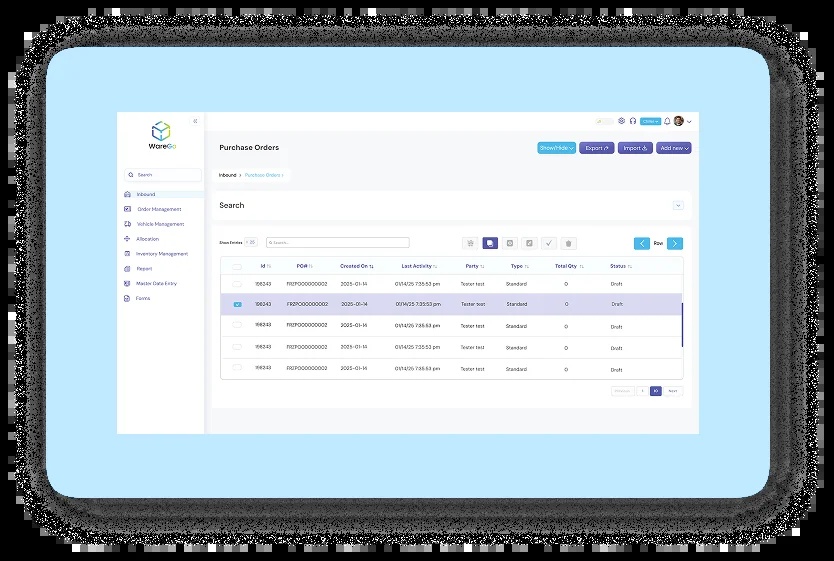
This is a business built around operational detail. WareGo’s public product screens include inbound records, vehicle management, allocation, inventory and reports. A manager looking at those modules can ask a much more useful question than whether the software feels modern: which repetitive decision would this remove from today’s workload?
Asadullah Khan appears as CEO on the company’s About page and is identified as its founder in the TechBehemoths directory. WareGo states its mission as making warehousing effortless. Its stated values emphasize teamwork, integrity and learning. The product gives that mission a practical interpretation: fewer separate places to check before deciding what happens next.

What the monthly price does - and does not - buy
WareGo advertises an Essential package at $350 a month, with 2,000 monthly orders, a client portal and up to 10 users. Enterprise is custom-priced. The pricing page also displays separate Standard and Pro offers, with different allowances. The sensible reading is that a prospect needs a current package specification.
The detailed tables identify limits and possible additional charges for integrations, facilities and ERP work. They also distinguish support availability between packages. These details matter alongside the broader promotional promise of a free trial and no implementation cost: the signed scope needs to say which services and connections are included.
The monthly fee buys a package. The warehouse needs a working process.
THE BUYER’S QUESTION
For planning purposes, $350 multiplied by 12 is $4,200 a year before additions. That is arithmetic on an advertised subscription, not a customer’s deployment bill. A useful comparison would put the required subscription, connections and implementation work beside the actual operating problem being addressed. Cheap unused functionality is still unused functionality.
WareGo’s business model therefore rewards understanding the customer’s volume and complexity. A single location with modest order flow and a multi-client operation with custom billing can both need warehouse software while buying quite different scopes of work.
Forecast the purchase. Track the return.
WareGo’s forecasting product extends the story upstream. The company describes using sales history, supplier lead times, seasonal trends and planned promotions as inputs. Its advertised outputs include purchase recommendations, adjusted reorder points and safety-stock updates. The intended benefit is a better purchasing decision before the receiving team encounters the next delivery.
Those inputs provide a useful way to question the AI claim. A buyer can ask how promotions are recorded, how lead times are maintained and what happens when an item has little sales history. The sensible test is whether the recommendation helps someone make a defensible stock decision. The word “AI” cannot answer that question by itself.
Returns take the process in the other direction. WareGo describes a customer initiating a return through a portal, followed by policy checks, approval, a return authorization number and a shipping label. After the appropriate refund or replacement, the system updates stock and order information.
That sequence reveals why returns belong in a warehouse profile. A parcel coming back needs a recorded outcome just as much as a parcel going out. WareGo advertises tools for managing returned stock and notifications for customers. For an operator evaluating the system, an exchange or an item requiring repair offers a useful test of how closely those records follow reality.
Make the demo earn its keep
The lesson to copy from WareGo’s customer examples is the starting point. Oaks had a synchronization problem. Eximpo had manual coordination and visibility problems. Both accounts point toward identifying a specific failure before choosing a collection of features.
A practical trial could follow one representative order from receipt through allocation, picking, shipment and the customer’s status view. Then add a complication: a partial delivery, a return or a client-specific charge. Record the manual interventions still required. That exercise turns a sales demonstration into something the warehouse team can judge.
There are conditions under which the approach will disappoint. If staff continue making stock movements outside the recorded workflow, the screen and shelf can diverge again. If the required integration is outside the agreed scope, another manual handoff remains. These are evaluation implications of the workflow WareGo describes, and reasons to test the awkward cases early.
WareGo’s appeal rests on a recognizable promise: let a growing operation coordinate its physical work with fewer information gaps. The decisive evidence belongs on the warehouse floor. Can the team find the goods, fulfill the order and tell the customer what happened? That is a much better ending than another spreadsheet called “final.”
Follow the order further
Explore WareGo, its pricing options, Oaks case study, Eximpo case study and warehouse blog.