Buying a present can be an expensive business. Morgan Hermand-Waiche managed to turn it into a company, a decade of competition, and eventually a transaction with the very retailer he had hoped to unsettle. The present was lingerie for his girlfriend. The problem was the gap between what he liked and what a Harvard MBA student could afford. The eventual buyer was Victoria’s Secret.
In November 2022, Victoria’s Secret & Co. announced an agreement to acquire Adore Me, the business he had founded in 2011. The announced structure began with a $400 million upfront cash payment and provided for further consideration. For years, Hermand-Waiche had pointed to the incumbent as the reason an alternative should exist. Now the incumbent wanted access to the alternative’s technology, customers and way of working.
It is a pleasing reversal, though an acquisition announcement makes a tidier ending than a life does. Hermand-Waiche continued with the business after the deal. By August 2025, he had left. Adore Me subsequently changed its subscription model. His story has room for ambition, inventive management, customer complaints and a founder discovering that the business he built would go on making decisions without him.
A shopping problem with an engineering answer
He came from Marseille, where his family worked in clothing retail. His route into the trade took a detour through mathematics and computer science at Mines Paris, consulting at McKinsey, and Harvard Business School. He had worked across Asia and Europe before moving to the United States. The ingredients were an unusual combination: familiarity with clothing as a business, training in quantitative problems, and an appetite to start something himself.
The gift-shopping episode supplied a market to investigate. During his MBA years, he began exploring whether attractive lingerie could be sold online at more accessible prices. Professors became early investors. Fabrice Grinda, the entrepreneur and angel investor, became an early backer and helped him work through the business model and approach to the market. Adore Me’s website launched in March 2012.
The idea sounded straightforward. Its execution involved suppliers, advance orders, sizes, inventory and cash tied up long before customers paid. The company came close to failure early on. Hermand-Waiche described the difficulty of negotiating substantial production commitments months ahead. A clever website could introduce the customer. It could do little to charm a factory out of its minimum order.
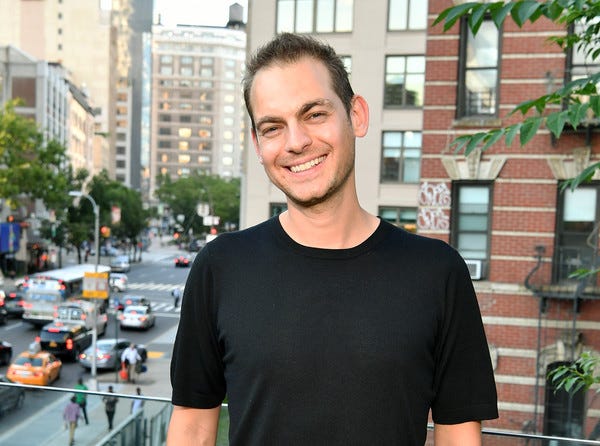
There was an older entrepreneurial itch, too. As a student in France, he had pitched an apartment-subletting platform and encountered disbelief that people would rent their homes to strangers. The precise calendar matters less here than the recurring attraction: spotting a transaction people considered awkward, then wondering whether a business could make it ordinary. He did not arrive at lingerie after a lifelong devotion to lace.
As he put it in French, what particularly appealed was building a company from nothing. That helps explain the direction Adore Me took. The intimate apparel was the product; the making of a functioning organization was a considerable part of the attraction. His attention kept travelling beyond the garment to the machinery needed to sell it.
Let the picture lose
At Adore Me, even a photograph could be treated as a proposition awaiting an answer. The company tested different models and poses for the same lingerie set. Visitors saw different versions; purchases helped determine which performed better. A creative decision that fashion businesses might settle by taste became a question customers could answer through their behavior.
That working method suited Hermand-Waiche’s education. It also required a certain willingness to be contradicted. The image that looked right to the people creating it might lose when it met a shopping basket. Testing gave a young retailer a way to learn without requiring its founder to possess the instincts of a veteran merchant. An opinion could have a hearing without receiving tenure.
In 2017, he described a business with roughly 1,000 products and new collections of 40 to 60 styles each month. Revenue had reached $84 million in 2016, he said, up from $15.5 million in 2014. The offer also evolved: alongside membership, shoppers could buy individually. He said nearly half of customers were ordering à la carte. Customers were changing the business as they used it.
New styles each month, as described by Hermand-Waiche in his May 2017 interview.
Size range was another practical opening. Selling more sizes meant reaching people who had fewer choices, but it also meant accepting more design and inventory complexity. An inclusive promise has to survive a fitting room, a product page and a return parcel. His response was to bring in people who knew the product more deeply than he did.
The founder leaves room
Helen Mears had worked at Wacoal and on Victoria’s Secret’s in-house design team. After a conversation with Hermand-Waiche, she was offered a job on the spot. She became Adore Me’s chief design officer. Years later, she described considerable freedom to shape the product, without the layers of approvals she had known elsewhere.
“It’s up to you, Helen, just do whatever you want to do.”
Hermand-Waiche’s instruction, recalled by Helen Mears
Chloé Chanudet, who joined as an intern and became chief marketing officer, described a similar division of responsibilities. The founder worked on strategic direction; he did not make her marketing decisions. The arrangement gave experienced specialists room to exercise judgment while a younger company found its shape. The freedom was concrete: decisions could happen without returning every question to the founder’s desk.
His own account of leadership was compact. Asked in late 2019 which skills mattered, he answered: “listening, leading and adapting.” He emphasized following changes in customer expectations and setting an example through actions. These are easy words to put on an office wall. They acquire more substance alongside a designer who says she was actually allowed to design.
There were less conventional gestures, too. In 2015, Adore Me attracted attention for giving some departing employees $10,000 farewell checks. The payments were discretionary, rather than a guaranteed benefit for anyone who resigned. Hermand-Waiche saw value in recognizing people who had worked hard, even as they left. It was an unusually literal investment in being remembered fondly.
The warehouse behind the website
A growing online retailer can buy services for almost everything around a sale. Adore Me took on the burden of building more of its own systems. Its engineering operation in Bucharest, proprietary technology and distribution infrastructure became part of Hermand-Waiche’s argument for the company. The spending created obligations, but also gave the team more control over how an order moved.
In 2019, the business described its new distribution center as a 130,000-square-foot operation with extensive automation. It had moved away from an outside logistics provider. Physical stores were another experiment. Hermand-Waiche argued that an online brand needed a presence shoppers could encounter in person, even while acknowledging how small Adore Me remained beside Victoria’s Secret.
- 01 Design & fit
- 02 Software & stock
- 03 Pick, pack & send
- 04 Listen & adjust
A simplified view of the activities the business brought together.
The mundane details mattered to him. Years earlier, he had described orders wrapped in colored tissue, sealed with a sticker, packed with a thank-you note, then protected for delivery. By the time he wrote about operational resilience in 2020, he was considering how control of fulfillment supported new shopping formats and changes to packaging. The package was doing several jobs before anyone opened it.
His writing placed financial flexibility, technology and adaptable colleagues together. He argued that profitability gave a company room to respond when conditions changed. This was a working philosophy with a fairly unromantic center: avoid constructing a business that needs everything to go according to plan. Fashion supplies plenty of surprises without a founder commissioning additional ones.
The charge on the other side of the screen
The customer experience also produced a serious failure. In 2017, Adore Me agreed to return more than $1.3 million to settle federal charges involving its VIP membership. The Federal Trade Commission alleged that the company removed unused store credits when customers cancelled or disputed transactions, despite promising the credits could be used anytime. It also alleged barriers to cancellation.
The order required clearer disclosures, consent for recurring billing and a simple way to stop charges. These were company practices under his leadership. They belong beside the account of experimentation and customer choice. A retailer can improve how customers find a product and still make the financial relationship difficult. The inconvenience of ending a membership is as real as the convenience of starting one.
When the rival wrote the check
By the acquisition announcement, Adore Me served more than 1.2 million active customers. Victoria’s Secret wanted both a brand and capabilities it could use across its own business. The deal closed on December 30, 2022; completion was announced in January. The buyer estimated that Adore Me had generated $250 million in profitable sales for fiscal 2022.
The result was a particular kind of acknowledgment. The incumbent had once been the reference point against which Hermand-Waiche explained his opportunity. It now saw value in bringing his team’s work inside its organization. The original competitive pitch had become a negotiation about cooperation, software and customers. Business has a habit of rearranging the seating plan.
His departure was reported in August 2025, as Christine Vellani took leadership of the brand. In April 2026, Adore Me ended its Elite subscription boxes and pointed customers toward A-List Rewards. Those developments make the founder’s tenure a completed chapter rather than a permanent description of the company. His public LinkedIn profile now lists a stealth AI startup in New York.
That move gives the story another beginning, with the details still to emerge. What his Adore Me years show is a sustained interest in how things work together: people with authority, software with a purpose, garments that fit, packages that arrive. A shopping problem had led him into an organization. The organization had grown large enough to continue its story after he left.
More from this story
- CompanyAdore Me ↗
- LinkedInMorgan Hermand ↗
- X / Twitter@morganhermand ↗
- WritingHis retail essay on Medium ↗
- Video interviewBFM Business: the early Adore Me years (French) ↗
- ConversationThe design and marketing chiefs on building Adore Me ↗
- TransactionThe acquisition announcement ↗
- Customer experienceThe membership settlement ↗
- Next chapterThe 2025 leadership transition ↗
- Company updateThe end of Elite boxes in April 2026 ↗