At fourteen, Paul Altieri had a useful view of success: close enough to carry its golf clubs, far enough away to study its wrists. During summers working as a caddy in New England, he noticed Rolex watches on club members he admired. The watch became a promise he made to himself. Someday, if things went well, he would have one too.
Years later, he would spend his working life answering a rather less romantic question. How much was that promise worth, second-hand? A Rolex could arrive with a famous name, a reassuring weight and a price demanding serious consideration. None of those things told its owner what a dealer would actually pay.
Altieri built the Rolex Exchange model at Bob’s Watches around putting that answer in public. On the same website, customers could see buying prices and selling prices. The dealer’s margin, usually the subject of a private conversation, became something a shopper could examine before starting one.
The view from the golf bag
The childhood attraction survived adulthood. Altieri graduated from Boston College in 1979 and began selling fine jewellery and watches after college, in 1980. His taste increasingly ran toward watches, including Rolex and Patek Philippe. He liked the practical versatility of a Rolex: something that belonged on a ski trip, underwater or at a bank meeting.
That is an appealing amount of employment for one accessory. More to the point, it explains why he saw these watches as objects people would keep using. They could move between occasions, and eventually between owners.
He also worked in real estate and collected vintage timepieces through the 1990s and early 2000s. Buying through eBay and Craigslist exposed him to the ordinary collector’s predicament. An object could be desirable while the transaction surrounding it felt distinctly less inviting. He wanted a safer, more open way for people to trade.
Two prices, one awkward question
In 2010, Altieri acquired and relaunched Bob’s Watches, a business named for its original owner, Bob Thompson. The name stayed. It has the useful quality of sounding like a person you might telephone, even if the person answering has to explain that he is Paul.
He has even joked about starting over with a different company name: “Cool Watches, Ltd”. The joke suits a business that sells objects surrounded by solemn vocabulary. Collectors can spend considerable time discussing a dial, a reference and a set of papers. The name above the shop does not have to join the ceremony. Bob’s remained easy to remember, and Altieri had other things to change.
The important alteration was in the information offered. A seller wanted to know the value of a watch already in their possession. A buyer wanted to know whether the asking price made sense. Both faced a dealer who knew more about the market than they did.
Publishing the buying and selling prices gave each customer a reference point. It also exposed the space in which the company had to earn its living. Inspection, photography, inventory and service would need to justify that space. Customers could make the comparison themselves.
buy price
sell price
Asked to explain the company’s success, Altieri offered a compact list: “Honesty, trust, transparency, and marketing.” The last word earns its place. He took search visibility seriously early on, then expanded into other channels. A fair proposition still needed an audience to discover it.
The weeks when nobody bought a watch
The beginning was quiet enough to test his conviction. He remembers the first two or three weeks of July 2010 going by without the business buying or selling a watch. It is a wonderfully unceremonious opening for a company devoted to expensive objects: time passing, watches elsewhere.
Altieri had put $300,000 of his own money into getting started. He says the business reached break-even within a year. His retrospective account dwells on the arithmetic: how many watches needed to move each day, what acquiring them would cost, and how much the business could afford to spend.
“We grew patiently, and we grew profitably.” The sentence describes a preference as much as a result. He wanted a business whose pace he could understand and sustain. He urges entrepreneurs to allow more money and more time than their first plan suggests.
There is something fitting about that caution in a watch dealer. The objects may encourage grand gestures. Paying for the next week’s inventory requires a less theatrical temperament.
“Simplicity counts. Keep it simple!”
Paul Altieri, on his personal business-philosophy blog
Carol, the camera, and the work behind the dial
The company story includes his wife, Carol Altieri, its chief operating officer. Her remit covers operations, product pricing, policies and customer relationships. Paul has credited her with helping the business develop its daily operations as it grew.
The official team listing also gives the photographers their own entries, alongside watchmakers, purchasing staff and people handling quality control. For an online dealer, these jobs meet at the product page. A photograph must show a distant buyer enough detail to make a serious decision. Inspection must establish what the photograph alone cannot.
Altieri has repeatedly warned that counterfeits have become harder to detect. The problem extends to genuine watches containing substituted components. A Rolex with an altered dial or replacement parts presents a different proposition from an original example, even if a casual glance finds both convincing.
The promise of transparency therefore continues past the price. The buyer needs an accurate account of the object itself. Expertise has to survive the trip from the workbench to the description on the screen.
His personal business-philosophy page has the brisk tone of notes kept beside a desk. Keep recruiting, he advises, as a baseball team develops future players. Plan for lasting company value while remembering the immediate need to earn a living. The metaphors are practical and occasionally impatient. Someone has to field a team before anyone can admire the score.
He describes himself as competitive, even when the contest is a relay race at a family reunion. In that account, improvement keeps him interested. It is an easy trait to recognize in a collector: there is always another detail to understand, another example to inspect, another person who knows something you do not. Running the company gives that appetite a daily job.
An acquired taste for things that fade
Altieri’s personal taste has moved toward vintage Rolex. He likes dials and bezels that have changed colour over time, the sort of ageing that can make an individual watch interesting to a collector. He has named the Paul Newman Daytona and a gilt-dial Submariner 5512 among his favourites.
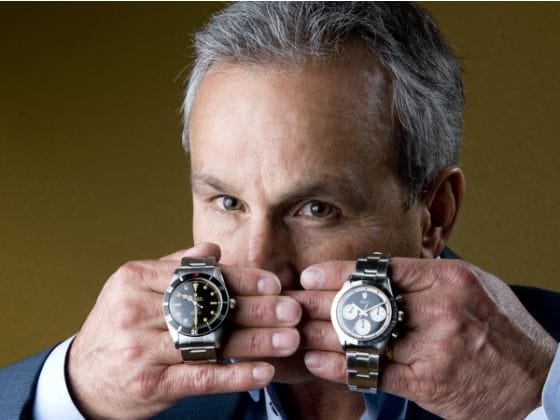
Originality matters to him. So does meeting an original owner and hearing the story attached to a watch. A reference number identifies a model; it cannot supply the years somebody spent wearing that particular example.
There is also pleasure in finding someone willing to discuss the details at length. In a 2023 Watch & Tell conversation, Altieri sat down with collector Morgan King to share pieces from their collections. Their subjects included vintage Daytonas, a Submariner 6200 and the finer points of chronograph pushers.

The conversation gives the business biography some welcome company. Here is the retailer as a fellow enthusiast, pleased to have another collector at the table. His advice to beginners follows the same instinct: find a model you love, rather than choosing chiefly by which one might rise most in value.
A change of scale, in millimetres
Experience has not made him immune to surprise. In September 2026, he discussed the renewed strength of smaller Rolex watches. He had watched case sizes grow for years and had been slow to embrace the reversal. The company’s transactions gave him reason to look again.
In a December 2025 to May 2026 comparison, five of the ten fastest-appreciating Rolex references at Bob’s Watches were smaller Datejust or Lady-Datejust models, measuring between 26 and 31 millimetres. This was evidence from the company’s own sales, rather than a verdict on every watch in the market.
Fastest-appreciating Rolex references at Bob’s were smaller Datejust or Lady-Datejust models.
The geography has changed too. By January 2026, Bob’s was selling through airport duty-free concessions in Las Vegas, Abu Dhabi and New York’s JFK. These were placements inside travel-retail stores rather than separate Bob’s boutiques. Altieri described airport inventories of about twenty to thirty watches.
He still considered the business primarily an e-commerce operation, with locations in Newport Beach and Naples. Airport counters gave it another place to meet customers. The online model remained central to how he wanted to grow.
The watch he would buy back
For all his work clarifying prices, Altieri has described a sale that numbers alone cannot settle. A collector repeatedly approached him about a gold Paul Newman Daytona with a black-and-gold dial known as the John Player Special. Eventually, an attractive offer persuaded him to part with it.
Writing in September 2026, he said he wished he still owned the watch. The difficulty was replacing an example of comparable quality. The combination of dial, condition, originality and history might not become available again when he wanted it.
That regret sits comfortably beside the enterprise he built. A public price helps an owner decide whether an offer is fair. It cannot decide whether the owner should accept. After decades spent studying what other people will pay for watches, Altieri still has to make that decision for himself.
The teenage caddy knew exactly what he hoped to own. The experienced dealer has learned to ask how much he would miss it.
Keep exploring
Watch the conversation, read the interviews, or follow his writing.
- Watch & Tell: Paul Altieri and Morgan King ↗
- Paul Altieri’s personal blog ↗
- Paul Altieri on LinkedIn ↗
- Bob’s Watches ↗ · Company profile ↗
- The 2025 business interview ↗
- His column on watches he regrets selling ↗
- The conversation about smaller Rolexes ↗
- Listen: The WOW Factor interview ↗
From Bob’s Watches: Instagram · YouTube · X · Facebook · TikTok