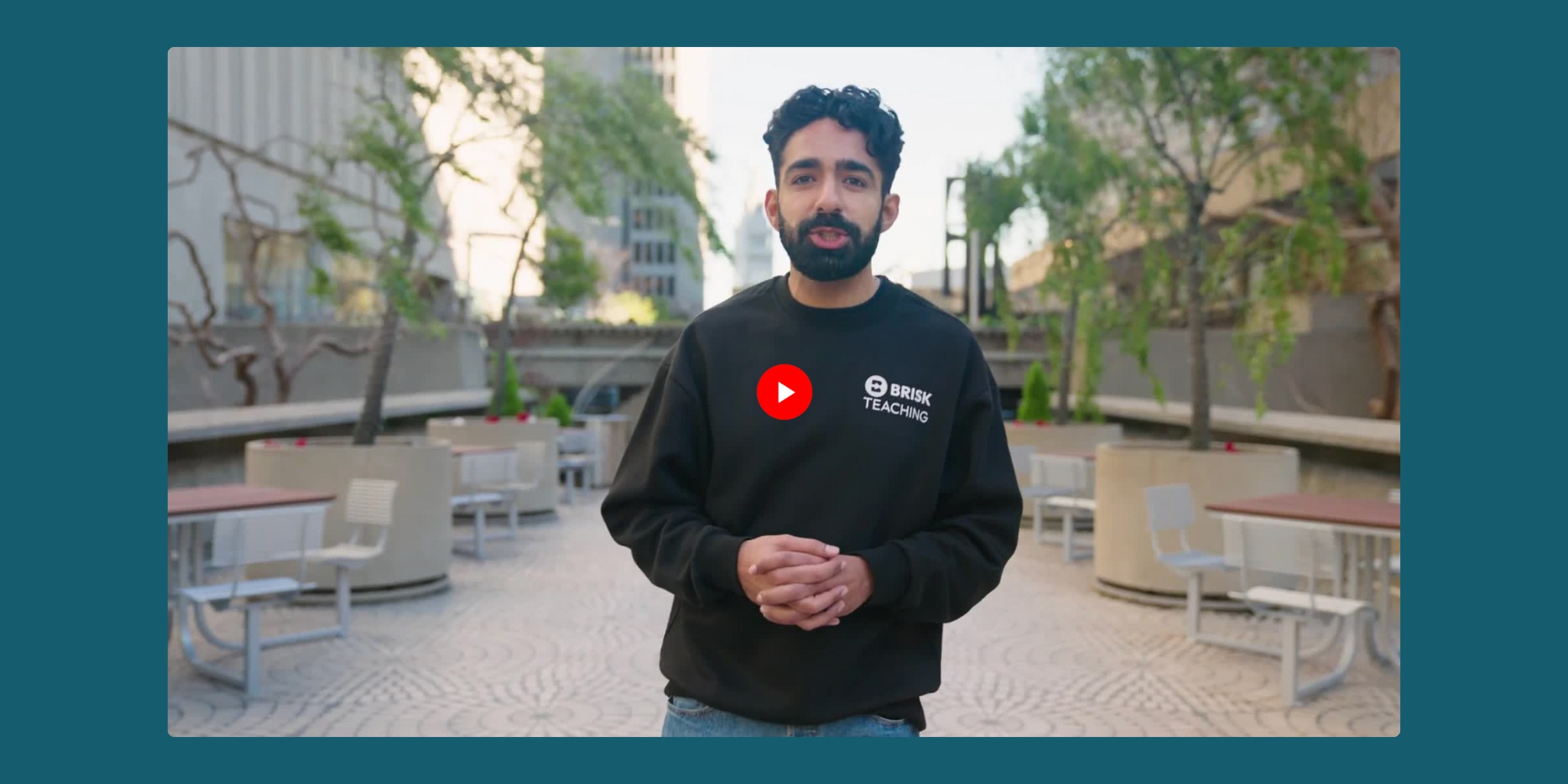
Arman Jaffer arrived at the 2023 ISTE education conference with a company to introduce and no money for a booth. His solution was to walk around handing out Brisk iced tea. Here was an artificial intelligence startup making its entrance through a beverage pun. The technology might have been new. Getting someone to stop for a drink was a fairly well-established interface.
At the conference, he met some of the company’s earliest users. Teachers were already talking about the tool on Facebook and Reddit. Before there was much of a marketing budget, there were people willing to tell other people that something useful had arrived.
That is a fitting opening for a founder whose consequential early decision was to abandon a piece of software he had already built. Jaffer wanted to put AI to work for teachers. Conversations with teachers persuaded him that his first delivery mechanism, a standalone web app, would add another destination to an already crowded working day. He started again.
A television education in public service
Long before Brisk, Jaffer had acquired an ambition from television. Growing up, he loved The West Wing and wanted to work in the White House. The fictional administration had a persuasive recruitment department. He eventually joined the real White House Office of the Chief Technology Officer, bringing a background in computer science and economics from the University of California, Berkeley.
His career also included work on Google’s mobile search team. At the White House, he worked on technology policy and initiatives involving the Department of Education. These were different vantage points on the same practical difficulty: a technological possibility has to find its way through institutions and into someone’s actual working life before it becomes useful.
Jaffer has said he has never been a classroom teacher. His understanding of the job developed through working alongside educators. That distinction matters to his story. The founder was learning about a profession whose routines, constraints and judgments belonged to other people. Listening would have to do work that personal classroom experience could not.
The document editor before the browser bubble
At the Chan Zuckerberg Initiative, Jaffer became a product manager on the education team and launched Notebooks, a digital environment for collaboration between teachers and students. The project concentrated his attention on feedback: how teachers respond to work, how students reflect on it and how a document can support that exchange.
He and another engineer pitched a classroom-focused document editor. The idea received funding, and he went on to lead the Notebooks team. He also learned from colleagues who had built technology at Facebook. It was an education in product development inside an organization with resources to pursue an exploratory idea.
Feedback offers a useful way into Jaffer’s later decisions. A teacher’s comment has a destination and a purpose. It refers to a particular passage, reaches a particular student and asks for some next step. Software can produce plausible sentences while still making that exchange cumbersome. The location of the comment matters almost as much as the words.
When he left CZI in 2022, Jaffer explored startup ideas rather than heading straight into another education company. He joined South Park Commons that summer and participated in its spring 2023 Founder Fellowship. Education drew him back. By then, language models had made the problem he knew look newly approachable.
“I’m an impatient person.”
Arman Jaffer, speaking about building Brisk
The first product had the wrong address
His initial web app offered a place for AI-assisted teacher work. But teachers’ existing work was happening elsewhere, across documents, articles, presentations and school systems. Each trip to a separate application required a little transportation: copy the material, explain the task, retrieve the result, return it to the right place.
Jaffer rebuilt Brisk as a Chrome extension and launched it in spring 2023. An extension could follow teachers through their existing applications. The choice made a browser’s architecture part of the company’s argument. A teacher should be able to act on the material already open, with less preparation required to get the software involved.
The difference becomes tangible in a Google document. Brisk’s feedback and writing tools connect AI assistance to work already underway. Inspect Writing lets teachers examine how a student’s document developed. The underlying interest is in the process of writing, alongside the finished submission.
Jaffer’s impatience, which he has cheerfully acknowledged, makes sense in this setting. Education software promises to save time, yet the steps needed to use it can consume time first. His design choice treated those steps as a problem worthy of engineering. A very small button could carry a rather large objection to the way software was being delivered.
A conceptual illustration of the workflow, not a measured comparison.
Teachers were the distribution plan
Jaffer encountered investors who doubted that teachers would adopt unfamiliar technology quickly. His experience suggested that teachers improvised constantly, often without products designed around their needs. The early conversations and the iced-tea conference tour put him in direct contact with the people who could test that belief.
By September 2024, Brisk announced a $5 million seed round led by Owl Ventures, bringing its funding to $6.9 million. It also introduced Brisk Boost, extending the product into AI-supported activities for students. The company was moving from helping prepare instruction toward participating in the instructional exchange itself.
Recognition followed. Jaffer appeared in the education category of Forbes’ 2025 30 Under 30 list. By March 2025, he was announcing more than a million educators across 100 countries and partnerships with over 2,000 schools. One of those schools was his own high school, a pleasingly circular customer reference.
Bessemer Venture Partners led a $15 million Series A that March. Its investment thesis emphasized the browser extension and a future classroom agent. For Jaffer, the money expanded what the team could attempt. It also made the question of what teachers and students received in return harder to leave abstract.
- 2023
- Brisk launches as a browser extension.
- 2025
- $15 million Series A led by Bessemer.
- 2026
- Jaffer reports more than 2 million teacher users.
Dated milestones. User figures are company-reported.
What should happen after the worksheet?
The company’s ambitions also complicated its original stance toward standalone software. Brisk Next, introduced in 2025, added a web application for planning, assignments and feedback. The founder who had discarded a web app now had a company offering one. The useful question was what work the new space could bring together.
By July 2026, Jaffer was describing a conversational redesign of the extension and reporting more than two million teachers using Brisk. Teachers could find tools by describing what they wanted, then refine a resource through conversation. The company offered access to the classic experience through the end of 2026, giving users time to adjust.
There is a recognizable continuity here. First, the problem was getting AI to the place where teachers worked. Then it was making the interaction less cumbersome once it arrived. An interface can accumulate menus as readily as a browser accumulates tabs. Even successful software has housekeeping to do.
A curriculum is more than a pile of content
In January 2026, Jaffer announced Curriculum Intelligence, aimed at grounding AI outputs in a district’s adopted materials, standards, sequence and pacing. The proposal addressed an awkward consequence of effortless generation: a worksheet can be well written and still be the wrong worksheet for Tuesday.
Districts had already made choices about what students should learn and when. Brisk’s announced approach sought to make those choices available to the AI, with spring pilots and availability planned for the 2026-27 school year. Preparing materials faster would have to coexist with keeping instruction coherent across classrooms.
This is a more demanding proposition than helping an individual produce something quickly. It asks software to understand the context around an assignment. Jaffer’s early insight about location now has an instructional counterpart: a resource needs to fit into the course around it, just as the tool needs to fit into the teacher’s day.
The question that outlasts the funding round
In an August 2026 essay, Jaffer described another change in emphasis. Brisk had commissioned a Whiteboard Advisors paper on measuring AI’s instructional impact. The company was looking beyond hours saved toward what it called Quality Instructional Moments: observable student interactions connected to learning science and made more feasible through AI.
The distinction puts pressure on his own pitch. Saving preparation time is useful. Whether that time supports better feedback, more appropriate practice or a more responsive lesson is a further question. Counting generated resources cannot answer it by itself. The founder’s stated ambition increasingly requires evidence about what follows generation.
Jaffer began with a practical complaint about extra destinations. His subsequent work keeps returning to the distance between producing software and helping someone teach. There are now investors, district leaders, student activities and curriculum plans in that story. Its most revealing moment may still be the early one: he listened to teachers, looked at his first product and decided to begin again.