Ari Naim looked at a dinosaur. His four-year-old son looked at something else. When Naim turned back, the boy had disappeared into the Museum of Natural History. There were two directions to choose from. He chose one, without success. Ten or fifteen minutes later he found his son studying an exhibit, evidently having enjoyed a rather less eventful interval than his father.
The episode became part of Naim’s explanation for a child-monitoring product developed by his company, Remote Play. For an engineer accustomed to making portable electronics, the experience presented an unusually sharp design brief. A parent ought to know when the distance between two people has become uncomfortable. Preferably before a museum visit turns into a search operation.
That small question - where is it, and how far away? - runs through a substantial part of his working life. Naim co-founded CenTrak in 2003. He also worked on digital audio devices, wireless tags and ways to navigate collections of music. Across these projects, the interesting action happens between the physical object and the information someone needs about it.
Before the tag, a voice in a box
In 1993, Naim founded Sycom Technologies, later called Digital 5. Its early products included digital voice recorders and software for transferring recorded speech into computer audio files. The Total Recall products started at $99. Recording a voice was only half the proposition; getting the recording somewhere useful completed the job.
Another application turned web pages into recordings for car radios. Consider the domestic ambition of that idea: the internet, still associated with a computer on a desk, could accompany a driver. Long before every screen and speaker seemed to demand an account, Naim was working on moving material between devices.
By 2004, Digital 5 supplied software and system intellectual property for networked consumer electronics, and Naim held a board seat. The company’s work included sharing downloaded music and pictures among computers, DVD players and television displays. The living room had acquired enough electronics to require its own diplomatic service. Making the devices cooperate was a business.
A portable player has to survive being portable
One of Naim’s inventions bears a wonderfully plain title: “Hard disk based portable device.” The patent names Ari B. Naim as inventor and Digital5 as the original assignee. Filed in November 1999 and granted in February 2004, it describes a portable player using a hard disk alongside memory.
The engineering concern is practical. A hard disk holds a collection, but a handheld player must manage power and the interruptions that movement can cause. The patent describes buffering data so that playback can continue while the disk is inactive. A listener wants a song; the machine must arrange storage, power and continuity without making the listener responsible for the arrangements.
Here is a useful way to read an inventor’s career: follow the inconveniences. A recording needs transferring. A collection needs carrying. A portable device needs to keep working while it moves. The titles can sound dry, but the objects are headed for pockets, cars and people with considerably more interesting things to do than supervise a circuit.
The little bodyguard
Remote Play’s Tag Alert carried that thinking into the business of leaving things behind. In 2006, Naim described thin tags attached to valuables and a monitor carried as a key fob or clipped to clothing. Once an item moved beyond the chosen range, the monitor sounded an alert.
The promise depended on timing. Discovering a missing phone after several hours means reconstructing a day. A warning while it is still nearby gives its owner a much shorter assignment. Naim called the continuously operating tag “a little bodyguard.” It is a pleasing job description for something expected to spend its working life stuck to a possession.
The design also depended on avoiding another chore. The battery could run for months, so the owner would not have to remember to switch the device on and off. A reminder that requires constant reminding has a rather limited future. In this version of consumer electronics, convenience begins with what the customer can stop thinking about.
“It’s a little bodyguard.”
Ari Naim on Tag Alert · 2006
Four founders, one exacting question
CenTrak brought Naim together with Israel Amir, Gideon Naim and Karups Annamalai. The collaboration carried engineering into a company built around real-time location. Ari and Gideon were brothers as well as co-founders; Amir was another Drexel alumnus. The enterprise was a collective undertaking, with familiar relationships inside it.
Naim’s own Drexel education crossed disciplines. He earned a bachelor’s degree in chemical engineering in 1987, followed by a master’s in 1989 and a doctorate in 1992 in electrical engineering. He also served as chairman of the IEEE Philadelphia Section’s Communications and Information Theory group. The career joins product making to a substantial technical education.
In February 2016, Halma announced its acquisition of CenTrak for $140 million in cash consideration, subject to a net-asset adjustment. The price belongs to the company transaction. For Naim’s story, the more interesting point is that a business founded around a technical capability had grown into something another group wanted to own and support.
Cash consideration announced for Halma’s acquisition of CenTrak, subject to a net-asset adjustment.
The battery is part of the business model
By 2018, CenTrak’s location technology was being piloted through partners in shops, restaurants, hospitality and other commercial settings. Bluetooth Low Energy beacons helped extend the possibilities. A building could offer navigation; an office could understand how rooms were used; a site could add more precise location functions as its needs developed.
Naim’s comments about these deployments had an unromantic emphasis: upkeep. A beacon can lose power. A large building can contain enough beacons that checking each one becomes a job in itself. His argument was that the system needed support, management and maintenance, including visibility into which devices required attention.
This is the point in a technology story where the demonstration gives way to Tuesday afternoon. Someone has to replace a battery. Someone has to know which battery. A persuasive prototype can hide that labor for an hour; a working installation must account for it. Naim’s attention to the problem connects his earlier pocket devices with the demands of a larger network.
Back to Drexel, with something to plug in
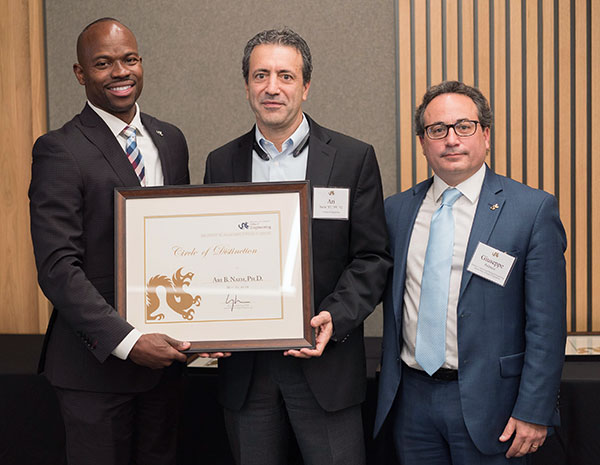
In May 2018, Drexel inducted Naim into its College of Engineering’s Circle of Distinction. The ceremony put him between Provost Brian Blake and Interim Dean Giuseppe Palmese, holding a framed certificate. After years of making small devices, here was one object that could be located without wireless assistance.
There was a more hands-on expression of the university connection, too. CenTrak donated location equipment for Drexel’s Innovation Studio and for asset management in laboratory and workshop settings. A volunteer team, including Gideon Naim, installed the equipment. First-year design projects were among its intended uses, with possibilities for graduate work on beacon technologies.
“Inspiring young talent to be future leaders in technology and innovation is key,” Naim said. The donation gave that statement a material form. Students could encounter a working system, decide what to do with it and discover its constraints. An alumnus can return with advice, a cheque or an award speech. Equipment offers a different invitation: make something.
A family story escapes the short-film brief
Naim’s work with his brother also reached a different kind of production. Both are credited as executive producers of “Exodus 91,” directed by Micah Smith. The film concerns their father, Israeli diplomat Asher Naim, and the negotiations surrounding Operation Solomon, the 1991 airlift of Ethiopian Jews to Israel.
Ari was born in Nairobi, Kenya, during his father’s diplomatic career. His mother, Hilda, came from Boston. As an adult living in Tenafly, New Jersey, he helped bring a piece of that family history to the screen. He and Gideon had initially imagined a film of ten or fifteen minutes. The project grew into a feature.
The finished film combines narrative scenes, archival material and interviews, and deliberately plays with the boundary between reconstruction and documentary. Its official description places questions of identity, immigration and representation alongside the diplomatic story. A family legacy had become a work with room for other people’s perspectives.
That choice deserves space in a profile of an engineer. A location system is valuable when its answer is dependable. A film can be valuable when it leaves the viewer with questions. Naim’s credits include both kinds of undertaking. The brothers also offered matching support for an OpenDor Media campaign to bring the film to wider audiences and support accompanying educational resources.
- 1993Recorded voicesSycom Technologies
- 2003Located objectsCenTrak co-founded
- 2018Back on campusCircle of Distinction
- 2022Preserved a storyExodus 91 film credit
Enough room to keep building
In August 2020, David Minning succeeded Naim as CenTrak’s president and CEO. At the time, Naim was to continue as non-executive chairman. The change separated the founding chapter from day-to-day leadership without pretending that every founder’s useful work must end with an executive title.
A decade after the acquisition, Halma’s 2026 annual report returned to Naim’s account of joining the group. His emphasis was on access to resources a smaller company would struggle to provide for itself, leaving more attention for technology and the value offered to customers. The purchase had an operating logic beyond its announcement-day price.
The distance from a digital recorder to a film credit looks considerable on a résumé. Seen through the actual projects, the route is easier to follow: build a useful object, make information accessible, help another generation work with it, give a family story a public life. The museum boy was found looking at an exhibit. His father kept finding things to make.