A customer complaint is a small thing until it has to travel. Someone records it. Someone assigns it. Someone checks whether the technician arrived. At each transfer, information can stall. In AQe Digital’s account of its work for Citizen Industries, a Daikin Group company, requests were scattered across spreadsheets and isolated tools. The difficulty was keeping a service operation informed about itself.
- AQe builds custom software and connects existing business systems.
- Its own products tackle care staffing, factory schedules, reading and online commerce.
- The practical starting point: find the handoff where work stops moving.
AQe built a centralized complaint platform, with automatic assignment, escalation and live status updates. The company reports 40% faster complaint resolution and 50% fewer data errors. Those are vendor-reported results, rather than a controlled experiment. Still, the intervention is unusually legible. A complaint acquired a route, an owner and a visible status. Digital transformation, for once, fits inside a sentence.
The business hiding in the handoff
AQe Digital, formerly AQe Group, sells the engineering required to make those routes work. Its offer includes product development, cloud systems, AI and analytics, enterprise integration and modernization. Buyers can commission an application, extend an engineering team or connect tools they already own. The unglamorous work includes permissions, data synchronization, testing and deciding what happens when a process goes wrong.
Its market spans SMEs, startups, agencies and enterprises. Published testimonials include HDFC ERGO, Columbia Books & Information Services and XKGLOW. A testimonial attributed to ePublishing’s president and CTO, Trey Connell, describes an RFP involving more than ten companies and a development engagement lasting over two years. That is a useful clue to the business model: prolonged participation in someone else’s operations.
“AQe Digital is part of our secret weapon.”Duncen Bell, Columbia Books & Information Services
Customer testimonial published by AQe Digital
For a buyer, the appeal is continuity. The team building the application can remain involved as requirements change. The corresponding obligation is to define ownership carefully: who controls the code, who maintains integrations and who responds when an upstream service changes? A finished interface answers only part of that contract.
- 01RecordOne shared case
- 02RouteA named owner
- 03EscalateAn exception path
- 04MeasureTime to resolution
Twelve brands meet one problem
The unusual feature of AQe is its breadth. Alongside software, its portfolio includes architectural drafting, building information modeling, 3D visualization, creative services and publishing production. A building model and a journal manuscript seem like distant relatives. Both pass between specialists, formats and approval stages. Coordinating those transfers gives the group a recognizable operational theme.
AQe’s corporate history dates its beginnings to two computers in 1997. A historical Ace Infoway founder interview records incorporation in 1999. Its timeline describes acquisitions of a US design firm and a Chennai civil engineering firm in 2008, followed by the Qe digital-commerce division in 2014. In 2024, twelve brands came together under AQe Digital.
That consolidation makes commercial sense if a client can move between specialties without assembling a new supplier network. It also creates a test: can the provider coordinate its own teams as effectively as it promises to coordinate the customer’s systems? The range is a potential advantage when projects cross disciplines. For a tightly bounded assignment, a specialist agency remains a sensible alternative.

What a calendar knows
RotaWiz makes the company’s product ambitions tangible. Built for Australian NDIS providers, it combines rostering with care plans, incident reporting, invoicing, availability and Xero integration. Its scheduler displays recurring work, open shifts and employee availability together. The product addresses a particular coordination problem: matching care commitments with people, time and the paperwork that follows.
That specificity matters. A calendar can display an appointment without understanding a care business. RotaWiz adds the surrounding operational records. SmartPPS applies a related idea to manufacturing, combining production scheduling, capacity planning, machine utilization and ERP integration. Calrik handles appointment booking, calendar synchronization, reminders and time zones. Each product packages a recurring task that otherwise invites manual coordination.
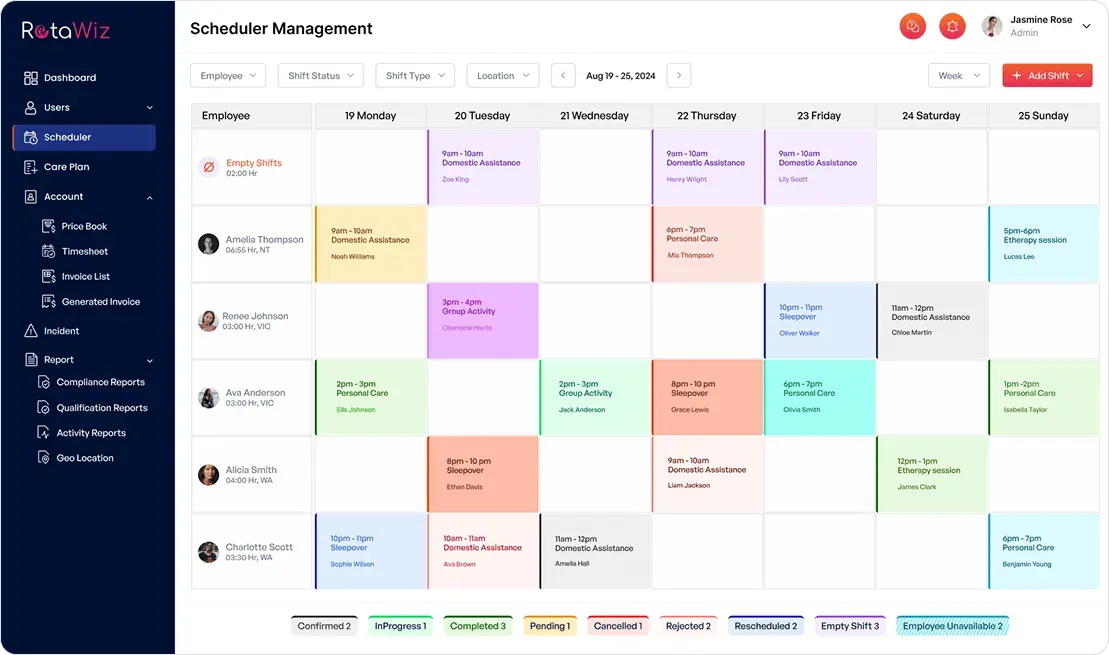
The portfolio also includes GroBro.AI, a children’s reading program with assessments, adaptive pathways and a monthly GroBox, and QQQe, a Shopify analysis tool that prioritizes store issues and recommends actions. These extend AQe beyond selling development capacity. They give buyers something more defined to evaluate: a particular workflow, a feature set and a product demonstration.
Before the intelligence, the plumbing
In its EV charging case study, AQe describes a US operator constrained by disconnected hardware, static sessions and third-party platform dependencies. The response combined Open Charge Point Protocol integration, an event-driven architecture, proprietary software and centralized monitoring. Machine learning sat within that system. The stated reasons for changing direction were control, interoperability and the friction of scaling manual operations.
The pattern appears elsewhere. An Austrian logistics engagement connected fleet information, routing and maintenance. A UAE telemedicine project used Salesforce to connect patient management and scheduling. An antiques marketplace required support for more than 1.4 million listings, alongside transactions, subscriptions and content. Different industries; familiar difficulties getting records and actions to stay aligned.
In April 2026, AQe announced a healthcare workforce platform with voice automation, workflow coordination and human escalation. It also announced expanded Gulf operations and QeMatic workflow extensions. These moves carry the same proposition into new settings. The buyer’s question remains concrete: which task changes, who handles exceptions and what measurable result justifies the continuing expense?
Copy the first move
The useful lesson is to choose one journey before expanding the technology brief. Follow a complaint, a shift or an order. Establish where its record lives, who owns the next action and when an exception reaches a person. Measure completion time and errors before changing the process. Then judge the result against that baseline.
This approach depends on access to usable records, cooperation between teams and someone responsible for maintenance. A business with a straightforward booking need may be better served by existing software. AQe fits where operational complexity makes integration worth paying for. Its most persuasive work gives that complexity a visible route through the business, one handoff at a time.