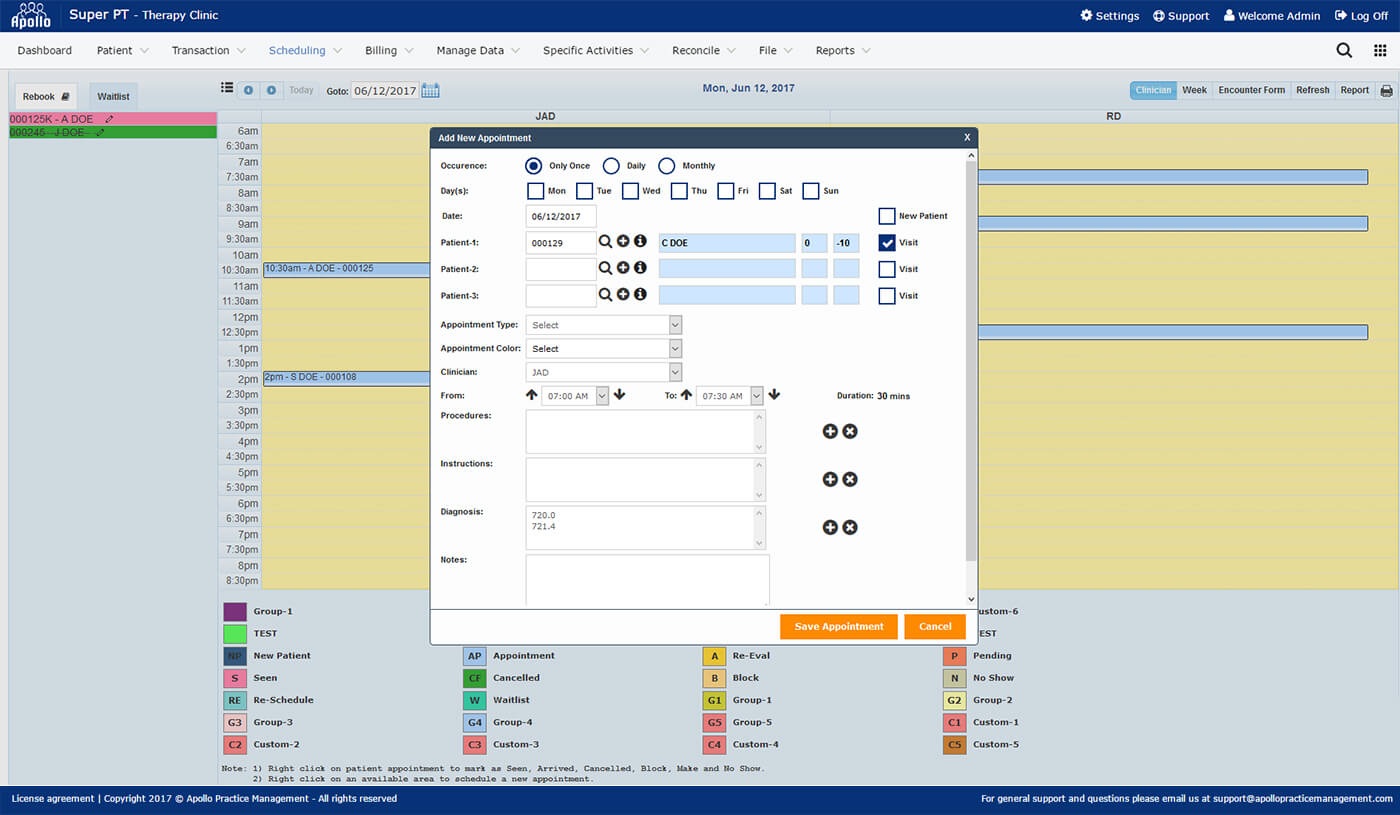
There is a peculiar kind of missing patient in a physical therapy practice. The person has not been discharged. But there is no next appointment. Look at tomorrow’s calendar and the name is absent. Look at a list of completed treatments and the story is unfinished. Apollo Practice Management gives this person a place on the screen: the rebook column.
- Scheduling, clinical notes, billing, and reporting share one platform.
- The rebook column makes patients awaiting another appointment visible.
- Monthly plans start at $108; staff accounts and additional locations are included.
The column sits beside the schedule. Apollo’s description is wonderfully specific: a patient belongs there when there is neither a scheduled appointment nor a discharge date. It is a small answer to a familiar organizational problem. Work becomes easier to forget when it stops appearing in the place people check.
That detail explains Apollo more clearly than the phrase “practice management.” The company sells software for physical therapy clinics. Its subject, though, is the space between tasks: the appointment that needs rebooking, the visit that needs a charge, the payment adjustment that needs another look.
A business problem with a clinical address
Randy Porter founded Apollo in 2007. The company’s origin account begins with a complaint about multiple software programs that did not work well together. Porter brought a background in business management, medical consulting, and physical therapy billing. The problem he chose was administrative, but the consequences played out inside working clinics.
Clinical input came from Danielle Vittone, identified in Apollo’s account as the owner and director of Western Massachusetts Physical Therapy and a physical therapy educator at The Sage Colleges. That contribution matters. A billing specialist and a treating clinician encounter the same patient through different obligations. Useful practice software has to accommodate both.
Apollo says the system was rolled out to facilities in the Eastern United States. An October 2013 announcement described its cloud-based offering. The basic proposition remains recognizable: use a browser to manage the practice, with scheduling, documentation, billing, and reports available together.
Three records of the same visit
Consider a completed appointment. Clinically, it produces a note. Operationally, it occupies a slot in a therapist’s day. Financially, it may produce a charge and an insurance claim. These are different records of the same event. When they disagree, somebody has to reconstruct what happened.
Apollo lets a clinic customize SOAP notes - Subjective, Objective, Assessment, and Plan - with its own sections and templates. Its documentation tools include charge entry inside the note, connecting clinical work to billing. Scanned documents and patient records can also be kept together. The objective is fewer occasions to enter information again.
- 01ScheduleBook and rebook
- 02DocumentRecord the care
- 03BillCapture the charge
- 04ReviewFind loose ends
The billing tools cover patient invoices, insurance claims, payment posting, and overpayments. A cash-paying patient can leave with a receipt; a payment covering more than one visit can be recorded as an overpayment. These are ordinary situations that become irritating when a system assumes every transaction follows the same path.
The reporting side asks whether the pieces match. Apollo describes a scheduling-versus-transaction report that catches patients seen without corresponding charges, as well as charges without a scheduling entry. Its reporting page also advertises more than 400 predefined reports, including missed appointments and aged receivables. The interesting number is whichever report exposes something a clinic needs to act on today.
In a July 2025 article, Apollo describes its Reconcile log as tracking entries, edits, and deletions since the previous reconciliation. It recommends reviewing the log at least daily. The practical lesson travels beyond healthcare: if several people can change a financial record, make those changes inspectable.
The front desk gets a login
Apollo charges by practitioner band. Its published Single plan is $108 a month for one practitioner; Team is $228 for two to five. The plans include scheduling, billing, and EMR, with unlimited non-practitioner accounts. Multiple locations and technical support are included too.
Team plan · 2-5 practitioners
500 texts + 500 faxes per month
That makes staff access a consequential part of the offer. The receptionist, biller, and practice owner all need to work on the same administrative chain. A charge for each additional login could complicate that arrangement. Apollo’s distinction is between practitioner capacity and supporting users.
Communications have limits: Single includes 100 texts and 100 faxes monthly; Team includes 500 of each. Those allowances deserve attention alongside the subscription price. The company advertises monthly service without a long-term commitment. A clinic comparing offers should compare the plan it would actually use.
The awkward cases belong in the demo
Apollo competes in a field that includes WebPT, Fusion, SPRY, and other therapy platforms. Its appeal rests on the combination of clinic-specific details, customizable documentation, and included staff access. Those features give a buyer concrete things to test against an existing workflow.
The customer accounts contain useful friction. In a testimonial published by Apollo, Orthopaedics Plus office manager Scott Shore describes early problems and developers responding to feedback. He says his favorable usability rating followed changes in the product. It is a customer’s experience, rather than a promise about every installation.
“My 5-star rating for ease of use was not always the case.”
Scott Shore, Orthopaedics Plus
Customer testimonial published by Apollo
There is also room for a clinic that likes its current documentation software. Apollo’s March 2025 integration guidance describes retaining an external SOAP system and connecting it to Apollo billing and reporting through HL7. That is a practical concession to established habits. The specific connection still needs checking.
Likewise, migration depends on what the old system can supply. Apollo’s September 2026 guide offers free migration from many popular systems and explicitly includes reviewing requirements, verifying transferred information, and training staff. A browser-based service also depends on an internet connection. These conditions belong in the buying decision.
The idea a reader can borrow is modest: find the unfinished work, give it a visible place, and assign someone to look. For Apollo, that can begin with a patient who needs another appointment. The column is small. The obligation it remembers is not.