Anuj Sachdeva’s first response to an Inc. 5000 application was admirably short: “sure, let’s apply”. His team had brought him the idea; he agreed, then put it out of his mind. A few months later, the email arrived. Clovity had made the list on its first attempt. The founder who had barely paused over the application found himself unexpectedly moved by the result.
He recalled the episode in September 2024, when Clovity was marking its fourth consecutive appearance. The detail is more revealing than the trophy cabinet. A company can accumulate awards while its founder accumulates speeches. Sachdeva remembered the team bringing him a form, and the pleasure of seeing their work acknowledged. There is something rather agreeable about ambition catching its owner by surprise.
By 2026, the sequence had reached six appearances, running from 2021 through 2026. Yet the more interesting development was taking place beneath the annual announcements. Sachdeva, Clovity’s founder and chief executive, was leading a business whose public identity had moved from connecting devices to reorganizing how institutions work. Sensors, cloud platforms, service desks and government workflows make an unlikely dinner party. In his career, they keep finding themselves at the same table.
2021–2026
enterprise award
Atlassian partner award
Before the workflow, there was the wire
The earlier Clovity story concerned a practical difficulty: getting information out of connected devices and into systems where someone could use it. A sensor might report a condition. A gateway might carry the message. A cloud platform might store it. An enterprise application still had to make sense of it. Every handover offered another opportunity for complexity to acquire a committee.
In 2019, Sachdeva was discussing CSensorNet, Clovity’s framework for connecting devices, cloud infrastructure and enterprise systems. Its stated emphasis included integration and encryption from the edge to the cloud. Clovity worked with hardware, connectivity and technology partners, including Microsoft, Advantech, Dispersive Technologies and Sigfox. The underlying proposition was to make a collection of separate components behave like a usable system.
That December, Clovity announced another release of CSensorNet, alongside hardware and software bundles and an IoT-as-a-service pricing approach. Smart cities, energy and industrial applications were among the intended uses. The bundling mattered to the business argument: customers were being offered a way to assemble deployment components together, rather than conducting a small diplomatic mission between every supplier themselves.
In 2020, the IoT Breakthrough Awards named Clovity Emerging Company of the Year for the enterprise market. This was recognition for the company and its platform, rather than a personal decoration for Sachdeva. His response emphasized the team’s work and the partner ecosystem. Even then, the public language around his business repeatedly returned to the relationships required to make technology useful.
Getting the parts to work together
A conceptual view of the integration problem running through Clovity’s work, from CSensorNet to enterprise service management.
An application he almost forgot
The Inc. 5000 episode gives this technical history a more personal scale. Sachdeva did not describe a grand campaign for the first listing. The suggestion came from his colleagues. Only after the result arrived did the significance settle in. In his recollection, the satisfaction came partly from knowing the team’s sustained effort had become visible beyond the company.
By the fourth appearance, he was writing about the need to adapt as conditions changed. He described employees finding different ways to serve clients, developing capabilities and entering markets. His account also connected growth with diversity and inclusion, reflecting Clovity’s identity as a minority-owned business. These were priorities he chose to put alongside the financial recognition.
The rankings themselves deserve a little precision. Clovity entered at No. 1,240 in 2021; its 2026 position was No. 3,662, with 73 percent three-year growth listed for that edition. Six appearances mean continued inclusion in a growth ranking. They do not describe an uninterrupted climb toward No. 1. Business is already demanding enough without obliging every chart to resemble a ski lift.
For Sachdeva, the repeated appearances have become part of how he talks about expectations. His later public comments present sustained performance as something the company intends to keep delivering. The change in tone is noticeable: the first result pleasantly surprised him; the subsequent sequence became a standard against which he wanted the organization to measure itself.
Government work brings its own manners
Clovity’s current business puts Atlassian services much closer to the foreground. Its partner directory entry identifies it as a Platinum Solution Partner, with specializations in cloud migration and service management. Jira, Confluence and Jira Service Management sit at the center of that work. Here the connections run among teams, requests, documents and permissions, as much as among machines.
A government customer makes the consequences of those connections particularly clear. Modernization has to accommodate continuity, security and compliance. Moving information is only part of a migration; existing workflows, identities, integrations and access rules need attention as well. Sachdeva’s public discussions increasingly occupy this less theatrical territory, where an orderly transition is a very respectable achievement.
In January 2026, he appeared in the Ascend to Cloud session with Matthew Graviss, Atlassian’s public sector chief technology officer, and Michael Allen, New York State Department of Labor’s deputy commissioner for technology. The subject was moving beyond aging data center environments toward secure cloud platforms while keeping operations running. It placed the supplier’s chief executive in a conversation with both a platform leader and a government technology practitioner.
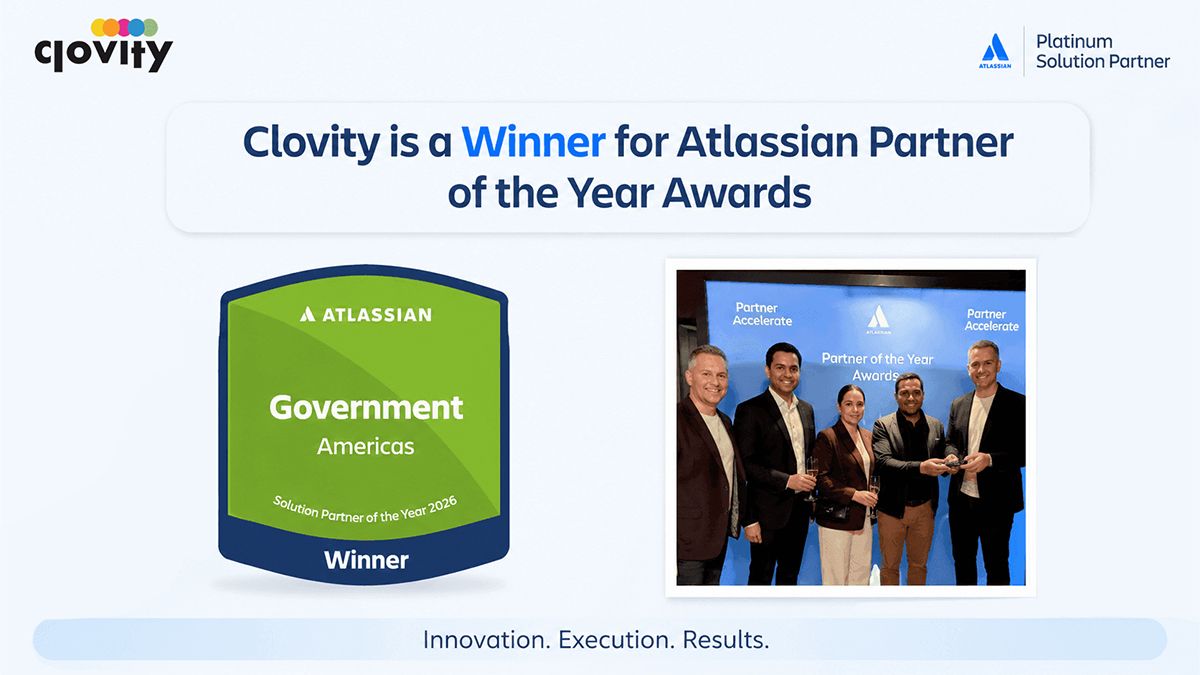
Clovity announced the Government Americas category of Atlassian’s 2026 Partner of the Year awards in May. Its account described work across federal and state, local and education organizations, including expanded Atlassian adoption at the IRS and service modernization at Metra. The examples explain the direction of the company more clearly than a general promise to transform everything in sight.
A passport for the process business
Geography is another part of the story. Clovity’s July 2024 announcement paired entry into Japan with expanded services in the United Kingdom. Sachdeva described Japan as an opportunity to apply AI to business operations in an established technology market. The proposal included practical applications such as predictive maintenance in manufacturing and analytics for retail supply chains.
Those examples are useful because they make the aspiration testable. A maintenance model has to help someone decide when equipment needs attention. Supply chain analytics have to inform decisions about goods and movement. Sachdeva was presenting AI through business tasks with identifiable users and purposes. The adjective may be fashionable; the customer still expects the machinery to turn up for work.
The global footprint is also visible in Atlassian’s directory, which lists London and Tokyo among the additional locations Clovity serves. Sachdeva himself is based in Dublin, California, in the San Francisco Bay Area. His public professional record also includes an earlier senior vice president role at Nexient. That background adds an enterprise services chapter to a profile now associated with founding and running Clovity.
International expansion changes the demands on a founder. The company’s own description combines US leadership with global delivery. For a services business, that makes coordination part of the product customers experience: who understands the requirement, who implements it and who remains available afterward. The integration theme follows Sachdeva out of the technology diagram and into the organization chart.
The people around the platform
In January 2026, Clovity added former CoreTrust chief executive Mahesh Shah as an operating advisor. The remit included commercial execution, AI-enabled Atlassian solutions and scaling the company’s operating model. Sachdeva highlighted Shah’s experience across engineering and bringing products to market. The appointment put an experienced outside executive beside the leadership team as the company pursued its next stage.
Other recurring collaborators make the work more tangible. Sachdeva joined Clovity’s Cameron Starman and Atlassian’s Dave Rheaume for a higher education service management podcast published in November 2025. Their subject extended beyond a conventional IT help desk to facilities, human resources, legal and research operations. It is the sort of conversation in which a campus starts to look like a network of interdependent services.
There is a personal thread in how he describes these connections. Reflecting publicly on an East Coast trip with Clovity’s leadership team in 2026, he emphasized face-to-face conversations with customers, Atlassian and Carahsoft. The memorable part, in his telling, was the exchange of ideas and the strengthening of relationships. For someone selling cloud expertise, he retains an evident professional appreciation for being in the room.
“The challenges we face will continue to evolve, and so must we.”
Anuj Sachdeva · September 2024
The form, the team, the next decision
Sachdeva’s stated ambitions now include agentic AI, cloud migration and modern enterprise service delivery. Clovity also builds Marketplace applications, adding software products to the services conversation. These plans remain plans until customers put them to use; their interest lies in how closely they sit beside the integration problems the company was already discussing in its connected-device years.
The founder’s public story is therefore best followed through decisions: supporting a platform, cultivating partners, entering markets, adding experienced leadership. The Inc. 5000 application supplies a pleasingly modest opening to that sequence. Someone on the team suggested trying. He said yes. Recognition followed, and then came the obligation to keep earning the attention.
It is a useful scene to remember amid the awards and acronyms. Before the announcement, there was a form. Before the form, there were people doing the work. Sachdeva’s most human recollection begins when he realizes quite how much it matters to see them recognized.