Amit Goel went into The Narrows with a plan. The river had some amendments. In his account of the hike, published in July 2026, the Droisys co-founder and CEO described expecting heat, transport delays and a journey of roughly three to four miles into the canyon. Conditions proved more accommodating. He kept going, eventually reporting more than eight miles.
Then came the less accommodating details: slippery rocks, uncertain footing and stretches of water that reached his chest. An executive can revise a forecast from a chair. Revising it while standing in a river has the advantage of immediate feedback.
The appealing detail is the hiking pole. Goel used it to check the ground before committing his weight. For a technology executive, it makes a useful image: the equipment helps, while responsibility for the next move remains with the person holding it. Keep that distinction in mind. It follows him back to work.

A company old enough to have a past
Droisys dates to 2003. Goel’s MBA came from San Francisco State University, where his studies ran from 2001 to 2003. His business career has therefore unfolded over a period long enough for yesterday’s new technology to become somebody else’s modernization project. That is an occupational hazard of staying in software.
The company works on software development and digital transformation, serving established organizations as well as startups. Its work includes integrating applications, designing interfaces and turning emerging technologies into usable systems. Goel’s business is located in the gap between a promising idea and something a customer can actually operate.
There is a paper trail for the company’s longevity. Its Inc. profile records eleven Inc. 5000 appearances, beginning in 2008 and extending to 2023. The 2010 entry was No. 1,092; the 2023 entry was No. 4,948. These are separate annual rankings, rather than a smooth growth curve. They mark repeated appearances across different business years.
An anniversary measures elapsed time. A sequence like that supplies dates at which a business was still moving. For a founder, there is considerable work hidden between those entries: keeping an organization useful while the problems customers bring to it change.
The unglamorous job description
Goel’s operational responsibilities are unusually concrete. His NIET advisory biography describes managing employee matters, internal systems and business processes. It also identifies customer relationships, workforce planning, employee development and retention among his areas of work. The list has fewer fireworks than the average technology pitch. It has rather more people.
One stated responsibility is making sure members of the organization understand the corporate vision and their own role in it. That sounds straightforward until a company must carry the same meaning across clients, disciplines and locations. A plan can be perfectly clear in the room where it was written and become surprisingly foggy on the way to everybody else.
Droisys’s leadership spans technology and business functions. Sanjiv Goyal is president; Dean Lane is CIO. Other leaders cover information systems, gaming, finance and professional services. Goel occupies the CEO role within that group. The company’s work draws on strategy, programming, design and engineering, giving coordination a practical purpose.
Consider what those disciplines ask of one another. A design needs to survive implementation. A technical choice must fit a business requirement. A customer needs someone to explain what will happen next. This is where operations earns its keep, in the handoffs that an organization chart can name but cannot perform.
An office with a verb in it
In September 2021, Droisys announced a larger Las Vegas Technovation Center. The name carried its own ambition: innovation was supposed to happen there, rather than simply appear on the stationery. The company said the new premises were 400 percent larger than the previous office and reported a 200 percent increase in its local team during the preceding year.
Those figures described the Las Vegas operation at that moment. They were accompanied by a plain explanation from Goel: “Solving client problems with technology is our mission.” The center, he said, was about taking concepts through to execution.
President Sanjiv Goyal connected the Las Vegas presence to serving customers in consumer packaged goods and gaming. The location consequently had a commercial reason as well as an address. For Goel, the announcement made his operating responsibilities tangible: a growing team, more space and customer problems close enough to keep the work specific.
Calling a room an innovation center is easy. Filling it with work that somebody needs is the more demanding part. Goel’s own explanation placed the emphasis on the customer problem, giving the building a job to do.
“Solving client problems with technology is our mission.”
Amit Goel · Las Vegas center announcement, 2021
A photograph, then the homework
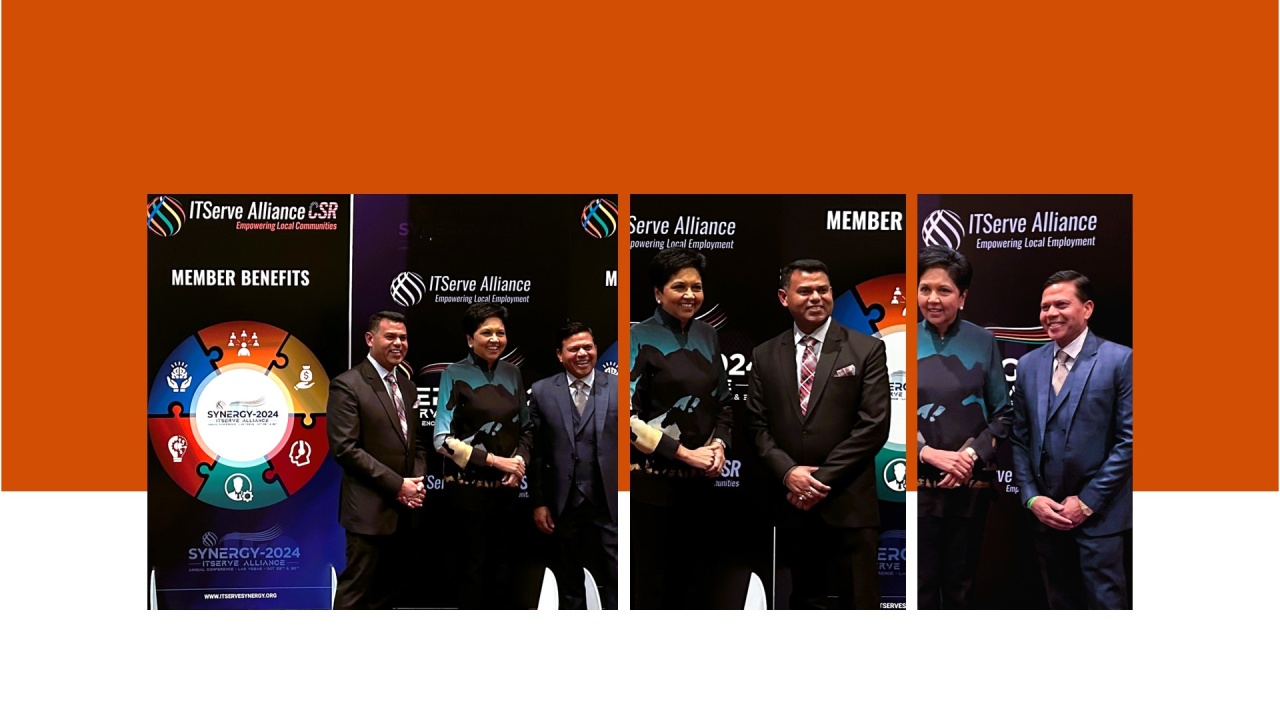
Las Vegas appears again in Goel’s story in 2024, this time at ITServe Synergy. He attended Indra Nooyi’s keynote and later wrote about what he wanted to carry away from it. The accompanying photographs preserve the conference encounter. His reflection supplies the homework.
He singled out adaptability, decisions guided by purpose, empathy, inclusion and collaboration. His stated ambition was to apply those ideas in both his career and his personal development. The emphasis on learning is useful: a CEO title settles a reporting line, while leaving plenty of room for its holder to be a student.
Goel’s response also extended beyond admiration for a celebrated speaker. He connected inclusive workplaces to innovation and collaborative relationships to professional growth. These were the parts he chose to discuss, giving his own account a clearer center than a ceremonial thank-you.
A conference photograph records who stood beside whom. What follows the photograph is harder to frame. Goel described a commitment to becoming more adaptable and more attentive to others. That is a declared aim, with the ordinary difficulty that aims require another decision tomorrow.
Closing remarks before the dancing
At the Indo-American Community Federation’s March 2024 anniversary dinner in Milpitas, the program assigned closing remarks to Amit Goel, president. Next on the schedule came music and dancing. It is a nicely literal illustration of a public role: say what needs saying, then give the room back to the people.
The event marked the organization’s thirtieth anniversary and centered education within its theme of unity through diversity. Its board included Goel alongside founder Jeevan Zutshi and other community leaders. The federation brings people from different backgrounds into contact through meetings, cultural exchanges and public gatherings.
By July 2026, Goel was among the directors organizing another gathering, this one in Fremont for the United States’ 250th anniversary. The program brought elected officials and community leaders together for a discussion of the country’s past, present and future. Immigration, education and civic participation were among the subjects addressed.
The difference in setting is worth keeping: here the people gathering have different public responsibilities, constituencies and experiences. A company can set an agenda through management. A community organization has to persuade people that sharing the room is worth their time. Goel has held responsibilities in both settings.
The classroom is part of the work
Education runs through his commitments with dates and duties attached. Goel has served on an Ohlone College advisory committee concerned with business management and computer applications curricula. He also served as an adviser to Noida Institute of Engineering & Technology, which maintains a biography describing his operational experience.
His wider volunteer record includes the CIO Scholarship Fund and the Bay Area chapter of Pratham Education Foundation. Together, these roles put an additional set of institutions beside the company in his working life: a college, a technical institute, a scholarship organization and an education nonprofit.
Curriculum work is a particularly concrete way for an employer’s experience to meet a student’s future. There are courses to consider and staff to work with. The value of such participation lies in the subject under discussion, rather than in the mere existence of an advisory title.
For a profile of a software CEO, these commitments widen the frame. The people who will eventually build and operate technology first need places to learn. Goel’s record includes participation in that earlier stage of the journey, before a project becomes a product or a candidate becomes a colleague.
The next problem has an address, too
In April 2025, Goel posted from São Paulo about participating in Trade Winds: The Americas. He described seeking partnerships, meeting international business leaders and exploring opportunities for growth. The dates were specific, April 7 to 9; so was the intention to connect with people beyond his existing business setting.
In September 2026, Droisys announced a gaming platform bringing together its casino and sports betting technology practice. The launch included RouteHub and RouteOps for operators of gaming machines across bars, taverns and licensed retail locations. The announcement described Goel as responsible for the company’s operating strategy.
Here was another version of the handoff problem: putting operator intelligence and back-office execution into a coherent offering. The company described the two products as addressing those respective needs. A product announcement establishes what a business intends to offer; the continuing operating work is making that offer useful to its customers.
The timeline now runs from a company founded in 2003 to a new product line in 2026, with offices, classrooms and community events along the way. Goel’s responsibilities have concrete settings, each with people who need something to happen after the meeting ends. The next step earns its significance there, when somebody has to take it.