A manufacturer comes to Amit Gautam with a forecasting problem. There is too much uncertainty about demand, too much information scattered across the business, and a practical need to decide what happens next. The customer has a business to run. Shopping for a fashionable piece of technology is rather far down the list.
That is the example Gautam chose when explaining his work in November 2023. Customers, he said, “typically describe the problem at hand.” His responsibility is to work backwards from that problem to an appropriate combination of tools. In the technology business, where even the stationery can appear to have a transformation strategy, this is a useful place to begin.
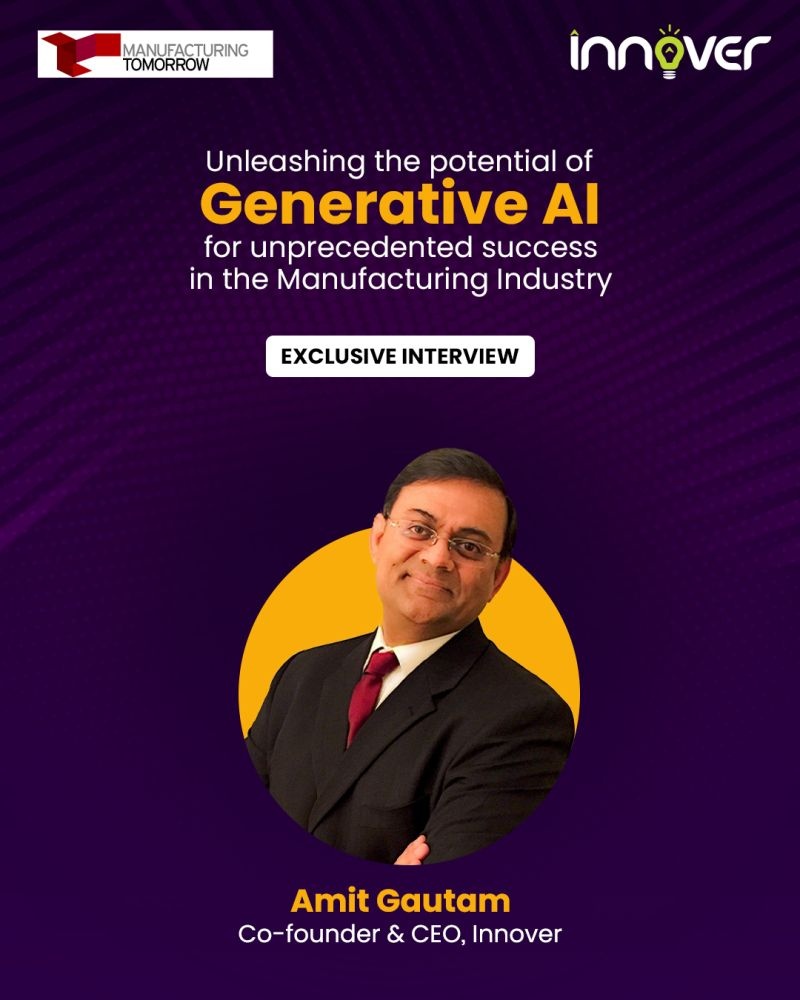
Gautam is the co-founder and CEO of Innover Digital, based in Alpharetta, Georgia. His remit covers the company's products, services, execution, financial performance and growth. The interesting part of his public career is how often the same concern returns, wearing the vocabulary of a different technological moment. A forecast, a member renewal, a search query, an invoice: each is an opportunity to make the machinery of a business work a little better.
Before the AI vocabulary
Before Innover, Gautam held leadership roles at GE and Cognizant. He earned an engineering bachelor's degree in India and studied data science at Harvard. Those are two different educational facts; his Harvard study should not be inflated into a degree. His career connects the operating concerns of large organizations with the possibilities of data.
In 2020, he was writing publicly as Innover's president and chief strategy officer. By October 2022, he was publishing as its CEO and co-founder. The responsibilities have a recognizable continuity: products, services, financial performance and growth travel together. Someone ultimately has to answer for whether an idea survives contact with the customer's working day.
His October 2020 writing on 5G considered what faster connectivity would mean for supply chains. He argued that enterprises adopting it would need to reconsider their data infrastructure and analytical capabilities. A faster network, in that account, brings obligations as well as opportunities. Information arriving sooner still needs somewhere useful to go. That early concern with the connections between systems helps explain his later interest in AI that can act on what a business knows.
A visit to the metaverse, with a return ticket
By December 2022, Gautam was discussing virtual tours, immersive shopping, digital workplaces and experience centers. The metaverse offered an expansive canvas. His explanation, however, kept circling back to specific uses: what could an organization let a customer experience, and how might that improve the relationship?
He described virtual environments as a way to loosen the constraints of geography. A hotel visit or a trade-show encounter could be approached differently when the participants did not have to occupy the same room. The attraction was the experience a business could offer, with a reason attached to the investment.
Innover also brought its digital experiences and analytics studio services to India, proposing a combination of customer journey work, personalization and experience-driven commerce. The range of technologies was broad. The commercial question was comparatively narrow: could these tools help companies understand and serve their customers? Read alongside his later AI work, this period shows a recurring selection rule. New possibilities get an audience. They still have to explain what they are for.
The unglamorous business of joining up a donation
In March 2023, Innover launched Innoraise, a cloud-based platform for nonprofits. Memberships, donations and events were brought into an integrated view, with a unified shopping cart, personalization and data insights. A supporter should be able to engage with an organization without repeatedly discovering the boundaries between its software systems.
Gautam framed the launch around the difficulties nonprofits face in building communities of supporters. There is a very human consequence behind the technical language. Every awkward transaction asks someone to spend more patience on an organization they were already inclined to help. Administrative inconvenience is an eccentric fundraising strategy.
The launch also brought an outside operating perspective through John Sullivan, managing partner of Sullivan Advisors and a former CIO at the American Chemical Society and AARP. He described the value of connecting existing association-management systems. The underlying idea fits Gautam's wider work: find the places where useful relationships are interrupted by disconnected processes, and improve the connection. Here, the outcome involved a member or donor, rather than a factory or a freight network.
The people have to come along
There is a second customer in Gautam's thinking about organizations: the employee. In October 2022, writing about retention, he argued that employers should give their workforce the attention they give valued customers. He recommended conversations about why people stay, flexibility in where work happens, and opportunities to develop skills.
The practical suggestion was to ask employees about their aspirations before those aspirations became a resignation letter. His argument also made room for people who want more than the next rung on a management ladder. Learning a different technology, mentoring colleagues or contributing to company decisions can matter too.
That concern resurfaced in his generative AI discussions with Rakesh Prasad, Innover's strategy and solutions leader. Gautam emphasized awareness and opportunities for existing employees to learn how to use the technology. The approach gives people something concrete to do with a large, abstract change. It also places a demand on leadership: buying a tool does not teach a team how to work with it. Someone has to make room for the learning.
“Driving awareness almost always drives positive change in the workforce.”
Amit Gautam · on adopting generative AI
A chatbot meets the stockroom
When ChatGPT entered workplace discussions, Gautam described specific experiments in ecommerce. Innover was exploring natural-language customer service, more useful product searches, image-based generation of product descriptions and tags, and conversational access to sales and customer insights. These were proposed applications, rather than a claim that every experiment had already produced a result.
He paired that encouragement to experiment with an explicit concern for confidential organizational and customer information. The invitation to explore came with limits on what information should be exposed. In an enterprise, enthusiasm cannot be the only access policy.
His manufacturing discussions raised a related problem: a general model does not automatically understand a particular business. Production records, equipment information, sales signals and partner data live in different places. They carry histories and relationships that matter. The appeal of a conversational interface is easy to appreciate; the work required to make its answers useful happens behind it. For Gautam, the manufacturer's forecasting question remains a better starting point than a shopping list of AI features.
The model needs a business education
In March 2024, Gautam set out the choices facing an organization considering generative AI. Start with an appropriate use case. Assess the quality and scale of the data, security requirements, infrastructure, response times and request volumes. Then decide what kind of model and implementation the job requires.
He discussed the trade-offs among ready-made foundation models, custom models and fine-tuning. A ready-made model offers a quicker beginning. Building one independently requires money, expertise and time. He presented fine-tuning as a way to adapt a foundation model using information specific to the business. That was his recommendation in that piece, rather than a universal guarantee for every deployment.
The order of decisions matters in his account. A company first decides what it hopes to accomplish, then examines the conditions under which the system will operate. A polished answer in a demonstration tells a buyer little about costs, confidentiality or performance under everyday demand. Those questions are less theatrical. They are also much closer to the CEO's job.
- 01Build awareness
- 02Set governance
- 03Plan implementation
- 04Run experiments
- 05Measure the return
Trying the machinery at home
Innferre gives that argument a product expression. In a public LinkedIn post, Gautam explained the platform's purpose in terms of business context: understanding a customer's data and the relationships within it. Innover described a combination of retrieval-augmented generation, knowledge graphs and domain data encapsulation to support contextual responses.
He added a small, revealing detail: “We are using Innferre internally too!” He described applications spanning software development and business productivity. It is an unusually direct moment in an otherwise formal public vocabulary. The supplier is also a user, with its own reasons to care about whether the machinery helps.
In the 2024 conversation with Prasad, the broader adoption sequence was awareness, governance, implementation, experimentation and an eventual return on investment. Adjacent uses could follow once an initial problem was understood. Taken together, the post and the discussion suggest an appetite for experimentation with a sequence attached. A trial should teach an organization something it can use when deciding what to attempt next.
A growing company, and a shorter unit of proof
Innover appeared at No. 2,523 on the 2025 Inc. 5000 and was included in Inc.'s Best Workplaces list in 2023. Gautam's response to the growth recognition credited the team and the clients. His use of the company's nickname for its employees, Innovators, put the collective effort at the center of the announcement.
The recognition gives the entrepreneurial story a public marker. It also helps keep the scale of the claim straight: a company ranking is a company achievement, made through the work of many people. Gautam leads the organization; the delivery depends on colleagues who turn the proposals into functioning systems.
By October 15, 2026, the focus had moved further into AI agents completing operational work. Innover announced OpenAI Select Partner status and plans to deepen the use of OpenAI models within Innferre and its Digital Command Center. Gautam's examples were tickets closed, technicians dispatched and invoices posted. The verbs had become rather more demanding.
“Enterprises have no shortage of AI pilots,” he said. His stated ambition was to move more work into production and measure the benefit in time and money. Across the changes in vocabulary, that is the through-line in his career at Innover. The next presentation can be as elegant as anyone likes. There is still a forecasting problem waiting outside.
Follow the conversation
Interviews, writing and places to keep reading.