A holiday wish list is a surprisingly efficient way to find out what an office is thinking. At Tru India, colleagues wrote down the presents they wanted, and Mandeep Singh read the requests aloud. Among them was a mini bar setup. Enterprise technology has many complicated requirements; that particular specification was admirably clear.
The exercise appeared in the team's holiday greetings for the year ahead. Singh was introduced then as chief operating officer. Today, Tru lists him as co-chief executive officer, and he is identified as a co-founder. The distance between those two scenes is small enough to be interesting: the executive responsible for a business also taking a turn as the office's reader of wishes.
It is an ordinary moment, which is part of its appeal. Nobody had to turn it into a theory of management. People were allowed to want something, write it down, and hear it acknowledged. In an industry fond of describing the future in language suitable for a spaceship, there is pleasure in a request that could be fulfilled by a reasonably well-stocked shop.
Singh's public work moves between these scales. There is the business spread across countries, with enterprise systems and AI on its agenda. There are colleagues receiving recognition. There is a product concerned with how work is observed. Follow those threads and a question keeps returning: what deserves a leader's attention, and how does that attention reach the person doing the job?
The work behind the applause
In a post about recognizing employees, Singh made his emphasis plain. He thanked the people solving problems, putting in late hours, and turning small successes into progress. He described the satisfaction of seeing a team develop and receive recognition. His closing words to those colleagues were direct: ‘This is your moment, and you've earned it.’
That sentence gives the scene its proportions. An executive can occupy a remarkable amount of space at a ceremony ostensibly arranged for everybody else. Singh's message put the occasion back in the recipients' hands. The language was celebratory, but the things being celebrated were familiar: effort, commitment, problems resolved. Work has a habit of becoming invisible precisely when it goes well.
There is also a colleague's view of the management group. In a farewell reflection after nearly two years at Tru India, digital marketing and analytics manager Saphal Parmar thanked Singh alongside Yogesh Jindal, Chandan Thakur, and Varinder Singh. Parmar described supportive management and people who were accessible when guidance was needed. The compliment belonged to a group, rather than to a solitary figure at the top.
That distinction matters in a profile of someone with a shared chief executive title. A business is experienced through many people. A request for help may reach a manager, a delivery lead, or a colleague before it ever reaches the executive suite. Parmar's account gives that larger network a human shape: names attached to assistance, rather than a value statement framed on a wall.
Praise from one departing employee cannot describe every working day. It can, however, tell us what that employee chose to remember. Here, the remembered quality was approachability. The recognition post offers a complementary view from Singh himself. Taken together, the two moments show attention moving in both directions: colleagues being acknowledged, and management being remembered for making itself available.
“This is your moment, and you've earned it.”
Mandeep Singh, on employee recognition
A shared title, a distributed business
Tru's leadership page places Singh beside chief executive Aly Hemraj. Around them are executives responsible for delivery, operations, experience, technology, and data. Those titles describe the range of work a technology business must coordinate. A promising idea still needs someone to design it, somebody to build it, and a team capable of delivering it without losing the original intention along the way.
The company describes hubs across Canada, the United States, India, Indonesia, and the Middle East. Its work includes SaaS architecture, enterprise experience design, and agentic AI deployment. For Singh, the co-chief executive role sits inside that geography and that mix of disciplines. The organizational challenge is easy to state and harder to execute: people in different places must contribute to the same result.
An earlier operational chapter is visible at Mysense Technologies, whose team page identifies Singh as chief operation officer. Corporate records also list him as a director from April 2022, alongside colleagues including Chandan Thakur and Yogesh Jindal. These are concrete connections in his career. They put an operations role and a company directorship beside the current shared leadership position at Tru.
The surrounding business has its own longer history. Tru dates its beginnings to web development in 2012. Its published milestones include an enterprise client in 2013, a Toronto headquarters in 2014, and later offices in India and Riyadh. These are company milestones, and they should be read that way. They explain the institution Singh helps lead without assigning every event to his personal hand.
A growing company accumulates obligations as well as offices. Each additional discipline introduces another handoff; each location adds another schedule. The title at the top can make all this look elegantly compact. The work beneath it rarely is. In Singh's case, the operational roles provide a useful way into the story: they place coordination, rather than celebrity, near the center of the frame.
Three colleagues take a leap
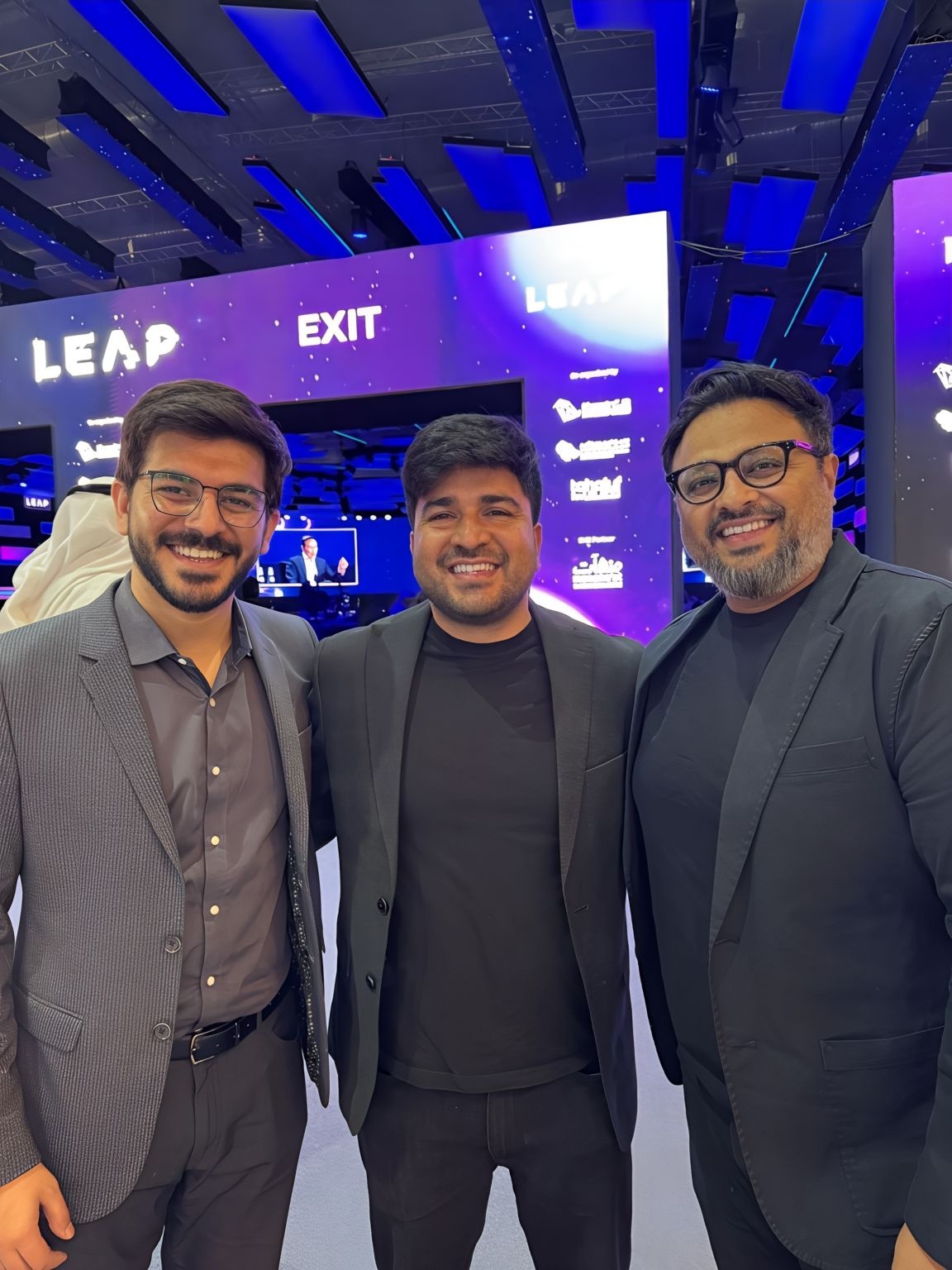
In February 2025, Singh represented Tru at LEAP with Dhruv Dhanda and Bilal Hameed. The team's photograph catches him in the middle, smiling in a black jacket and dark shirt. Around the group, the conference lighting is emphatically blue and purple. Technology gatherings may disagree about the future, but they have reached a broad consensus about what color it should be.
Tru's account of the visit highlighted AI, cloud, robotics, and technology infrastructure. Among the sessions it discussed were a conversation involving Boston Dynamics founder Marc Raibert and another concerning NVIDIA and Oracle. The account places Singh at a gathering where enterprise ambitions met demonstrations and infrastructure discussions. It gives a specific setting to the much broader phrase ‘digital transformation.’
The photograph has another virtue: it contains three colleagues. The trip was a team appearance, and the image preserves that fact. Shared leadership becomes less abstract when people are standing beside one another. There is no need to invent a private conversation or a decisive deal to make the picture useful. Attendance and company are enough.
A conference can gather an enormous vocabulary under one roof. An operating business has to decide which parts belong in its own work. The interesting question for an executive attending is what can survive the journey from stage to project. A demo can end with applause. A client implementation has to continue after everybody has gone home and the lighting crew has packed away the purple.
What a manager can see
Another part of Singh's public activity concerns MaxelTracker, a workforce analytics and employee monitoring platform. His LinkedIn profile lists the business. Its tools include time tracking, application and website activity, attendance, screenshots, and reporting. The proposition is that managers can use work data to understand patterns instead of reconstructing a week from memory and a handful of status updates.
A colleague's announcement for TiECON Chandigarh 2025 named Singh among the people representing MaxelTracker on March 6 and 7, at Booth 9. Harinder Kaur, Devanshu Goyal, and Sagar Bhanot were also named. The pitch addressed teams working in offices, remotely, and in hybrid arrangements. That setting is useful: a product proposition being brought to a booth where people can ask inconveniently practical questions.
Singh later recalled an encounter at TiE Chandigarh in which someone looked at the product and said, ‘This would've saved months of guesswork.’ He connected that reaction to his belief that timely visibility helps businesses execute. The visitor's identity and circumstances were not part of the account. The remembered sentence was the point: a person recognizing a problem they had already lived with.
Workforce monitoring also raises a question that a dashboard cannot settle by itself. What should a manager conclude from the activity being measured? A record can show time spent in an application. Interpreting the value of that time requires context. The product's public positioning emphasizes better decisions and less micromanagement. Those are aims to be tested in use, rather than outcomes guaranteed by installing software.
MaxelTracker's commercial team describes conversations with founders and business leaders across the United States, Canada, the United Kingdom, and India. The recurring topic is how to improve productivity while avoiding excessive supervision. It is a revealing tension for this part of Singh's work: the buyer wants a clearer picture, while the people in that picture still need room to do their jobs.
Read beside the employee recognition post, the product story becomes more interesting. Celebration and measurement are different managerial acts, each involving a choice about what counts. The record of an hour and the judgment of a contribution are related, but they answer different questions. The worthwhile discussion starts when a leader keeps both in view, rather than allowing the easiest number to make the whole decision.
Back to the wish list
Singh's public appearances include a Tru India World Book Day feature with other leaders discussing books that influenced their thinking. The group format is consistent with the rest of the picture: colleagues sharing the frame, each bringing something to the conversation. A reading recommendation, like an award or a holiday request, allows a person to show up through a detail rather than a title.
The aspiration visible in Singh's work is practical: lead a growing technology business, recognize its people, and improve the information available to managers. Those ambitions meet in the daily decisions that seldom receive a conference stage. Who needs guidance? Which contribution deserves recognition? What does a report explain, and what question should someone ask before acting on it?
Return to that office wish list. Its appeal is the absence of mystery. Colleagues were asked what they wanted; Singh read the answers. No analytics system was required to discover the mini bar. For a leader working on visibility, it is a nicely economical reminder that some useful information arrives simply because somebody made room for people to say it.