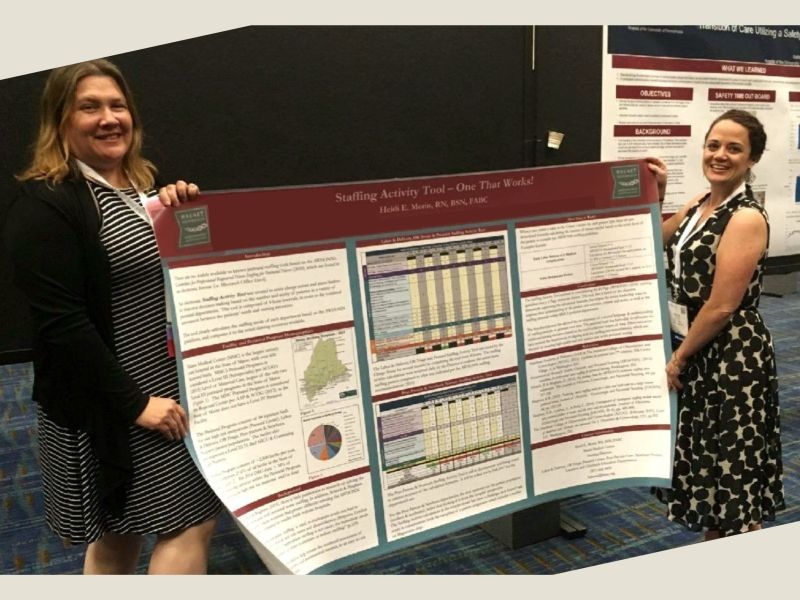
In the photograph, the company is still a poster. Heidi E. Morin and Sarah Austin stand at either end of it, holding up the results of a project Morin had developed while working as a director. There are tables, charts, an institutional logo and rather a lot of small print. It is the sort of object that requires someone to stop walking and ask a question. In 2016, it was also a glimpse of a future neither a job title nor a business card could yet describe.
Years later, Morin revisited the photograph. She was now founder and CEO of Parity Healthcare Analytics. Austin had become the company’s director of customer success. The two people holding the poster had acquired another shared undertaking. Morin wrote that her earlier self would have had difficulty believing where the project would take her.
It is an appealing company origin because the surprise belongs to the founder herself. Morin had been trying to make a part of her working life function better. The prospect of running a software business arrived along the way. Before the company existed, there was work she understood, a tool she wanted and an audience of colleagues who understood why she wanted it.
The operator before the entrepreneur
Morin’s career began with nursing and widened into management. Her professional record traces a progression from Johns Hopkins Hospital to Central Maine Medical Center, then to a director position at Maine Medical Center. Between the first role and the last were coordinator and manager responsibilities. She accumulated experience inside an organization before setting out to sell organizations a different way of working.
Her education added another perspective: a master’s degree in nursing administration and an MBA. Those qualifications sit neatly beside each other in a biography. In practice, they concern people who may attend the same meeting and leave with very different accounts of what happened. An operational leader has one view of the work. A finance team must translate that work into plans, allocations and explanations for the next reporting period.
Morin’s founding problem lived in that translation. She believed the available tools failed to represent the work she was responsible for managing. She looked for a solution, then developed her own. The important biographical detail is her starting position: she was already accountable for the department whose numbers she was questioning. Any alternative would have to survive contact with her own working day.
A poster finds an audience
Showing the project to peers changed its possible future. Morin presented her work professionally and received encouragement to develop it for use beyond her own organization. A local answer began to look as though it could travel. That is a different proposition from building something solely for the people who helped define it. Other users bring other routines, assumptions and expectations.
The photograph catches the project at a useful point between those possibilities. It is sufficiently developed to display and discuss, yet Morin still remembers the eventual company as a surprise. Austin’s later role gives the image a second life. What looks like a record of a presentation also records a professional connection that would continue inside the business.
Conference posters are usually asked to summarize work already done. This one has become interesting for what happened afterward. The charts could be printed; the future relationship between their presenter, her colleague and a software company remained unwritten. Morin’s retrospective delight comes from being able to see both versions at once.
“Start with the frontline problem.”
Heidi E. Morin, on developing an idea
The years between a tool and a company
There was institutional support for the next stage. MaineHealth’s innovation program included Morin’s workforce-tool project among its supported inventions. Its account of her participation describes a prototype, an innovation cohort and collaborators forming a company. Those are practical steps: finding people who can help an internal invention become something that can operate beyond its original setting.
A separate record captures the idea entering a more formal world. Morin is named as the inventor on a MaineHealth patent application filed on March 9, 2020, and published that October. The document puts her name beside a specified system and a filing date. It marks another stage in the project’s development, with the precision that administrative paperwork generally reserves for things someone might later argue about.
Parity dates its establishment to 2020. Its own company chronology places pilot testing in the United States and Canada at the beginning, followed by the completion of that testing and the development of a partnership model in 2022. Morin also describes securing grant funding for software development and eventually leaving her director role to concentrate on the business.
The project poster
Parity established
Pilots concluded
80+ partnerships*
A founder who enjoys the budget
By 2024, Morin was discussing management with Austin and Parity co-founder and COO Chuck Alsdurf on the company’s podcast. The subject was budgeting. Morin admitted to being among the relatively rare people in her former profession who actually enjoyed the process. It is a small confession, but a useful one. Budgets occupy a conspicuous place in her account of how leaders acquire room to act.
She recalled reviewing a plan in which projected activity increased while the workforce allocation fell. The relationship looked wrong. Following the calculations revealed a spreadsheet error. Catching it before the budget took effect would spare her a year of explaining a mismatch that had been built into the plan. Her advice was to approach a budget with an owner’s interest and to ask for help when its elements were unfamiliar.
The anecdote gives her enthusiasm a concrete purpose. A budget contains assumptions about what will happen. Someone who knows the operation can examine those assumptions before they become the standard against which everyone is judged. In Morin’s example, expertise meant noticing an inconsistency and tracing it far enough to make a correction possible. The reward for reading the spreadsheet was having fewer conversations about its mistake.
An editorial sketch of the approach running through Morin’s budgeting advice.
The boutique with a counting problem
Morin has a knack for taking a technical argument somewhere familiar. In an April 2025 essay about productivity, she invited readers into an imaginary clothing boutique. Suppose its staffing were evaluated by counting only shirts sold at noon. The shop also sells dresses, hats, accessories and jewelry. Its employees stock shelves, help customers and handle returns. A tidy calculation could leave a great deal of the business outside the frame.
The imagined boutique is an explanatory device, rather than another entry on her résumé. Its usefulness lies in how readily a reader can spot the missing work. An input can be easy to count and still be inadequate for the decision being made. Morin uses the shop to bring an argument about measurement out of specialist language and into an ordinary transaction.
Her writing on benchmarking raises a related concern: comparisons become harder when operations differ in ways a headline number fails to capture. The physical arrangement of a workplace, for example, can matter to how people are deployed. A number that appears comparable may require a closer look at the organization underneath it.
Listening has to change something
Her management advice also reaches beyond arithmetic. In a January 2024 article on staff engagement, Morin urged leaders to listen without becoming defensive, involve the team in solving problems and define how progress would be assessed. She included a continuing cycle of planning, trying, studying and adjusting. The attention goes to what a leader does after receiving feedback.
That sequence puts obligations on management. Inviting people to speak is only the beginning; their observations have to inform a decision. Measuring progress then gives the team a way to judge whether the decision helped. Morin also makes room for small victories and for changing course. There is a modesty in a process that expects its first answer to need revision.
The company she runs brings several disciplines into that conversation. Alsdurf’s background is in finance and software businesses. Chief technology officer Leah Sapan brings software-development experience. Morin brings the operator’s history. Their roles give organizational form to the different kinds of knowledge her early project required.
The work after the photograph
By 2026, Parity’s published timeline reported more than 80 partnerships across the United States and Canada, alongside an expanding team. The company says referrals from existing clients are its strongest source of new partnerships. Those are the business’s own measures of its progress, following the earlier milestones of testing and beginning to market its approach.
Morin now describes her work in terms of workforce strategy, technology, finance and continuing partnership. A June 2025 company essay explains the product as something intended to work alongside existing systems. That positioning asks the business to fit into organizations that already have schedules, budgets and reporting tools, along with people accustomed to using them.
The 2016 photograph remains a useful place to end because it gives that larger undertaking a human scale. Two colleagues are holding a piece of work up for other people to examine. Years later, they are working together again. Morin can look back and recognize the beginning of a business; at the time, she had a project worth showing. The poster had room for the charts. The company would need considerably more space.