The email that changed Allan Thygesen’s career went to somebody he already knew. In June 2022, Docusign’s chief executive had departed, and board chair Maggie Wilderotter was filling in. Thygesen was at Google, running an advertising business measured in tens of billions of dollars. He wrote to say he was happy there. He also said he might be interested in the permanent job.
There is a pleasing lack of ceremony about that approach. No grand announcement of a lifelong destiny. An opening appeared, a relationship already existed, and he raised his hand. By October, he was Docusign’s CEO. The position gave him something his enormous Google remit had never quite provided: responsibility for the whole company.
His new assignment also came with an awkward piece of good fortune. Docusign had made signing documents so familiar that its name could stand in for the act itself. Familiarity is an excellent marketing asset. It can also become a very comfortable cage. Thygesen’s job would involve persuading people that a company associated with the last page of a contract had business with all the other pages, too.
A small country, an outward view
Thygesen grew up in Denmark and studied economics at the University of Copenhagen. He has linked his concern for fairness and opportunity to his upbringing. His early working experience also encouraged him to look beyond a single domestic market. A small country gives a business reasons to become interested in the rest of the world rather quickly.
A student job at Radiometer opened a route he had not expected to take. He worked in its finance department while studying, and an American manager later supplied a recommendation for business school. In 1986, he went to Stanford. He had not intended the move to become permanent. Then he met his future wife, and the Bay Area acquired a stronger claim on his attention.
He earned his MBA as an Arjay Miller Scholar. That distinction belongs on a biography, but the geographical change matters more to the story. Copenhagen had supplied an economist’s education; California offered companies still being assembled. He could watch business ideas encounter customers, money, competitors and the occasional inconvenient fact.
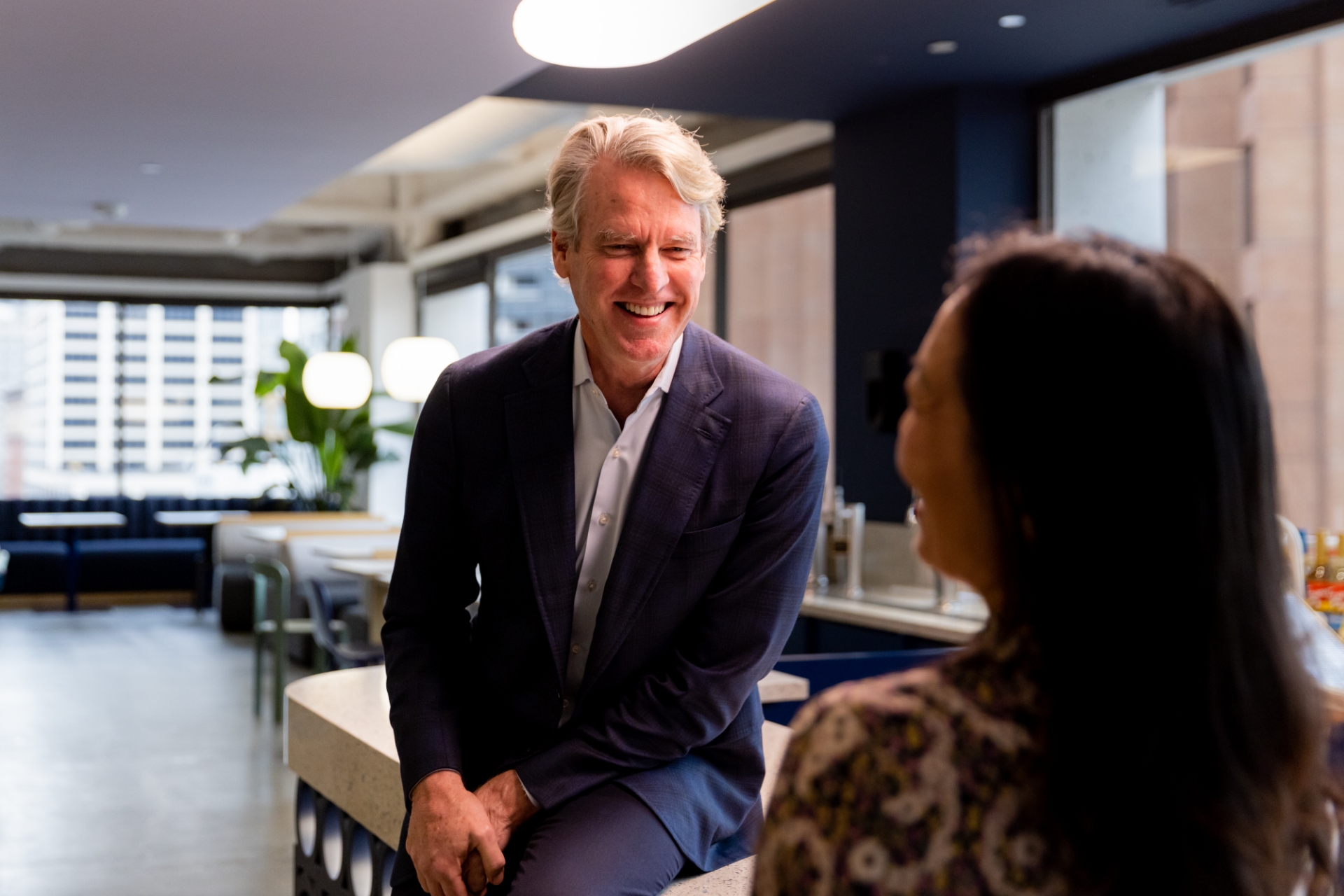
The venture fund with unfortunate timing
His early Silicon Valley career included executive work at Wink Communications, an interactive television company. He led sales and business development and helped take it public in 1999. That puts his experience in a particular technological generation: businesses were trying to make television interactive before the smartphone became everybody’s second screen.
Sales gives an executive an education that a strategy presentation can postpone. Somebody eventually has to agree to buy. Business development adds another complication: another company, with its own priorities, has to agree to cooperate. Thygesen’s later roles would keep returning him to those two questions, even as the numbers grew considerably larger.
He then spent years investing, including as a managing director and partner in Carlyle’s US venture and growth funds. His investments covered areas such as enterprise software, e-commerce and mobile advertising. The investor’s chair offered a wider view of how companies develop, with less protection from the possibility that an attractive idea might arrive at the wrong time.
He experienced that possibility personally. In 2008, after leaving Carlyle, he tried to establish a fund with a partner. The financial crisis made raising money for a new technology investment firm exceptionally difficult. He has described the episode as poor timing and acknowledged bad choices alongside the good fortune in his career. It is a useful interruption to any account that might otherwise start resembling an escalator.
Google was supposed to be a return trip
By the time Google entered the picture, Thygesen wanted to operate a business again. In his telling, prospective employers wondered whether a decade in venture capital had left his practical skills a little distant. Google offered a way to answer. What began around 2010 became roughly twelve years inside a company whose advertising operations connected him to businesses of almost every size.
He worked on the global business serving small and midsize advertisers before taking responsibility for the Americas in 2017. Global partners were added to his remit in 2021. At his departure, he had been leading a North and South American advertising business worth more than $100 billion. The sequence matters: his experience with scale included the relatively small customers that make scale possible.
At that size, a leader’s work involves systems and other leaders as much as individual transactions. A decision about serving advertisers has consequences for agencies, partners and colleagues far beyond one sales team. Thygesen had moved a long way from a startup’s immediate scramble, while remaining close to the commercial question of whether a product helps somebody’s business.
Alongside Google, he lectured at Stanford’s Graduate School of Business from 2014 to 2021. His continuing university ties include advisory work at the Institute for Research in the Social Sciences and the Stanford Institute for Economic Policy Research. The campus that first brought him to California remained part of his working life.
An old acquaintance, a new responsibility
The Docusign appointment brought those different experiences together. He had been an executive inside smaller businesses, an investor watching several businesses, and a leader inside a much larger one. Now he would face the decisions that come with having the entire organisation in his charge. His first CEO role arrived after decades of preparation, though the preparation had hardly followed a tidy syllabus.
Wilderotter was the connecting thread. Thygesen had stayed in touch with her over many years. His account of the appointment fits his broader view of professional relationships: help people, maintain real connections, and recognise that work done together carries further than introductions collected in a room.
“Too many people think that networking is about cocktail parties.”
Allan Thygesen
That observation has the advantage of making networking sound less exhausting. It also puts a burden back on the person doing it. A relationship that matters after twenty years requires more than remembering where somebody worked. Thygesen presents usefulness and sustained interest as the work itself. The email to Wilderotter supplied the other ingredient: when a possibility appears, say that you are interested.
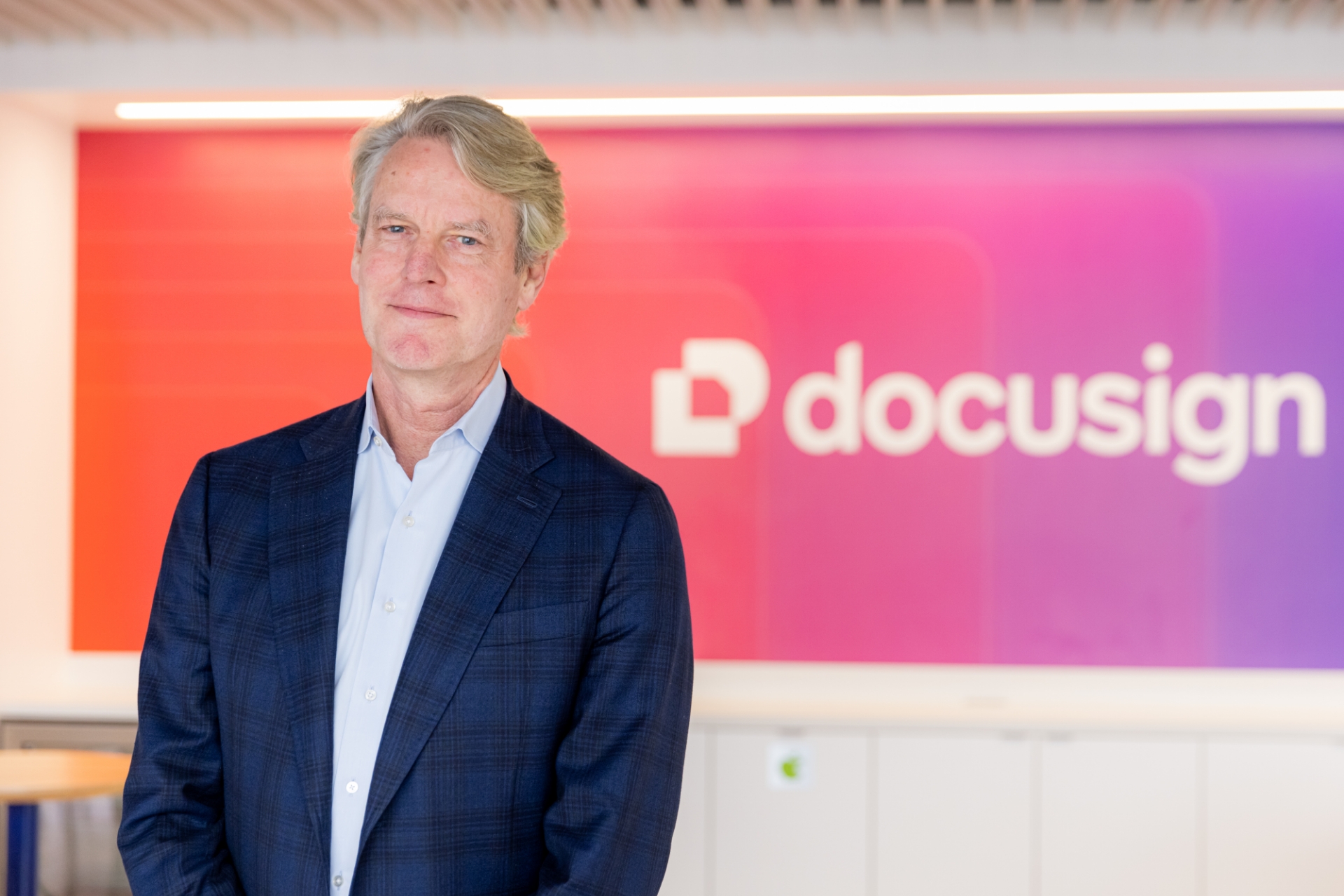
What happens after everybody signs?
In April 2024, Docusign announced its Intelligent Agreement Management platform, usually shortened to IAM. The shift expanded the company’s ambition across creating, committing to and managing agreements. Signing remained essential. The larger proposal concerned the information in the document and the work that surrounds it.
Consider the distinction between having a signed agreement and being able to use its contents. A business can possess a document without having a convenient way to find the obligations, dates and terms inside it. Docusign’s platform strategy addresses that gap through agreement repositories, workflow tools and connections to other business applications. The signature becomes one stage of a longer process.
- 01CreatePrepare and route
- 02CommitApprove and sign
- 03ManageFind terms and act
Three stages in Docusign’s published IAM strategy.
For Thygesen, that makes the familiar brand both a starting point and a challenge. Customers already understand why they need a signature. Asking them to change how multiple departments handle contracts is a larger conversation. It involves the people who create an agreement, the people who approve it, and the people who have to remember what everyone agreed to do.
His career offers a practical reason for that interest in the connections between things. He has worked on sales, partnerships and investing; each depends on getting information and incentives across organisational boundaries. A platform that connects those boundaries is a business argument he has spent years learning to make. Whether customers adopt it remains the test.
The next agreement may arrive with an agent
By June 2026, Thygesen was describing a further step: software that helps organisations act on agreement information. His vision includes AI agents negotiating with one another within rules established by people. He has presented that as an organisational challenge as well as a technical one. Someone still has to decide which terms an agent may accept.
The distinction deserves attention. Faster drafting is easy to imagine. Delegating decisions requires a company to state its preferences and limits clearly enough for software to follow them. In that future, the unglamorous work of defining authority becomes part of the product’s value. A contract may travel faster, but somebody still owns the promise.
There are figures against which to judge the current transition. In results announced on September 3, 2026, Docusign reported quarterly revenue of $875.7 million, up 9% from a year earlier. IAM represented 15.1% of total annual recurring revenue at July’s end, compared with 12.6% at April’s end. Those measures describe a developing business alongside an established one.
Company-reported quarter-end figures. Scale: 0-20%.
Thygesen also serves on the board of A.P. Moller - Maersk, which he joined in 2024. Shipping supplies a substantial physical counterpart to a career in software. Both businesses operate across borders, coordinate many participants and depend on commitments being honoured. The containers are rather harder to misplace in an email thread.
His appetite for change comes with a recent admission. Asked what he would reconsider about his Docusign tenure, he said he would have anticipated the move toward agentic AI and invested more heavily. “I’d always like to be even earlier,” he said. After decades of different roles, he still describes opportunity as something that can get ahead of him.
The early email to Wilderotter and the latest argument for agreement software share that restless quality. An established position can be satisfying and still leave a question unanswered. At Google, Thygesen wanted the whole company to run. At Docusign, he wants to follow the contract beyond its signature. The interesting part is what he can persuade people to do next.
Keep reading. Keep listening.
More from Thygesen, in print and on stage.
01 / WATCHMomentum 2026 opening keynote ↗02 / CONVERSATIONThirty Minute Mentors with Adam Mendler ↗03 / WRITINGThygesen’s Docusign essays ↗04 / INTERVIEWContract data, workflows and the pace of AI ↗