The contract is finished. Everyone has signed. Someone downloads the PDF, puts it in a folder, and returns to work. Months later, a renewal arrives. A price has changed. A cancellation window has closed. The document was safely stored; the useful information inside it never reached the person who needed it. This is the ordinary office predicament behind Docusign’s attempt to become something larger than the place where you click your name.
- Docusign sells signing software, then connects the work around the signature.
- Its next business is making contract terms searchable and actionable.
- The practical test: fewer handoffs, fewer missed dates, clearer ownership.
Electronic signatures solved a visible nuisance. Printing, scanning, faxing, and chasing a courier were easy things to dislike. Agreement management tackles something less visible: the journey between a promise and its execution. Docusign’s wager is that the second problem can support a substantial business alongside the first.
A very successful front door
Founded in 2003 by Tom Gonser, Court Lorenzini, and Eric Ranft, Docusign made its name by moving signatures onto screens. A sender prepares documents, assigns fields, and routes them to recipients. Signers can complete the process remotely. Templates reduce repeated setup; tracking and audit records help the sender establish what happened.
The audience reaches from a sole proprietor sending an engagement letter to a bank onboarding customers or a legal department coordinating approvals. Docusign now reports more than 1.9 million paying customers and over a billion users across more than 180 countries. Those are different populations: receiving a document does not make someone a paying subscriber.
That distinction helps explain its position. Every signing request introduces another person to the product, while the organization sending requests supplies the revenue. Docusign also advertises more than 1,000 prebuilt integrations. The familiar signature screen sits at the edge of a network of business applications.
The inbox was the first thing to fix
Consider Unilever’s procurement operation. In Docusign’s published account, distributed teams were working through office applications, email, printing, scanning, faxing, and phone follow-ups. Employees searched inboxes for contract attachments and checked whether they had the right version. Speeding up the final signature could only address part of that mess.
“We wanted tools and solutions that would harmonise, simplify and bring efficiencies.”Wei Ling Lim · Unilever
With Docusign CLM, a requester could enter the deal’s key facts, generate a contract with the appropriate clauses, and route reviews and approvals to the right people. The ready document then went through eSignature. Docusign’s case materials report a 50% reduction in turnaround time and an 80% reduction in drafting time. These are customer-case results, rather than a forecast for every buyer.
- 01PrepareFacts → clauses
- 02ApproveRules → owners
- 03SignSend → commit
- 04RememberTerms → action
The useful lesson is procedural. Choose the information a requester must supply. Decide which clauses belong in which circumstances. Name the approvers. Only then automate the route. Buying software before making those decisions risks giving an untidy process a faster conveyor belt.
Buying the space around the signature
Docusign’s expansion predates the current AI enthusiasm. In 2018, it announced an approximately $220 million cash agreement to acquire SpringCM, which supplied document and contract lifecycle management. In April 2024 came Intelligent Agreement Management, or IAM. The following month, it agreed to acquire AI agreement-management company Lexion for $165 million in cash, subject to adjustments.
IAM connects preparation, commitment, and management. Today’s product lineup includes Agreement Manager, a searchable repository; Workflow Builder, for automating processes; and Iris, its contract-specific AI. The September 2026 earnings release described an AI assistant, prebuilt agents, and Agent Studio for creating and governing custom agents.

The strategic pressure is straightforward. Adobe Acrobat Sign, Dropbox Sign, and PandaDoc offer alternative ways to get documents signed. Icertis and Ironclad compete in contract management. In its April 2024 assessment, IDC described eSignature as increasingly commoditized. Docusign’s response is to sell more of the surrounding process, using its installed base and integrations as distribution.
The price of changing course
There was a human bill. In February 2024, Docusign announced a roughly 6% workforce reduction, affecting about 400 employees, mostly in sales and marketing. It estimated $28 million to $32 million in restructuring charges. Thygesen’s employee memo said reductions in other operating costs had proved insufficient. The platform transition arrived alongside an uncomfortable operational reset.
For buyers, the bill begins with subscriptions. On October 24, 2026, the US pricing page showed annual plans billed monthly at $11 for Personal, $30 per user for Standard, and $45 per user for Business Pro, before tax. Other billing choices differ. Personal includes five envelopes monthly; Standard and Business Pro list 100 per user annually. An envelope is a send, potentially containing several documents and recipients.
Enterprise requirements bring custom terms. Implementation, identity checks, integration work, and internal process redesign also deserve attention. A team sending occasional straightforward forms may find little reason to purchase a broader agreement platform. A procurement operation with recurring obligations has a different calculation.

The PDF gets another job
The transition is measurable, though incomplete. IAM represented 15.1% of Docusign’s annual recurring revenue at July 31, 2026. Quarterly revenue reached $875.7 million, up 9% year over year. The newer platform is contributing, while the established business still supplies most recurring revenue.
IAM share of total ARR
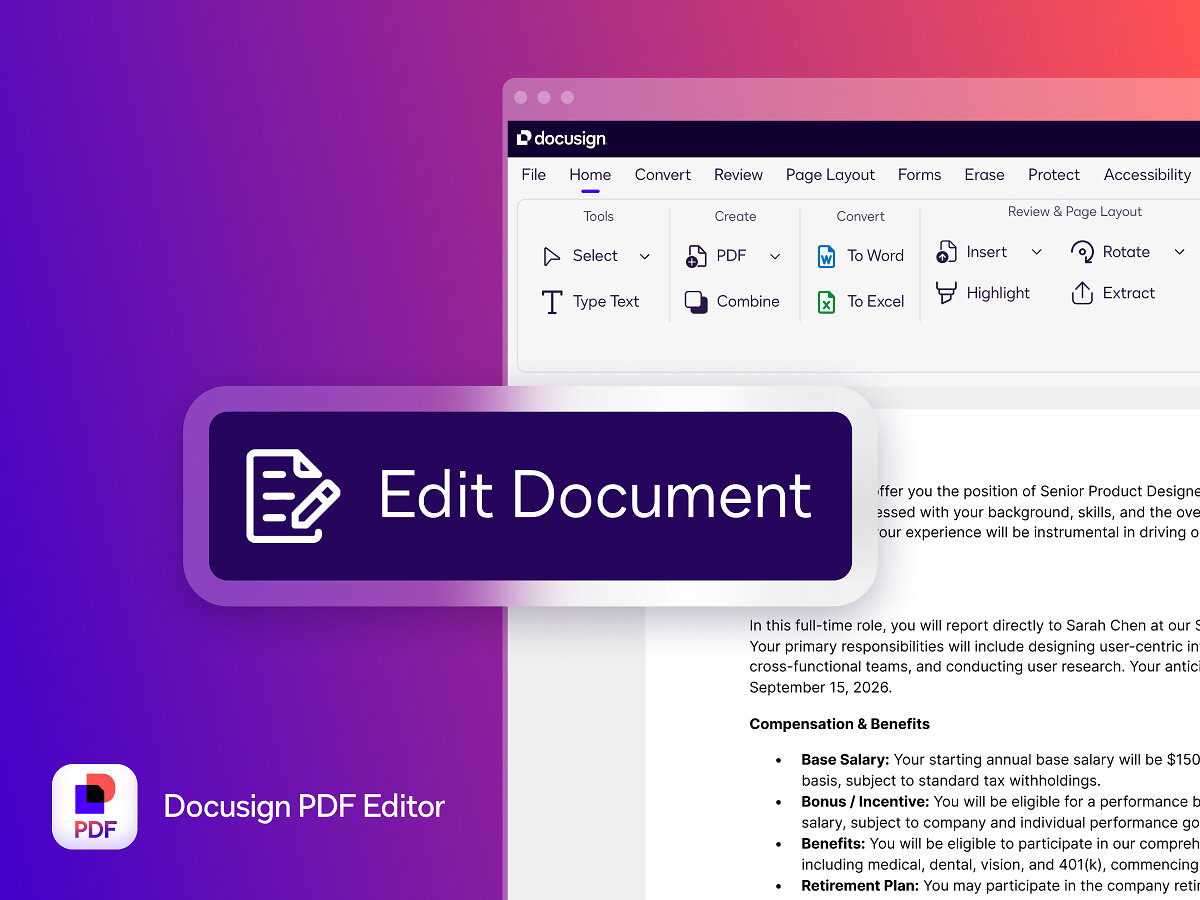
In October, Docusign announced deeper IAM availability across Salesforce, Agentforce, and Slack. It also introduced PDF Editor, scheduled for purchase from November 2. Editing, signing, and managing would sit closer together. The proposal is practical: fewer transfers between tools.
The buyer’s test should be equally practical. Start with one repeatable agreement. Assign an owner, define exceptions, and measure elapsed time. Check extracted terms against the document before acting. The promise becomes useful when the right person sees the right obligation early enough to do something about it.