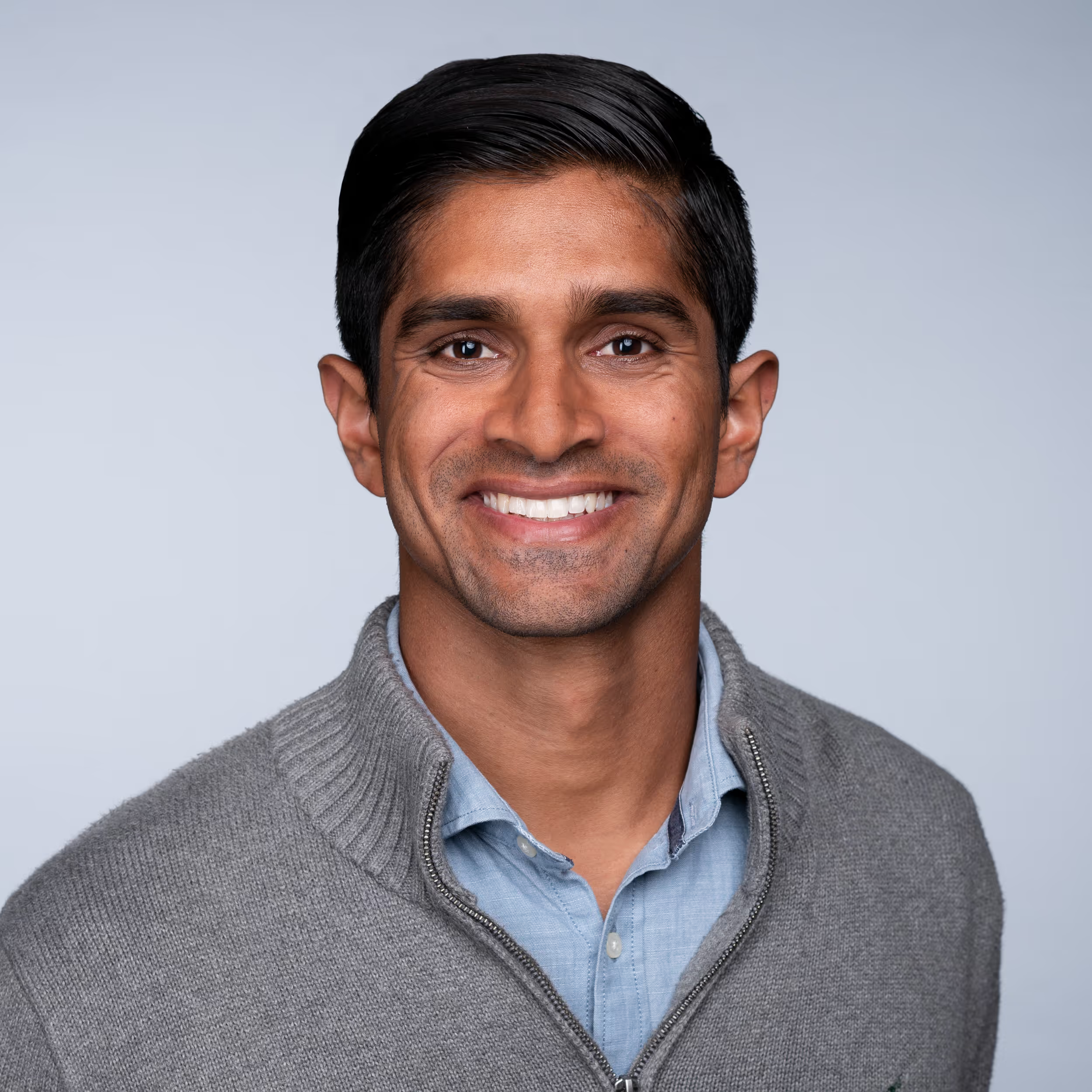
// Profile
The investor who reads the infrastructure stack, not just the deck
Most venture capitalists will tell you they're "hands-on." Gautam Krishnamurthi means it differently. At GreatPoint Ventures, the San Francisco firm where he holds the title General Partner, his team makes fewer than ten new investments per year across a universe where hundreds of startups compete for attention. That's not a capacity constraint. It's a philosophy. Every check comes with a phone number that actually gets answered.
His focus is the unsexy layer of the enterprise stack - the plumbing that makes AI applications actually work at scale. Data infrastructure. ML feature stores. Conversation intelligence. BI observability. The tools that engineers talk about at 11pm when something breaks in production. He backed definity (a $12M Series A for agentic data engineering), Coalesce (data transformation infrastructure), FeatureForm (ML feature stores), and Datalogz (BI ops and administration). These are the kinds of companies that rarely make mainstream tech headlines - until every Fortune 500 company quietly depends on them.
"Make big plans; aim high in hope and work."- Daniel Hudson Burnham, architect - the guiding motto at GreatPoint Ventures
Before GreatPoint, Krishnamurthi spent three years at CapitalG - Google's growth capital fund - where he worked on investments including UiPath and Robinhood. Those two companies went on to IPO. The experience gave him a rare vantage point: what enterprise automation looks like when it scales, and what happens to consumer fintech when regulatory tailwinds become headwinds. He brought that perspective to Green Bay Ventures in 2020, where in a single year as Partner he backed Databricks, RapidAPI, Sisu, and Fidel - a portfolio that reads like a who's-who of data infrastructure's breakout era.
Krishnamurthi joined GreatPoint Ventures in 2021, eventually rising to General Partner. The firm, founded in 2015 and headquartered at 744 Montgomery Street in San Francisco's Financial District, operates more like an operator collective than a traditional fund. Its partners include DJ Patil - the former U.S. Chief Data Scientist who wrote the first seed check into Figma - and Ray Lane, the veteran who served as President of Oracle and later as managing partner at Kleiner Perkins. Over 100 combined years of operational experience. It is a firm where context actually compounds.
In July 2024, Krishnamurthi appeared on the MLOps Weekly Podcast hosted by Featureform's Simba Khadder. The episode, titled "From Recession to AI Boom," covers his read on the market cycle - from the brutal 2022-2023 recalibration back to the frenzied optimism of the AI wave. His take: the infrastructure layer is where durable value accumulates, not in the application layer, which will commoditize faster than most investors expect.
The Business Insider Rising Stars of Venture Capital 2026 recognition placed him among a cohort of investors under 40 making bets that the mainstream has yet to fully appreciate. It's the sort of list that, in hindsight, tends to correctly identify careers before the rest of the market catches up.
GreatPoint Ventures writes checks from $250K to $20M, most often leading Series A rounds. The deliberate ceiling on new investments per year - fewer than ten - keeps each partner meaningfully engaged. They describe it as "hands-on operator style," which at GreatPoint means actual board seats, actual recruiting help, actual introductions. The 130+ portfolio companies across the firm's history represent a decade of concentrated conviction.
He grew up in Saratoga, California, a quiet suburb tucked between Silicon Valley's venture offices and the Santa Cruz mountains. He played varsity football at Stanford - both wide receiver and safety - while studying economics and later earning a Master's in Management Science and Engineering. The combination of contact sport and quantitative graduate work is, perhaps, an unusual preparation for a career in venture. It turns out knowing how to read defenses and model cash flows are not entirely different disciplines.
The career arc from Stanford to Goldman Sachs's West Region Advisory practice to CapitalG follows a recognizable path for the analytically gifted offspring of Silicon Valley. What made Krishnamurthi's trajectory different is where he chose to stop - and what he chose to do when he got there. Rather than climbing to a larger growth-stage fund or building toward a managing partner role at a mega-fund, he landed at a firm structured around founder density, board intensity, and the kind of long-term commitment that makes enterprise software companies possible in the first place.
His current board positions span Symbl.ai (conversation intelligence), Coalesce.io (data transformation), Onymos, Spot Insurance, STRIVR, LottieFiles, and Hypori, among others. The breadth reflects genuine pluralism in his investment thesis - but if you look at the common thread, it's the B2B stack. Infrastructure and tooling that enterprises need to function, not nice-to-haves, not consumer bets, not moonshots. Things that generate recurring revenue precisely because cutting them costs more than paying for them.
Krishnamurthi conducts founder interviews as part of GreatPoint's community-building work - including a published conversation with Logan Havern, CEO of Datalogz, on the future of BI Ops and data administration. That kind of engagement - investor-as-journalist for portfolio-adjacent ideas - is characteristic of an investor who wants to understand a market before betting on it, not after.