A cryptocurrency transaction can be public, permanent and almost impossible to explain to the person doing the accounts. Antoine Scalia built a company in that awkward space. The money has moved. The finance team still has questions. Somewhere between a wallet address and a financial statement, someone must work out what actually happened.
It is a curious place to look for a career in an industry fond of speed. Scalia has spent the years since 2018 following the paperwork. His company, Cryptio, began with a way to collect scattered crypto activity into a dashboard. It now builds data infrastructure and applications for institutions whose records need to withstand a much closer inspection.
There is a dry joke at the centre of this story. Digital money promised to move without waiting for the familiar intermediaries. The accountant, it turns out, still expects an explanation.
A dashboard before the institutions
Scalia studied at HEC Paris from 2013 to 2017, with an exchange at CUHK Business School in 2015. Before Cryptio, he worked in venture capital at Ventech. His route into entrepreneurship passed through the business of studying other technology companies before he had one of his own to run.
In his launch announcement, Scalia named Alexandre Bourgeus as his co-founder. They had spent four months at the HEC/42 Startup Launchpad. Within a week of launching, more than 200 accounts had been opened, and some users had already bought subscriptions. The first evidence of demand came in the ordinary, encouraging form of people signing up and paying.
The early Cryptio was recognisably smaller in ambition than the institutional platform he describes today. Users had assets on different trading platforms and in different wallets. Those assets were denominated in different units and changed value. Understanding the whole collection required gathering the pieces first.
Cryptio collected the transactions and presented them together. By 2019, Cryptio had 1,500 users; the application was free below 100 transactions a year. A professional version was being tested. That detail is useful to keep in mind when looking at the company now. The institutional business had a predecessor designed around an individual trying to see the contents of a scattered portfolio.
The continuity lies in the data. Both customers need a reliable account of activity that arrives from several places. The institutional customer simply brings more people who must approve the answer.
“We started with a bet on the corporate adoption of digital assets.”
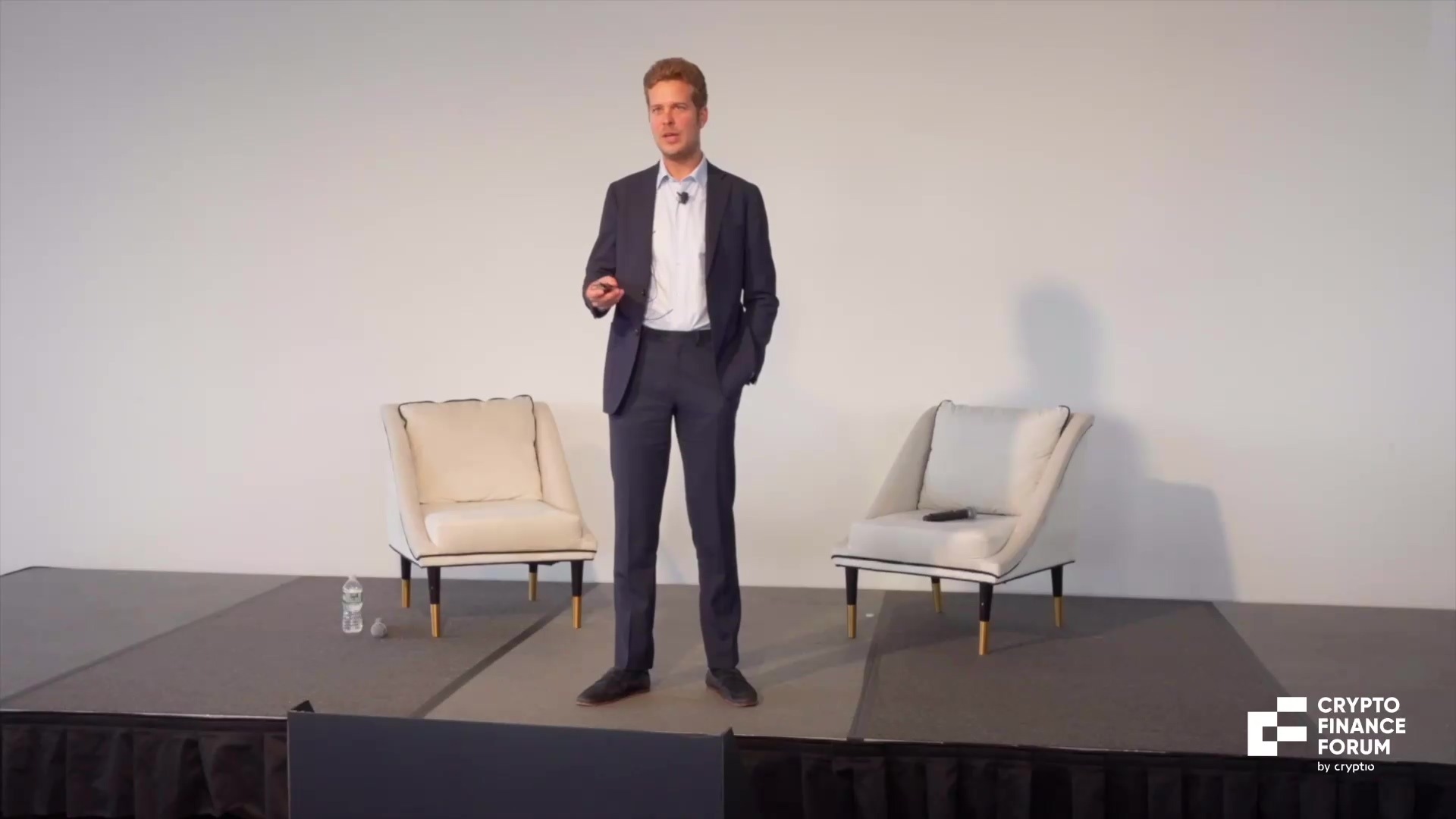
Antoine Scalia, Crypto Finance Forum, 2023
The accountant keeps calling
By his February 2022 appearance on The Accountant Quits, Scalia was explaining the work between blockchain transactions and ordinary accounting software. The conversation covered reconciliation, decentralised finance, auditing and organisations whose activity took place entirely on-chain. Cardano, Solana, Consensys and Aave were among the projects identified as customers.
The practical obstacle was translation. An accountant needs records that fit reporting workflows. Blockchain activity begins with a different vocabulary. Extracting it, interpreting it and getting it into the books involves work that a transaction explorer alone does not complete.
Scalia had an unusually memorable description of the early customer. In his 2023 Colossal keynote, he recalled startups dealing with an accountant calling ten times a day to understand what they were doing with their crypto. They wanted something adequate to answer those calls. Eventually, the requirements became more exacting.
Colossal, presented at Paris Blockchain Week, organised that response around data auditability, back-office workflows and operational dashboards. Scalia was also thinking about the person using the software: a finance professional who might know accounting very well without being fluent in crypto. A useful interface had to make the activity understandable.
There is a human scale to that design problem. A company can have complex technology and still leave an employee staring at a transaction, wondering which account it belongs in.
custodians
compare records
that can be checked
The transfer leaves a trace. Turning the trace into usable financial records is a separate job.
Four million reasons to listen
A customer’s growth supplied a concrete test. At the 2024 Bedrock keynote, Uniswap Labs CFO Justin Wong described moving from 12 tokens to more than 5,000 across nine blockchains. Monthly transaction volume went from 200,000 to almost four million. His team took the problem to Scalia and Cryptio.
The response was a batching engine. It consolidated activity daily, reducing the number of records finance teams had to work through while retaining the original transaction detail. Wong described a return from millions of transactions to hundreds of thousands in the working process, with the ability to inspect the underlying information later.
Those figures belong to that customer’s experience at that moment. They also make the founder’s challenge wonderfully tangible. Growth had arrived as a large quantity of accounting work. Scalia’s team had to help a customer handle it without losing the detail that made the records useful.
There is a temptation to tell a software company’s history as a sequence of launches. This episode offers another chronology: the customer’s business changes, the workload changes, the supplier listens, and the product has to catch up. The applause can wait until the records are usable.
A room for the people doing the sums
Scalia’s public work has also involved getting the people responsible for the numbers into the same room. At the inaugural Crypto Finance Forum in 2023, the audience included controllers, accountants, auditors and CFOs. The programme brought together participants from organisations including FASB, PwC, EY and Deloitte.
For Scalia, collaboration was part of defining accounting, tax and audit practices around digital assets. Cryptio then described a customer base exceeding 350, including Consensys, Uniswap, 1inch, Gnosis and NEAR. Its work also reached Bancolombia and Chivo, El Salvador’s government-backed wallet.
The mix matters. A software company can automate a process, but the people around it still have to agree on the questions the process should answer. A controller, an auditor and a developer approach the same transaction with different responsibilities. Bringing them together makes those differences available for discussion.
Scalia had already given his distrust of personality-led authority a compact public expression. In November 2022, he published an essay titled “Crypto should not have gods. Just auditable data.” The title has the satisfying economy of a complaint that has been edited down to its essentials.
It also makes a demanding promise for a founder. If evidence should carry the argument, the product has to make evidence available. A persuasive presentation only takes the customer so far.
One foundation, more demanding questions
Bedrock, introduced in 2024, extended Cryptio’s focus to reconciliation between on-chain wallets, liquidity providers and internal systems. Its ambitions included the high transaction volumes and reporting requirements of exchanges, banks and custodians. The problems increasingly crossed the boundary between a company’s blockchain activity and its own internal records.
In January 2025, Cryptio announced a $15 million Series A extension led by Alven. Added to the earlier financing, it brought the round to $25 million. Scalia’s stated expectation was that regulated products would bring the next wave of users into digital assets. Those products needed financial controls that institutions could work with.
Later that year, he presented a platform with three applications: accounting, tokenization compliance and loan management. They shared the same underlying data infrastructure. Accounting addressed the books; tokenization compliance checked issuance activity against records; loan management followed agreements, collateral and payments.
The attraction of that arrangement is easy to grasp. If each department constructs its own version of the same activity, the institution inherits another reconciliation problem. Shared, checked data gives the applications a common starting point.
Scalia’s role had expanded with the product. The founder who began by gathering transactions was now asking how several financial operations could use the same foundation. Each application brought a different set of users and decisions.
- 2018Bring the activity together
Cryptio is founded; the early product consolidates crypto transactions.
- 2023Make the records auditable
Colossal brings data auditability and finance workflows into focus.
- 2024Handle institutional complexity
Bedrock extends reconciliation and processing infrastructure.
- 2025Put more work on one foundation
Accounting, tokenization compliance and loan management share a data layer.
Eight years after the first dashboard
In March 2026, Cryptio announced a $45 million Series B co-led by BlackFin Capital Partners and Sentinel Global. The company reported more than 400 enterprise customers across over 30 countries and more than $3 trillion in processed transaction volume. SG Forge, Circle, Gemini and Securitize were among the institutions it named.
The money was intended to expand the platform, including loan and treasury management. The expansion follows the same operational thread: gather activity from different places, reconcile it, and make it useful to the people responsible for the books. Each additional application depends on that underlying work.
By then, the early dashboard and the enterprise platform were separated by eight years of changing customer demands. The founder’s public focus remained unusually consistent: give digital financial activity records that can be independently checked. His New York base places him within the institutional market his company increasingly serves; the work still depends on understanding what happens across many systems and countries.
There is room for ambition in that apparently prosaic task. Scalia wants Cryptio’s data to support more of an institution’s financial operations. Achieving that means repeatedly earning confidence in the underlying records, even as the applications above them multiply.
The early user wanted to know what a collection of crypto holdings was worth. The institutional customer needs to explain holdings, liabilities and activity to other people, under much greater scrutiny. Scalia has built his career along the distance between those questions. However quickly the money moves, someone still has to show the workings.
Follow the workings
Continue with Scalia’s conversations, writing and company updates.
Cryptio website ↗Antoine Scalia on LinkedIn ↗Antoine Scalia on X ↗Scalia’s writing on Medium ↗Watch: building enterprise crypto accounting software ↗Listen: the early bookkeeping conversation ↗The Bedrock keynote and customer accounts ↗The March 2026 funding announcement ↗