Matthew Van Niekerk went to business school with a company already in his head. It had a name, P2PFX, and an idea: let people exchange currencies with one another. Belgium was supposed to provide an MBA and, with luck, a team. The funding never arrived. It is an unglamorous opening for a blockchain founder, which makes it useful. Before the company that survived, there was a proposal that did not get financed. Before SettleMint, there was a question about who gets access to financial systems and how much trouble that access requires.
Van Niekerk later recalled thinking about that abandoned venture when Bitcoin appeared. He joked that he wished he had met Satoshi. The remark carries a little regret and a little generosity: someone else had found a way forward. His own route would take him through the inside of a bank before returning him to entrepreneurship. By September 2026, the company he eventually co-founded was ten years old, and his ambition had acquired an almost comically modest word: ordinary.
First, a different kind of board
He was born and raised in Canada and studied economics at Western University. After university, he moved to Japan, where he spent about seven years. Tokyo supplied experience in foreign-exchange brokerage and online retail. It also supplied an early business built around an interest that has remained outside his job description: snowboarding.
In 2003, he started an online retail company bringing difficult-to-source snowboarding goods to the Japanese market. Consider the scale of that problem. A customer wanted an item; the item was hard to obtain; a business could make the connection. There was no requirement to explain the future of finance before anyone could understand the transaction. Snowboarding equipment enjoys that advantage over distributed ledgers.
In a later account of his work, he put that retail venture alongside SettleMint. The connection he drew was the presence of a concrete difficulty that technology could address. Away from work, he described himself as a husband, father, barbecue enthusiast and snowboarder. His biography had room for both a boardroom and a board that was considerably more fun to fall off.
The bank years belong in the story
Belgium became home in 2006. His International MBA at Vlerick was followed by a series of roles at KBC. These were operating jobs with rather more substance than the word “innovation” usually reveals. He worked in internal management consulting, became a Lean Navigator, and served as COO of the Belgian consumer finance business.
From 2013 to 2016, he led platform innovation and development at KBC Securities Bolero. His responsibilities included the technical side of the online retail brokerage and the Bolero Crowdfunding platform. The latter gave him a place to explore blockchain in capital markets. His professional biography credits the platform with a publicly available blockchain application from a European bank or broker.
Those jobs give the later founder a useful backstory. Consumer finance involves operations. Brokerage involves platforms. Crowdfunding involves participation in a market. Across the sequence, the questions become increasingly close to the ones SettleMint would address: how does an application work, how does it connect to existing systems, and how do people actually use it? The eventual startup was preceded by years spent working within the kind of institution it would later serve.
A trip to Brooklyn, a company in Belgium
Van Niekerk dates his entry into blockchain work to 2014, while he was still at the bank. What caught his attention extended beyond banking. He saw applications in other industries, alongside a difficulty that kept recurring: building the software was hard. His account of the decision to leave places it in New York in 2015, during a visit for the Consensus conference and a trip to the ConsenSys office in Brooklyn.
He already knew his future co-founder. Roderik van der Veer and Van Niekerk had worked together before setting up SettleMint in 2016. Their partnership therefore began with experience of one another’s work. Van Niekerk would lead the business as CEO; Van der Veer would lead its technology. A new company did not require a new acquaintance.
The product addressed repeated obstacles in blockchain development. Developer tools, interfaces and reusable components could save each team from solving the same problems again. That proposition also widened the potential audience. A company with an experienced software team should have a route into blockchain without every developer first becoming a specialist in it. Van Niekerk’s enthusiasm was attached to that practical bottleneck.
The sensors were already out there
DataBroker DAO, another venture he co-founded with Van der Veer, made the access question tangible. Sensors were collecting information. Potential buyers might find that information valuable. Yet data could remain inside the organization that owned the sensor. The proposed marketplace would connect owners and buyers, allowing data to reach people beyond its original setting.
In September 2017, Van Niekerk announced that DataBroker DAO had joined the Sigfox Partner Network. The attraction was existing connectivity and the businesses already building and deploying sensors. Manufacturers, owners and buyers could meet through infrastructure that was operating already. Agriculture, automotive uses and smart cities were among the areas he discussed.
His writing could be blunt. In an October 2017 explanation of DataBroker’s relationship to IOTA, he argued for connecting to established sensor networks and concentrating on usable data. He also recorded the less theatrical work: a public demonstration in London in January, a beta release in March, user-interface iteration and business-model work with Vlerick students. The itinerary included Dublin, Brussels, Singapore, Dubai and Berlin. A marketplace needed participants, and finding them involved leaving the desk.
“People who say it cannot be done should not interrupt those who are doing it.”A favorite expression Van Niekerk shared in 2018
The work between interest and adoption
SettleMint’s developer proposition attracted a €16 million Series A in October 2022, co-led by Molten Ventures and OTB Ventures. Fujitsu Ventures, Allusion, Bloccelerate and existing investor Medici Ventures also participated. The funding announcement described plans to strengthen the business in Europe and Asia, expand into Japan and add staff. Japan was entering the company’s expansion story years after it had entered the founder’s life.
The investor’s explanation centered on a skills gap: organizations could be interested in blockchain while their developers lacked experience building with it. SettleMint offered a platform to reduce that difficulty. Van Niekerk’s argument included the security, scalability and interoperability requirements of enterprise applications. The challenge continued after a developer had written something that worked in a demonstration.
Co-led by Molten Ventures and OTB Ventures.
Announced on 11 October 2022.
His published work also began addressing the people around the technology. The 2023 Operational Guide to Blockchain Transformation for Banking and Financial Services bears his name as author and links people, process and technology. A separate supply-chain report surveyed 200 IT directors and executives about adoption and remaining challenges. Both efforts reflect an interest in what organizations must do to move from an appealing use case to implementation.
His conversations have followed that interest across industries. A 2024 supply-chain podcast discussed transparency, agriculture and food-and-beverage applications. An interview with Lam Trinh covered integration, team culture and the difficulty of adoption. These are subjects with an inconvenient amount of detail. They also make a better test of a software business than enthusiasm alone.
Tenacity, with questions from the room
At IIT Kharagpur in 2023, he stepped back from his usual blockchain talks to speak about strategy for technology startups. He credited the ideas in Play Bigger as an influence. When an audience member asked which trait mattered most for an entrepreneur, his answer began with tenacity. The question came from aspiring founders, and the answer concerned continuing through difficulty.
That is advice his own chronology can support without turning it into a legend. P2PFX did not secure funding. His career continued through different businesses and different countries. The co-founder relationship developed before the startup. SettleMint then required years of work. Persistence in this account includes learning how organizations operate and staying close to an actual problem.
He is listed among the mentors at Start it KBC. He also interviews other leaders in the Chief Digital Heroes newsletter. Recent subjects include Nick Philpott of Zodia Markets and Giovanni Everduin of Commercial Bank International. Asking questions has become part of his public work alongside answering them. A founder’s network becomes more interesting when it includes conversations about how other people do the job.
A surprisingly demanding word: ordinary
Today, Van Niekerk is SettleMint’s President. Adam Popat is CEO; Van der Veer remains CTO. Van Niekerk’s remit covers commercial strategy, partnerships, business development and market growth. The role suits a career that has repeatedly connected a technical possibility with the question of who will use it.
In their September 2026 anniversary note, the co-founders describe a future in which digital assets become ordinary inside regulated institutions. Their focus extends through an asset’s lifecycle: issuance, holding, transfer and servicing. They discuss involving legal, compliance, operations and technology teams early, when those teams can help shape the design. An asset has a life after its creation; a bank has responsibilities throughout it.
- Issue
- Hold
- Transfer
- Service
Four stages highlighted in the co-founders’ September 2026 note.
The ambition makes sense beside his earlier chapters. The retail customer wanted equipment they could obtain. The data buyer needed information they could access. The developer needed software they could build. The institution needs an asset it can operate within its rules and systems. Each case brings the excitement of an idea down to the conditions of use.
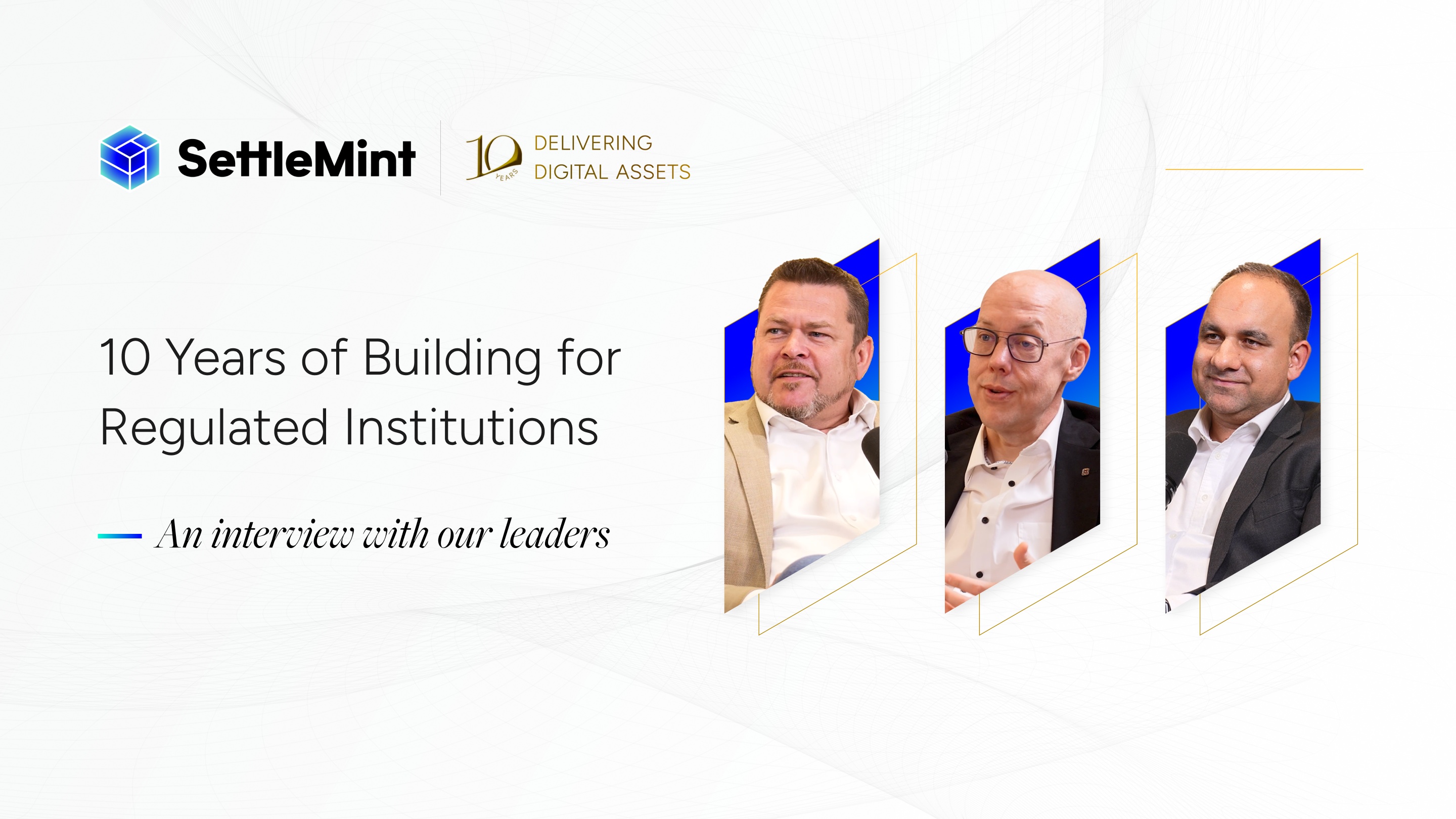
At the tenth-anniversary interview, Van Niekerk put the passage of time plainly: “We’re 10 years later, but we’re still only at the beginning.” Ordinary, in this story, is something to work toward. It means the interesting machinery has become dependable enough for somebody else to get on with their day.
Keep the conversation going
- SettleMint ↗
- Matthew on LinkedIn ↗
- Current leadership ↗
- The P2PFX origin story ↗
- Tokyo, snowboarding & the early ventures ↗
- KBC and Bolero career ↗
- Education & career dates ↗
- The Series A announcement ↗
- Ten years, in the co-founders’ words ↗
- The anniversary interview ↗
- DataBroker and Sigfox ↗
- DataBroker’s practical argument ↗
- The IIT Kharagpur talk ↗
- The operational guide ↗
- The supply-chain research ↗
- From Farm to Pint podcast ↗
- Conversation with Lam Trinh ↗
- Start it KBC mentors ↗