A market can stay open all night and still have nobody useful on the other side of a trade. That awkward distinction sits near the centre of Guilhem Chaumont’s career. Crypto made it possible to issue an asset and trade it around the clock. Finding a dependable price, with enough money behind it, remained a job for somebody.
Chaumont made that job his business. The French engineer and former HSBC trader co-founded Flowdesk in Paris in 2020. His early proposition was unusually concerned with the invoice: token issuers could pay for market-making technology and traders, supply their own capital, and see what the service was doing. In a business fascinated by tomorrow, he was asking who paid for today’s liquidity.
Six years later, his vocabulary includes institutional credit, tokenized securities, and licences in Europe and Dubai. The underlying question has survived the expansion. How do you make a new financial market dependable enough for someone else to use? It is an engineering problem with a considerable amount of paperwork attached.
First, learn how the machinery works
Chaumont’s education crossed two disciplines that would later meet inside Flowdesk. He completed an engineering master’s at École Centrale de Lyon in 2015, then a master’s in international finance at HEC Paris in 2017. Before his finance career, he worked as a student engineer at CEA, the French atomic and alternative energies commission, between 2012 and 2015.
At HSBC, he joined the Global Financial Resources Management team, working as a trader from late 2016 until July 2018 after an analyst internship. A bank’s trading operation is a useful place to encounter the practical limits of money: where it sits, what it costs, and which risks travel with it. His subsequent businesses would keep returning to those questions.
He was already trading cryptocurrencies in 2016. By the end of 2017, he had started a mining business. That meant encountering crypto through both its market and its production machinery. The combination is more revealing than a tidy conversion story. Chaumont’s route into the industry involved operating things, rather than merely expressing enthusiasm about them.
In 2018, he co-founded X-Network, the privacy-focused venture associated with X-Cash, and became its CEO. The project’s early white paper described a former trader trying to connect blockchain technology with mainstream use. That ambition predates Flowdesk. The product changed; the interest in making a technically novel system usable was already present.
Centrale Lyon
HEC Paris
X-Network
Flowdesk
The invoice was part of the invention
Flowdesk’s market-making service addressed an unglamorous difficulty facing token projects. A listing gives an asset somewhere to trade. It does not automatically produce a market with enough buy and sell orders to accommodate the people arriving there. A thin order book can make a modest transaction surprisingly expensive. The welcome mat is out; the furniture has yet to arrive.
Chaumont and his fellow founders, including Paul Bugnot, built a service around that gap. In its retainer model, the issuer provided capital and Flowdesk supplied trading infrastructure and people. The issuer kept the resulting gains and carried the losses. Fees, trading parameters, and visibility into activity became central parts of the proposition.
That last detail matters. Paying a service fee does not remove market risk. It changes the commercial relationship and makes its terms easier to inspect. Chaumont’s argument was that issuers should have more control over how liquidity was supplied, rather than surrendering the whole exercise to a trading counterparty whose incentives might differ from theirs.
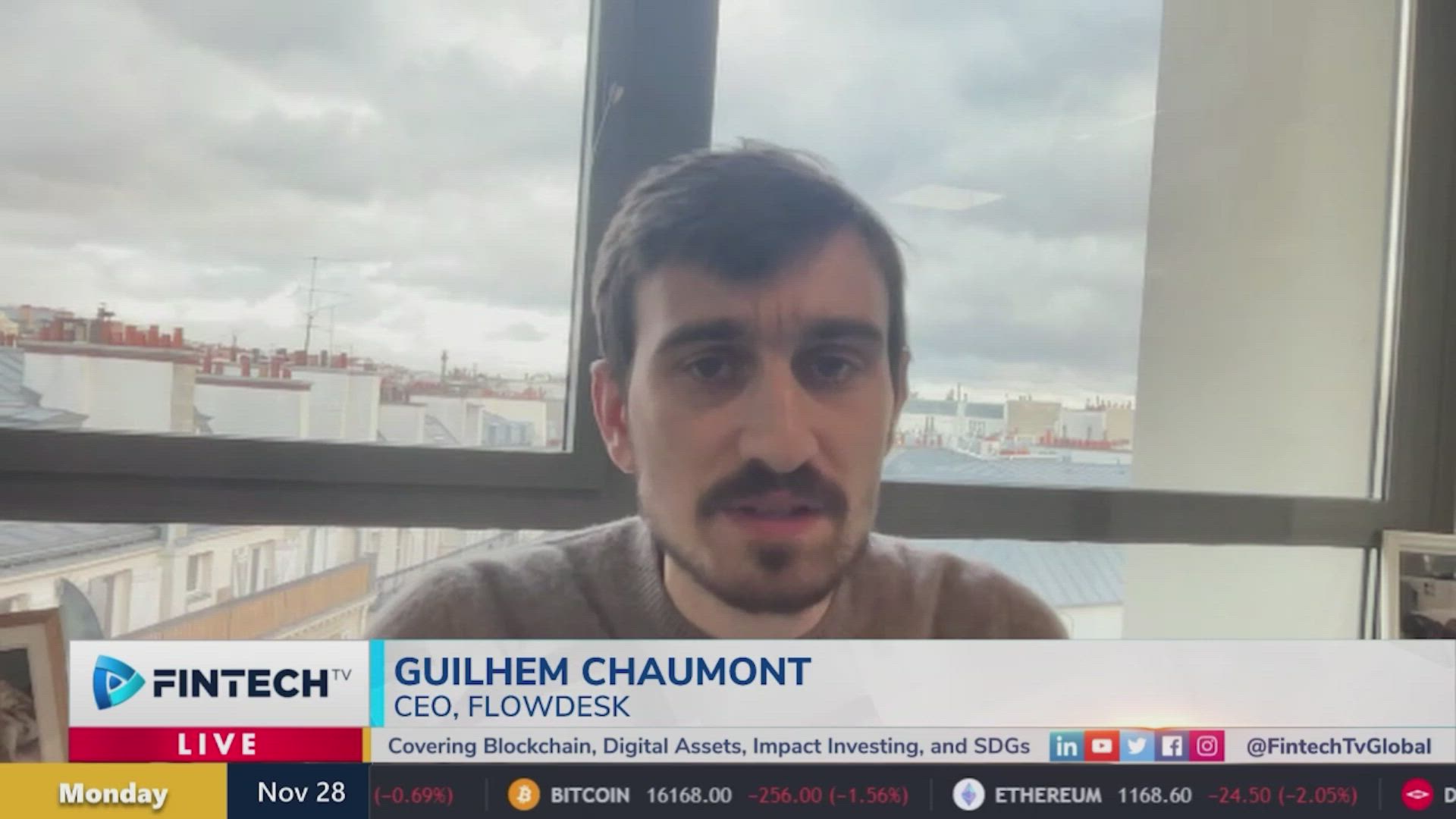
In June 2022, Flowdesk announced a $30 million Series A. Its infrastructure then connected 60 exchanges. The money was intended to extend that infrastructure and support international expansion. The investors included Eurazeo, Aglaé Ventures, ISAI, Coinbase, and Ledger. The institutional company of later years began with a specific service and a fairly specific complaint about how its market worked.
A new asset meets an old bank
One way to understand Chaumont’s progress is to follow the counterparties. In December 2023, Société Générale’s digital-assets subsidiary, SG-FORGE, appointed Flowdesk to make markets for its euro stablecoin, EUR CoinVertible. Flowdesk would provide liquidity for euro and USDT trading pairs. A company founded to help crypto projects trade was now supplying part of a European bank subsidiary’s blockchain infrastructure.
For Chaumont, the connection fitted a longer-held expectation that institutional activity would move onto public blockchains. The practical assignment was narrower than that ambition: help an actual instrument trade. A stablecoin can be designed for settlement or collateral, but users still need a workable route into and out of it. Finance has a habit of making the doorway as consequential as the room.
In January 2024 came another assignment: Flowdesk was one of four liquidity providers for Grayscale’s spot bitcoin ETF, alongside Jane Street, Virtu, and Flow Traders. The work connected bitcoin trading with the creation and redemption of fund shares. Chaumont pointed to a consequential difference between the systems: ETF settlement required liquidity providers to fund trades in advance.
That same month, Flowdesk announced a $50 million Series B led by Cathay Innovation. The timing made the fundraise and ETF appointment look like one neat sequence. Chaumont said the financing had closed before the ETF business was part of the plan. Business biographies enjoy inevitability. The calendar sometimes declines to cooperate.
Guilhem Chaumont, January 2024
How much money, exactly?
By March 2025, the financing story required a little arithmetic. Flowdesk announced financing totalling $102 million. Chaumont clarified publicly that this included the earlier $50 million Series B and a new $52 million extension. HV Capital led the extension’s equity component; funds and accounts managed by BlackRock supplied debt. The distinction changes what readers should understand about both the timing and the type of capital.
He also described a broader business. Flowdesk planned to expand OTC derivatives, establish a dedicated crypto credit desk, and consider a UAE office. The firm reported eightfold revenue growth in 2024 without publishing an absolute revenue figure in that announcement’s coverage. The growth multiple tells one part of the story; it does not supply the missing denominator.
A separate June 2025 agreement added access to a credit facility of up to $100 million from Two Prime Lending. Borrowings were to be secured against a portion of Flowdesk’s bitcoin holdings. The arrangement allowed multiple drawdowns and specified a 365-day maturity, with an extension subject to consent. Available borrowing capacity is a different thing from a new equity investment, and from money already borrowed.
For a trading business, those distinctions belong in the story. Capital is also working material: it helps finance positions and accommodate differences in settlement. Chaumont’s expansion was taking Flowdesk further into the financial mechanics surrounding a trade. The service had grown beyond placing quotes on an exchange.
Paris, with permission to go further
Chaumont remained publicly associated with Paris as Flowdesk expanded internationally. His 2024 discussion of Asia-Pacific opportunities focused on local institutional relationships and the possibility of further activity in Hong Kong. His ambition was geographical as well as technical. A market running through the night requires customers, counterparties, and operational coverage across time zones.
The European regulatory milestone arrived in June 2026. France’s Autorité des marchés financiers authorised Flowdesk Europe SAS as a crypto-asset service provider under MiCA on 25 June. The permissions included custody and administration, exchange, order execution, and transfers. These are named activities granted to a named entity. Such detail is the substance of the achievement.
In August, Flowdesk Omega FZE received its full Dubai broker-dealer licence from VARA, following an in-principle approval in June. The permission covered services for qualified and institutional investors in and from Dubai. Chaumont described the work behind it in terms of governance, compliance, risk management, and infrastructure. Expansion had acquired a very concrete form.
The two permissions apply to different entities and jurisdictions. Flowdesk’s own European disclosures make another useful distinction: regulatory authorisation does not guarantee an asset’s value, liquidity, or safety. For a founder who has repeatedly made transparency part of his commercial argument, precisely describing what permission means belongs alongside obtaining it.
The market stays open. The work continues.
By September 2026, Chaumont was describing the next problem in unusually practical terms. A tokenized asset may trade while its underlying reference market is closed. Pricing then has to account for the interval before that market opens again. Dividends, splits, and trading halts still matter. Fast-moving software inherits some remarkably old obligations.
His account also stressed the financing gap when a token settles immediately and the underlying asset follows a slower cycle. This is the territory his career has brought him to: the point where a technological promise meets inventory, custody, and someone’s balance sheet. A market available at any hour still has to pay its bills on time.
There is a restrained ambition in that choice of work. Chaumont’s public career runs from engineering and bank trading through mining, a privacy project, and a trading firm with more than 200 people. Each stage places him close to the mechanisms that let other people participate. The recurring subject is access, with all the complications that arrive when access becomes real.
His next chapter will be judged in that same practical language. Can institutions trade the size they need? Can they understand the arrangements? Can the machinery keep working when the reference market goes home? For Guilhem Chaumont, the future of finance has become a daily exercise in making the present function.
Continue the conversation
Follow Chaumont on LinkedIn, browse his earlier Medium writing, or explore Flowdesk.
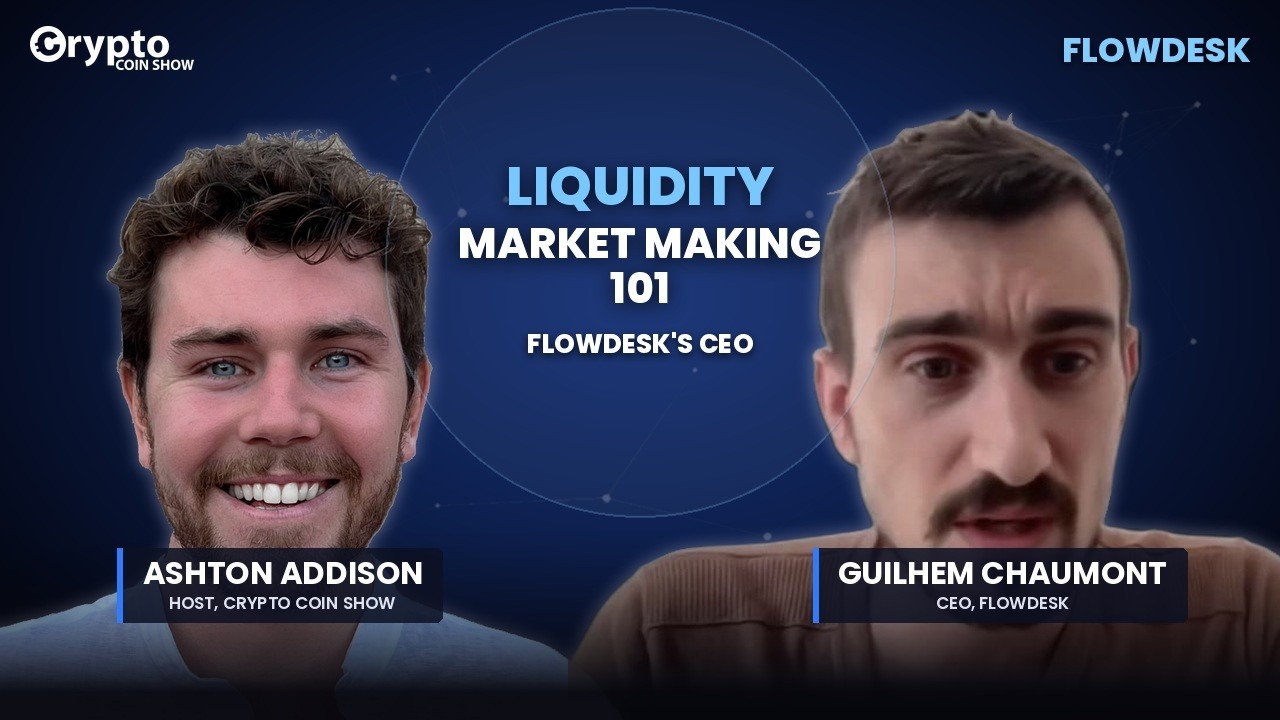 Watch · Market making, explained ↗Crypto Coin Show · 2022 · 24 minutes
- The Scoop: tariffs, tokenization and institutional adoption · April 2025
- A conversation about continuous trading and tokenized assets · September 2026
- Flowdesk’s ETF assignment and the Series B chronology · Blockworks
- The $52 million extension, explained · The Block
- Chaumont discusses conflicts of interest in crypto · FINTECH.TV