Kaiko · CEO & Chairman
Ambre Soubiran
She keeps the receipts for an entire asset class. Somebody had to.
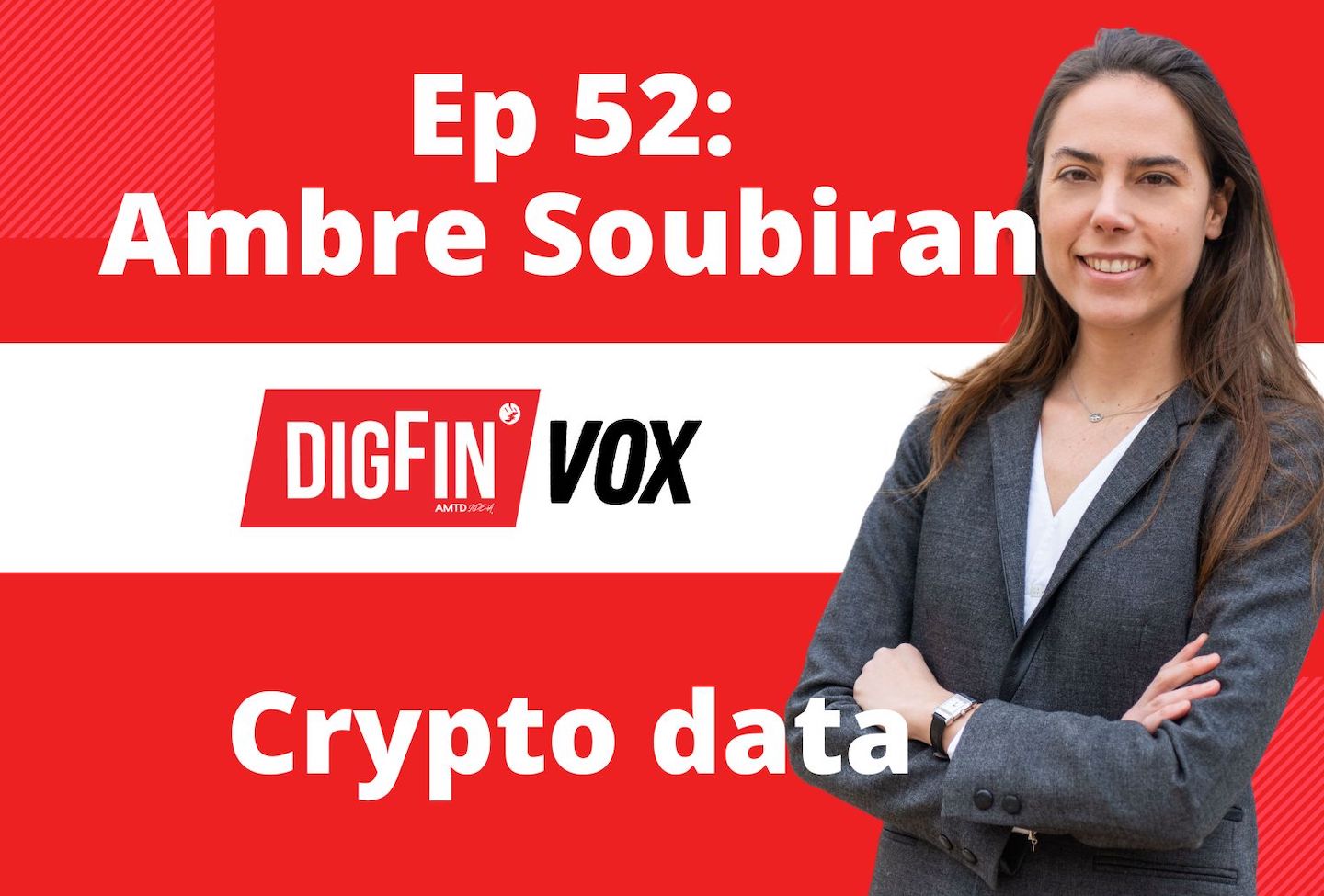 // The referee never plays. She just decides what counts.
She keeps the receipts for an entire asset class. Somebody had to.
// The referee never plays. She just decides what counts.
Walk into any serious conversation about crypto markets and somebody, somewhere, is quoting a Kaiko number. The benchmark that settles a fund's net asset value. The index a regulator squints at. The price feed an exchange trusts to mark a billion dollars of open positions. Behind that quiet ubiquity sits Ambre Soubiran, who runs Kaiko from Paris and treats data the way a watchmaker treats a movement - every tick has to be accounted for, or the whole thing lies.
Her day job is deceptively dull on paper: collect, clean, and standardize cryptocurrency market data, then sell it to institutions that cannot afford to be wrong. In practice it is closer to forensic accounting for an industry that spent its adolescence allergic to receipts. Kaiko captures every visible, executed trade across more than a hundred exchanges, stretching back roughly fourteen years, and turns that firehose into something a compliance officer can sign off on. The pitch is not excitement. The pitch is that you can finally measure the thing.
The detail that explains her is the one most founders would bury. In 2016 she did not start Kaiko. She bought it. At the time it was a bright idea with no revenue and no staff - the corporate equivalent of an empty room with a good name on the door. She had spent roughly a decade at HSBC in London and Paris structuring equity derivatives and equity-based financing, the kind of role people leave only for another bank. She left it for the empty room.
That move looks obvious now and looked reckless then. Soubiran had been following digital assets since 2012, back when an interest in bitcoin was less a career move than a personality quirk you mentioned carefully at dinner. She read the space as a structured-products person reads any new market: where are the gaps, where is the mispricing, what infrastructure is missing. Her answer was that crypto had plenty of opinions and almost no trustworthy data. So she went and built the data.
She came to it with the right toolkit. Applied mathematics at Universite Paris Dauphine, entrepreneurship at the Solvay Brussels School, summer finance at the London School of Economics. It is a resume engineered for someone who likes both the equation and the company that ships it. On a trading floor that combination structures exotic payoffs. Pointed at a young asset class, it structures the rails everyone else trades on.
Under her, Kaiko grew from that empty room into a business of roughly 130 people working out of New York, London, Paris, and Singapore, funded by more than $80M in venture capital including a $53M Series B in 2022. The company sells indices, benchmarks, real-time and historical feeds, analytics, and the unglamorous machinery of market surveillance - the tools that let a bank, an asset manager, or a regulator look at crypto and see a market rather than a rumor.
There is a quiet philosophy under the spreadsheets. Markets run on trust, and trust runs on measurement. If you cannot agree on the price, you cannot agree on anything - not the risk, not the exposure, not whether someone is cheating. Soubiran built a company whose entire value proposition is being boring on purpose: neutral, independent, regulatory-compliant, the same number for everyone. In a corner of finance famous for hype cycles and vanishing exchanges, selling reliability is its own kind of contrarian bet.
The recognition followed the work rather than preceding it. She has been named a French-American Foundation Young Leader and listed in the Choiseul 100, the ranking of France's most promising young economic leaders. She turns up on the agendas of Consensus and the major fintech forums, usually making the same unfashionable argument: that the grown-up version of this industry will be won on data quality, standards, and the patience to keep the archive honest while everyone else chases the next narrative.
What makes her unusual is not that she bet on crypto early - plenty did, and most of them were buying tokens. She bet on the plumbing. While the rest of the room argued about which coin would win, she quietly appointed herself scorekeeper, and the scorekeeper, it turns out, is the one everybody ends up needing.
Consider what that scorekeeping actually involves. A single asset can trade on dozens of venues at once, each with its own fees, its own clock, its own appetite for wash trading. A naive average lies. A good benchmark has to decide which prints to trust, which to discard, and how to weight what remains, then defend every choice to a regulator who is paid to be skeptical. This is the part of finance that never makes a headline and never can fail. Soubiran's background in structured products - where mispricing the inputs quietly detonates the whole position - turns out to be the ideal training for it. She has spent her career on the unglamorous side of the trade, the side where being right is invisible and being wrong is catastrophic.
It also explains her allergy to the industry's favorite mode, which is excitement. Crypto sells itself on upside, on the next cycle, on the screenshot of a number going up. Kaiko sells the opposite: continuity, neutrality, the promise that the data will look the same tomorrow as it does today regardless of whose narrative is winning. That is a strange thing to build inside a market built on narratives, and it is exactly why institutions that cannot touch the asset class without it have come to depend on her. The boring layer is the load-bearing one.
Geography is part of the strategy too. Running the company from Paris rather than San Francisco or Singapore is its own small statement - that the future of digital finance does not belong to a single time zone, and that a European base can sit credibly between American capital and Asian demand. With desks in New York, London, Paris, and Singapore, Kaiko reads as a follow-the-sun operation, a market that never closes watched by a team that never fully sleeps. For a French applied-mathematician who spent her HSBC years shuttling between London and Paris, the four-city sprawl is less an ambition than a continuation of how she has always worked.
Strip away the funding rounds and the speaking slots and the throughline is consistent: she finds the place where a market is missing its instruments and she builds the instruments. She did it inside a bank, where the instrument was a derivative. She is doing it now across an asset class, where the instrument is the data itself. The empty room she bought in 2016 was never the gamble it looked like. It was a structured-products person spotting an obvious gap - no trustworthy data, no trustworthy market - and pricing it correctly while everyone else was busy arguing about the coins.
“If you cannot measure a market, you cannot trust it.”// The Kaiko thesis, in one line
From the trading floor to the data layer. Each step looks small until you connect them.
Kaiko's footprint, sketched. Not a hockey stick - a foundation. The kind you only notice when it's missing.
She studied applied mathematics in Paris before she ever set foot on a trading floor. The numbers came first.
Her crypto interest dates to 2012 - roughly a decade before the institutions she now sells to took it seriously.
She bought a company instead of founding one. The startup was real; the revenue and staff were not yet.
Kaiko's Paris HQ sits at 2 Rue de Choiseul - the same name as the Choiseul 100 list she landed on.
Her competitive edge in a hype-driven industry is reliability. She sells the absence of surprises.
She runs a four-city company spanning New York, London, Paris, and Singapore - a follow-the-sun data desk.