Before a business could run its own corner of Avalanche, somebody had to put up 2,000 AVAX. Each custom-chain validator also had to validate the network’s primary chains. The tokens were staked, rather than spent, but the commitment was real. Imagine renting an office and discovering that every security guard must also buy a substantial interest in the building.
- Ava Labs builds the software behind Avalanche and sells managed infrastructure through AvaCloud.
- Dedicated chains let organizations choose their own participation rules and operating conditions.
- Etna lowered the entry commitment. Running a useful, secure application still takes work.
In December 2024, the Etna upgrade changed that arrangement. Sovereign Layer 1 validators could pay a continuous fee, initially estimated at roughly 1.3 AVAX a month, without staking those 2,000 AVAX on the Primary Network. This was a different bargain: less capital tied up before a customer had proved its idea.
*Initial estimate for the dynamic protocol fee. Stake and fees are different economic measures. Hosting, engineering and managed services cost extra.
A very expensive front door
Ava Labs occupies an unusual position in the blockchain business. It helped create a public network, Avalanche, yet part of its commercial proposition is helping organizations build networks of their own. Its customers can want the shared technology without wanting every application to share the same operating space.
The distinction matters. A game studio may want its own transaction economics. A financial institution may need to restrict who can participate. A public agency may need a shared audit trail with carefully controlled access. More throughput on a general-purpose chain does not, by itself, answer those requests.
Avalanche provides both a shared environment and dedicated chains. Its C-Chain supports Ethereum’s virtual machine, allowing developers to use familiar Solidity contracts and tooling. Separate Avalanche L1s offer room for different validation arrangements. The appeal is control without starting a blockchain project from a blank repository.
The professor, the students, and Team Rocket
The origin has an appropriately odd detail: Team Rocket. In 2018, researchers using that name published a paper describing a new family of consensus protocols. Cornell professor Emin Gün Sirer and doctoral students Kevin Sekniqi and Maofan “Ted” Yin were investigating related questions. They founded Ava Labs that year.
Consensus is the problem of getting distributed computers to agree on a record. Avalanche’s approach uses repeated sampling among participants, allowing agreement to emerge without every computer consulting every other computer at every step. The research became the basis for infrastructure that applications could actually use.
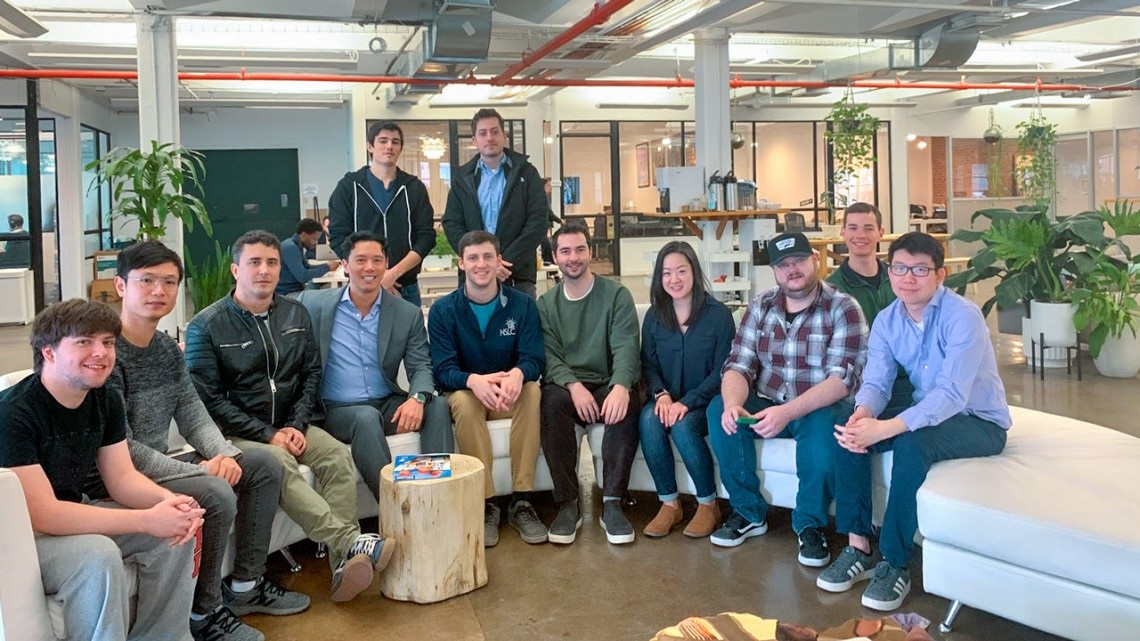
By May 2019, the company had emerged from stealth with $6 million in early funding. A public AVAX sale raised $42 million in July 2020, and Avalanche mainnet followed that September. Those milestones belong to a connected story, but they are different financial events: company funding, token sales and network activity should not be added together casually.
“Cornell is the academic home to blockchains and cryptocurrencies, and it’s hard to imagine Avalanche without it.”Emin Gün Sirer · Cornell Chronicle, 2020
Even the names require housekeeping. Ava Labs is the company. Avalanche is the platform and network. AVAX is the token. Buying the token does not buy shares in the company, and money moving across the network is not Ava Labs revenue.
Football and FEMA paperwork
FIFA gives the dedicated-chain argument a recognizable face. In May 2025, its FIFA Blockchain launched on AvaCloud, Ava Labs’ managed infrastructure offering. FIFA Collect, built by Modex, runs on top. The chain is compatible with Ethereum-style wallets, including MetaMask.
The customer wanted authority over its digital environment: fees, applications and the way fans enter. A dedicated network provides that room. It also places a familiar consumer problem ahead of the protocol: people collecting football moments should not need a seminar on blockchain architecture before getting started.
Deloitte supplies the less glamorous example, and perhaps the more instructive one. Its Close As You Go application coordinates disaster-recovery documentation on a permissioned AvaCloud L1. Local, state and federal participants can work with a shared record while access remains restricted to authorized entities.
- 01Local agency
Submit records - 02Authorized reviewers
Verify and approve - 03Shared audit trail
Prepare reimbursement
Simplified Close As You Go workflow. The ledger supports the paperwork; officials retain the approval role.
The problem is fragmented paperwork, duplicated effort and evidence that must survive an audit. AvaCloud’s case study reports documentation-processing reductions of 40 to 60 percent in early deployments. That is a vendor-reported result, not a promise that every disaster claim will move that much faster.
The day the gossip took over
On February 23, 2024, Avalanche stopped finalizing blocks for roughly five hours. An early suspicion centered on inscriptions, a way of placing data onchain. The diagnosis changed: a gossip-related transaction-pool bug was causing nodes to send excessive messages to one another.
Validators upgraded to AvalancheGo version 1.11.1, whose release suspended transaction re-push gossip. Service returned as operators adopted the fix. Some custom networks were affected because their validators also had primary-network duties. The incident exposed the practical consequences of that dependency.
Make the commitment smaller
AvaCloud, launched in May 2023, makes a commercial service out of deployment and operations. It manages underlying infrastructure so customers can concentrate on applications. Core, the company’s wallet, handles another part of the experience: holding assets, staking and accessing financial applications.
Alternatives include Ethereum’s rollup ecosystem, Solana and Cosmos-based application chains. A conventional database also deserves consideration when one trusted organization can maintain the record. A dedicated blockchain still needs security, governance, integrations and users. Lower entry costs cannot supply those automatically.
The engineering continues. September 2026’s Helicon upgrade introduced Continuous Execution on the C-Chain and changed Primary Network staking, including automatic renewal and a 48-hour minimum validator period. Operators face changing software and rules alongside the benefits.
The lesson other businesses can copy is concrete: examine what a customer must commit before discovering whether your product helps. Ava Labs’ evolution puts that commitment under scrutiny. For a football platform or a relief administrator, the useful question comes afterward: does the new infrastructure make the actual job easier?