For months before JANUS-1 rode a rocket into orbit, another JANUS-1 was already flying. This one lived in a lab, in software. Engineers could change a component, test the flight code and watch the imagined spacecraft respond. The physical satellite launched from India on February 10, 2023. Its virtual counterpart had spent the preceding months making that launch a little less mysterious.
This is the idea behind Antaris, the Los Altos company founded in 2021 by Tom Barton and Karthik Govindhasamy: begin the mission before the metal is finished. Satellite programs still need clean rooms, environmental testing, launch providers and people willing to trust a small machine to vacuum. Antaris adds a place to rehearse the whole undertaking while decisions remain reversible.
- Antaris sells software for designing, simulating and operating satellites and constellations.
- Its JANUS-1 demonstrator reached launch readiness in ten months; Antaris reports a 75% cost saving against comparable missions.
- The platform joins four tools: Design Studio, TrueTwin, Command Center and SatOS.
- Its buyers include government agencies, spacecraft builders, payload teams and commercial operators.
The expensive way to discover a small mistake
A conventional spacecraft project passes work between specialists. A mission planner defines what the satellite must do. Engineers choose a bus and payload. Software teams write the code. Hardware teams assemble it. Operators later inherit the result. Each handoff gives an assumption a chance to hide. The worst time to find one is after the spacecraft is sealed, shipped or launched.
Barton had led operations at Planet Labs and, earlier, a company that supplied servers to large cloud customers. Govindhasamy had been Planet’s technology chief, overseeing satellite and mission-control systems. They had watched two industries treat change differently. Software teams expect to test a system repeatedly. Space teams must eventually commit to hardware that is difficult to touch again. Antaris was their attempt to bring more of the first habit into the second industry.
The company’s most persuasive exhibit is not a slide of future savings. JANUS-1 was a 6U technology demonstrator carrying five payloads, with Antaris SatOS managing core spacecraft duties and coordinating onboard computing. Manufacturing partners XDLINX Labs and Ananth Technologies helped turn the design into a real vehicle. It flew on the Indian Space Research Organisation’s SSLV-D2. Antaris says the team went from concept to launch readiness in ten months and spent 75% less than comparable missions. Those comparisons come from the company; the launch itself is a harder, simpler fact.
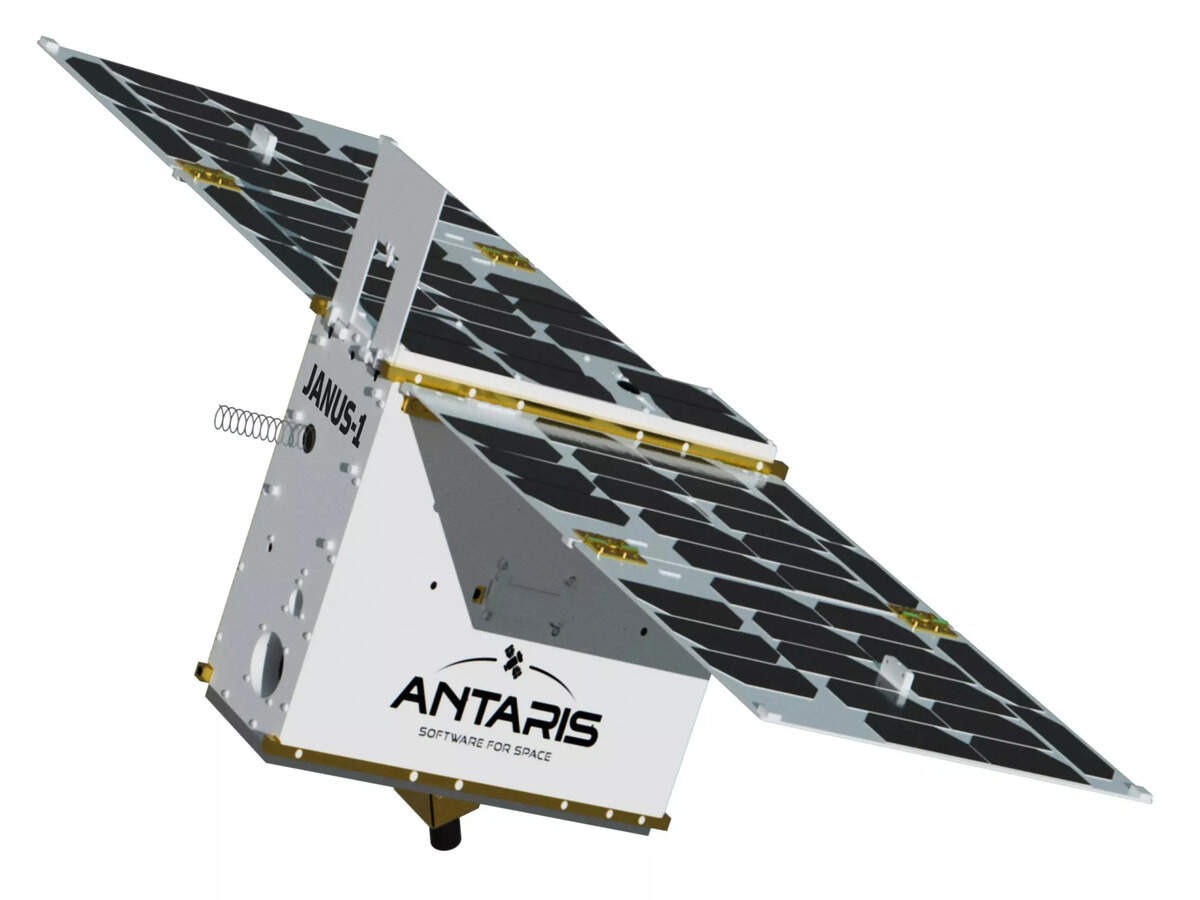
The time and cost figures are Antaris’s reported results for JANUS-1, not a guarantee for other missions.
A rehearsal with the real script
The distinction in Antaris’s pitch is that the rehearsal is meant to use the intended spacecraft configuration, including its software and drivers, rather than a generic cartoon satellite. Its TrueTwin environment models the bus, payload and mission. As physical components become available, teams can connect hardware to the simulation. This keeps the software test from drifting too far from the machine that will eventually fly.
Design Studio handles early mission and satellite choices. TrueTwin runs them in a virtual environment. SatOS supplies spacecraft software, either as a full stack or alongside a customer’s own flight code. Command Center handles provisioning, command and control at operational scale. Together they form the company’s business-to-business platform, sold to mission owners rather than to the public. Antaris does not list a universal price; the economics depend on the mission and the services required.
One mission, four connected jobs
That continuity is its difference from a toolbox assembled from separate vendors. A change to a payload should be visible in the model, the software test and the operations plan. The promise is particularly useful for constellations, where an error multiplied across many spacecraft becomes a very expensive habit. It also helps teams ask practical questions early: will this payload fit the power budget; what happens if a component fails; can the ground system keep up?
The customer is buying fewer surprises
Antaris’s named work spans very different missions. GalaxEye is using its software and bus reference designs for an Earth-observation spacecraft. Its TWINSAT work with the Space Development Agency uses digital versions of spacecraft to test operations without building a physical bench model for every exercise. A SpaceWERX contract awarded in 2023 gave the company $1.7 million to extend TrueTwin for in-space servicing and manufacturing research. In each case the buyer needs a way to test decisions before committing equipment, launch time or an operating crew.
The company also depends on partners. XDLINX and Ananth supplied the manufacturing muscle for JANUS-1. A 2026 agreement with Infostellar aims to connect cloud ground stations to Antaris mission APIs. SpeQtral has worked with it on a proposed quantum communications offering. These arrangements show the platform’s role in the market: Antaris is trying to coordinate hardware, software and ground operations that no single supplier owns entirely.
That ambition grew in 2026. In February, Antaris signed a memorandum with Saudi company SARsatX for an initial 16-satellite radar and optical constellation. In March it announced the first close of a $28 million Series A led by WestWave Capital, with Lockheed Martin Ventures participating. In July it established Aeonyx, a separate defense mission-virtualization business in Colorado Springs, while Antaris Global continued its satellite and sovereign-constellation work. A memorandum is a plan to cooperate, and financing is fuel; neither is the same as a delivered constellation. The next proof will be operational.
What to borrow from a satellite company
Most readers will never order a spacecraft. The useful lesson travels well. Start a working model before the final object exists. Run the actual code against that model. Replace guesses with real components as they arrive. Keep design, testing and operations connected, so a change in one place is not a surprise in another. Antaris did this with a machine that had to survive launch and orbit. A factory, hospital system or logistics network could borrow the sequence without borrowing the rocket.
There is a boundary to the analogy. A digital twin is only as good as its assumptions and measurements. Vibration, radiation, thermal extremes and imperfect suppliers still demand physical qualification and expert judgment. JANUS-1 did not make the hard parts of space disappear. It moved some of the learning to a time when an engineer could still press save.