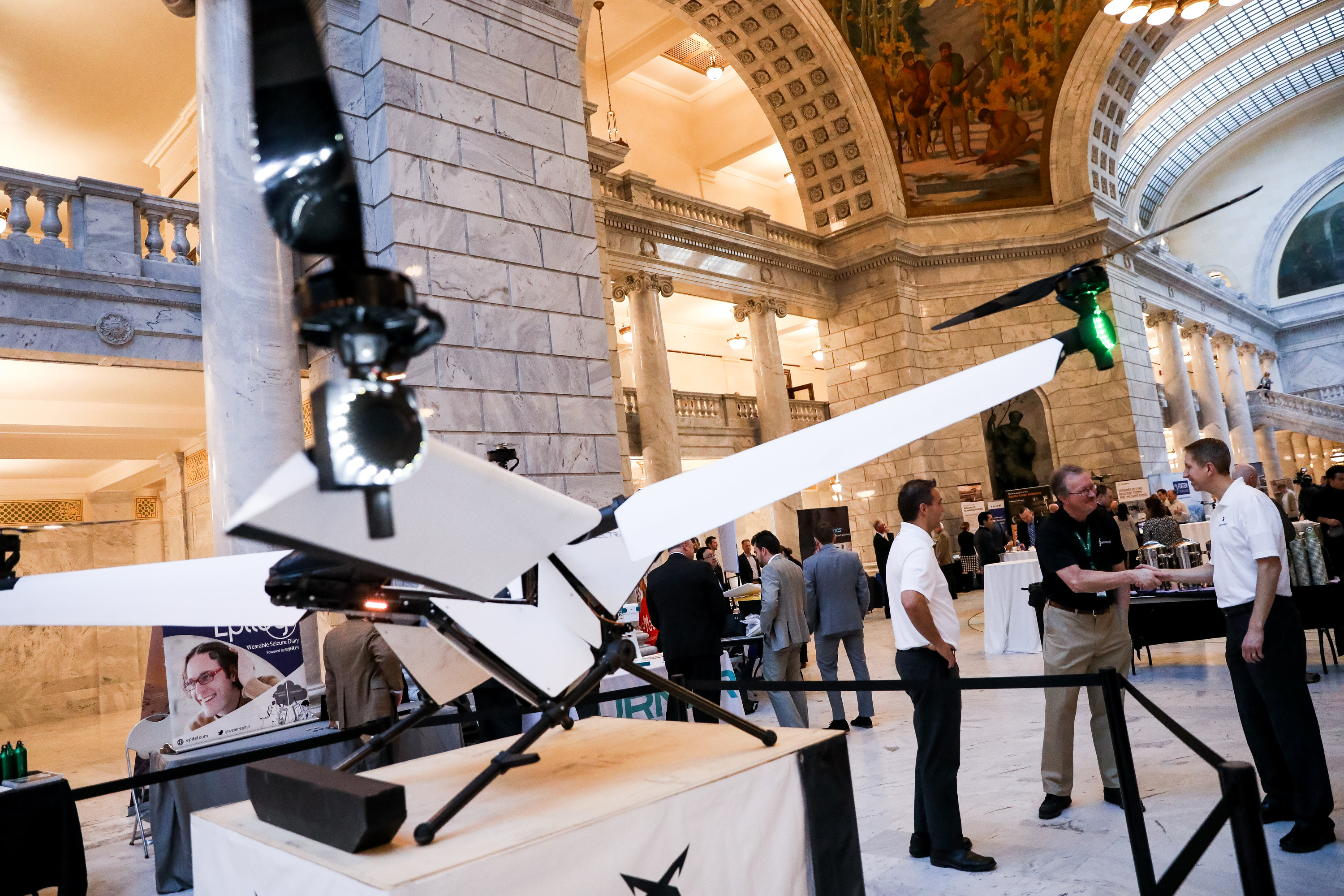
The flying machine looked pleasantly out of place beneath the Utah State Capitol dome. Its white arms reached across the marble rotunda. Green lights glowed at the ends of its rotors. Men in polo shirts stood around it doing what people always do when the future appears before lunch: they talked about how to make it work.
Randall Mills was one of them. In February 2020, he was photographed beside ElectraFly's founders, John Manning and Jason Burgess, at Utah's Industry Day. Mills was there as a senior program manager for KIHOMAC, an aerospace and advanced-manufacturing firm. The aircraft occupied most of the frame. Mills, in a black KIHOMAC shirt, was caught in conversation. The proportions feel honest. Hardware gets the spectacle. Conversation gets the hardware built.
Program managers work in that less photogenic territory between an idea and its reliable delivery. They live among schedules, requirements, budgets, changing assumptions and the occasional part that does not arrive on Tuesday. Their product is alignment. When they do the job well, everyone else gets to look uncannily organized.
He began with the signal
Long before the Capitol rotunda, Mills studied communications and digital signal processing at the University of Utah from 1984 to 1987. The pairing now seems almost too tidy. Digital signal processing is concerned with finding useful information inside a complicated stream. Program management asks much the same of organizations, except the noise comes from meetings, dependencies and people who use the word “urgent” with athletic enthusiasm.
Mills's professional summary reduces the whole enterprise to four words: “I am a problem solver.” He says he has more than 20 years of product and project management experience. That is a career measured less by a single invention than by the repeated act of turning ambiguity into the next sensible action.
The work also acquired stakes beyond elegant diagrams. In 2016, Mills published an invitation to software engineers under the headline, “If you'd like to see your code save lives...” The public excerpt was a recruitment call for experts interested in making the world safer. It revealed a practical ambition: technical skill should eventually meet a real human need.
That is the operator's bargain. One gives up the pleasure of treating the technical problem as the only problem. Code has users. Manufacturing has customers. Every milestone has a person waiting on the other side. The job becomes a continuous act of translation, and translation is useful only when the listener understands.
problem
language
can execute
I am a problem solver.Randall J. Mills
The optimism has elbows
Professional recommendations for Mills are unusually consistent about the way he occupies a team. One colleague praised his willingness to step up, his guidance and mentorship, and what he called Mills's “stubborn optimism.” The adjective matters. Ordinary optimism smiles at the schedule. Stubborn optimism opens it, finds the red cells and asks who needs help.
Another colleague described Mills as warm, calm and concerned with making people feel important to the mission. The same account emphasized customer support and the ability to work through significant challenges. A comment on a KIHOMAC post was even more economical: “Best boss I ever had.” It also called him a servant-leader mentor.
Such praise can sound soft beside the vocabulary of engineering, where tolerances and test results enjoy the authority of numbers. Yet program work is a human system wrapped around a technical one. A person who can lower the emotional temperature of a difficult discussion may save a week. A manager who gives credit generously may hear bad news early enough to use it. Kindness, in this setting, is not decoration. It is preventive maintenance.
Mills's own comments offer small evidence of that instinct. When a KIHOMAC colleague was praised for representing the company at Industry Day, he redirected attention to her leadership and wrote that it was a pleasure to work with her and the team. The sentence does not announce a philosophy. It practices one.
A title eats the org chart
In January 2024, Mills left KIHOMAC for QCC and announced the change with a title that refuses to fit on a respectable business card: “Engineer-CEO-CFO-Product Manager-Maintenance-Director of Fun and loving life.” Elsewhere, the role is listed more conventionally as chief executive officer. The long version is more revealing.
Its humor depends on recognition. In a compact operation, departments are sometimes moods rather than places. The chief executive reviews the product, checks the numbers, fixes the troublesome hinge and remembers that somebody must decide whether Friday needs doughnuts. A polished title would hide the range. Mills catalogued it.
The ending keeps the list from becoming self-important. “Director of Fun and loving life” sits beside CEO and CFO with equal grammatical dignity. It sounds like a joke, and it is. It also sounds like a small constitution. Work may be difficult without requiring everyone to become dreary.
Engineer. CEO. CFO. Product manager. Maintenance. Director of fun and loving life.The QCC job description, in one breath
There is a useful distinction here between collecting authority and accepting responsibility. Titles can be trophies. Mills's list reads more like a drawer full of tools, each one pulled out because the job in front of him needs it. The collection includes glamorous implements, such as CEO, and the organizational equivalent of a screwdriver.
That range connects the new chapter to the old one. The senior program manager standing near the aircraft in 2020 was already working across boundaries. Aerospace programs do not advance because one discipline wins an argument. They advance when disciplines exchange enough truth, early enough, to make the next test useful. The executive with maintenance in his title is making the same point with a grin: no task is beneath the mission if the mission depends on it.
A program manager learns quickly that nouns are deceptive. “The design,” “the schedule” and “the customer” sound like stable objects. Each is really a stream of decisions, many of them still moving. A requirement can be clear on Friday and newly complicated on Monday. The useful operator does not resent this motion. He builds a way for the team to see it, name it and respond without turning every revision into a small constitutional crisis.
Mills's public recommendations keep returning to this form of composure. People describe someone willing to enter the knot rather than stand outside narrating it. They mention confidence alongside kindness, resourcefulness beside concern. Those pairings are important. Confidence without curiosity can bulldoze a project. Kindness without candor can leave the hard decision untouched. Technical leadership needs both the nerve to choose and the patience to hear what the choice will cost.
There is also a quiet continuity between his studies and this style of work. Communications theory asks what a message becomes as it passes through a channel. Organizations have channels too, although they are less obedient than copper or radio waves. A customer's need passes to a product manager, then to an engineer, then into a plan, a purchase order, a test and a report. At each handoff, meaning can blur. The operator keeps checking whether the message arriving at the far end still resembles the one that began the journey.
This helps explain why colleagues emphasize Mills's habit of making people feel part of the mission. Inclusion is not merely a pleasant atmosphere. It improves the channel. A person who believes his observation matters is more likely to mention the odd vibration, the risky assumption or the customer comment that does not fit the current plan. In complicated work, small truths delivered early are cheaper than large truths delivered after the deadline.
The useful work between things
Mills's public record is not a parade of keynote stages or grand declarations. It is closer to the record of an operator: a technical education, decades in product and project work, a stretch managing engineering programs, praise from people who worked beside him, then a move into a role with deliberately porous borders.
That makes the photograph beneath the Capitol dome more than a pleasant curiosity. The aircraft is an object designed to defeat gravity. The people beside it are confronting a different force: the organizational drag that acts on every ambitious project. Their conversation is the work between things, between prototype and product, specialist and customer, excitement and proof.
Mills appears comfortable there. His education taught him to look for signals. His profession asked him to find them in teams. His colleagues noticed steadiness, optimism and care. His latest title admits that the boundaries were always somewhat fictional.
The machine in the rotunda had green lights, white blades and the courtesy to look futuristic. The program manager beside it had no such theatrical advantage. He had questions, relationships and a schedule. Those are quieter instruments. In practiced hands, they also create lift.