On a July day in California’s Salinas Valley, a yellow quadcopter made a small but awkward demand of its observers: patience. The SiFly Q12 stayed in the air for 3 hours, 11 minutes and 54 seconds. Guinness World Records certified the flight in the 5-to-20-kilogram class of electrically powered prototype multirotors. By the time it landed in Chualar, the familiar rhythm of drone work - launch, watch, hurry home for a battery - looked rather less inevitable.
- SiFly builds electric aircraft for long industrial missions, led by the Q12.
- Its commercial wager is fewer launches, fewer docks and more useful time aloft.
- A $20 million Series A now backs a move from test flights to production.
- Public safety, infrastructure and agriculture are the first markets in view.
That record is a feat of engineering. It is also a pointed question for anyone who has ever tried to run a drone program across a city: how much of the budget is spent on flying, and how much on arranging for flying to resume? SiFly’s answer begins with endurance, then wanders into real estate, staffing and software. The aircraft is the visible object; the proposed saving lies in everything it might let an operator avoid.
The clock was the product
Founder and CEO Brian Hinman came to SiFly in 2021 with a history of building communications hardware businesses, including PictureTel, Polycom, 2Wire and Mimosa Networks. In a 2026 interview, he described starting with a simple design reversal. Most quadcopters, he argued, are shaped for hovering near an operator. He wanted one optimized for forward flight and future missions beyond visual line of sight. That meant revisiting the airframe instead of merely asking a familiar drone to carry a larger battery.
The Q12 is SiFly’s answer: an all-electric rotorcraft with four large rotors, vertical takeoff and landing, and a body designed to travel. The company advertises more than two hours of hover time, up to three hours in forward flight, roughly 60 mph top speed and a payload of up to 10 pounds. Its product page lists camera and thermal options, mapping sensors, cellular connectivity and swappable payloads. Those specifications describe an aircraft intended to inspect a long power line, map a large farm or arrive over an emergency and remain there.
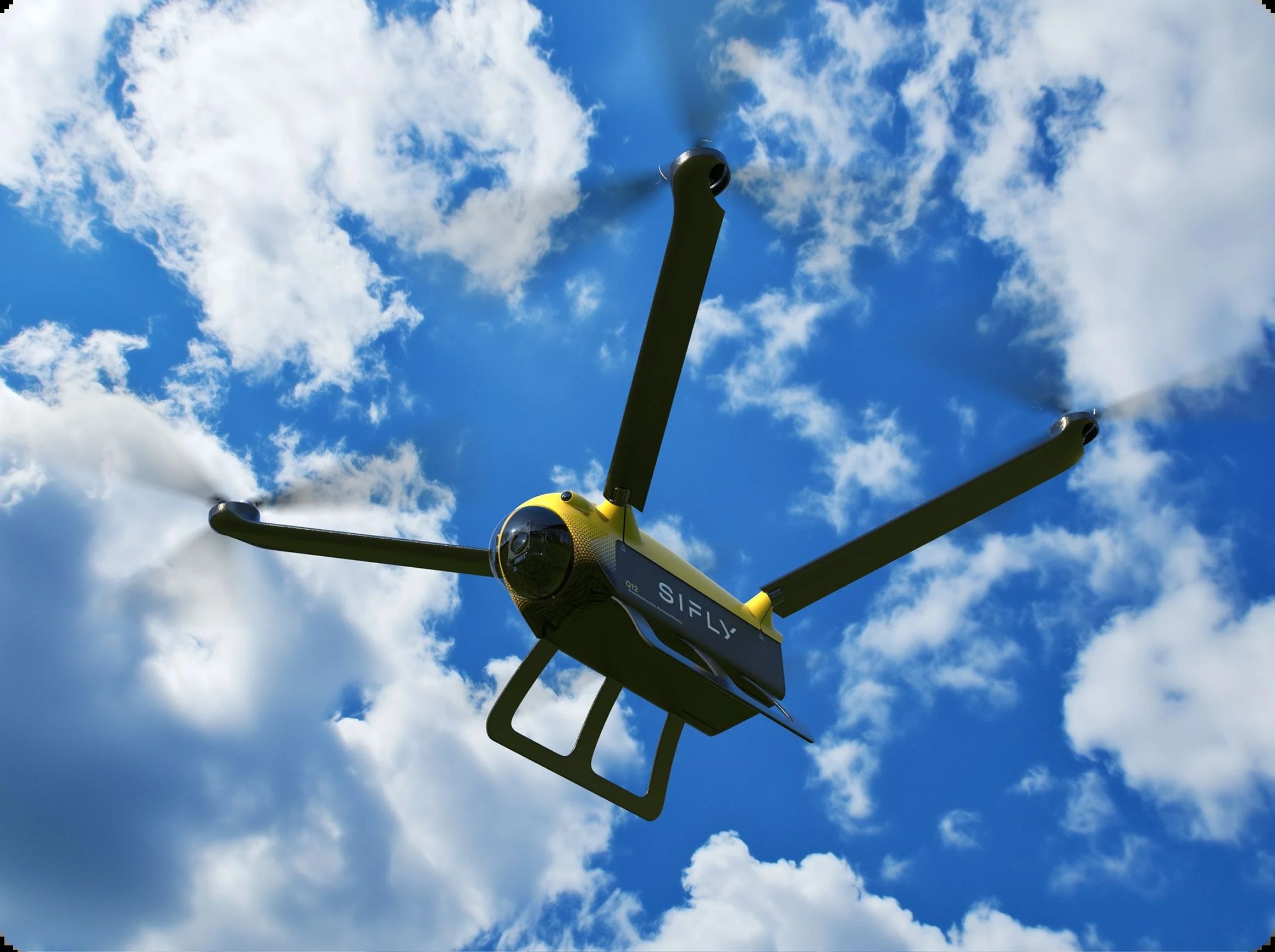
The record is independently certified. The other figures are company specifications, and real missions will vary with payload, weather, flight path and reserve requirements. That distinction matters. A patrol manager cannot purchase a world record; the manager can only purchase dependable time on station. SiFly’s competitive claim is that such time is scarce enough to remake the economics of an entire operation.
A parking space instead of a patchwork
Drone programs often compensate for short flights by scattering docks around a service area. Each dock creates another site to acquire, connect, maintain and protect. SiFly’s DronePort proposal turns that pattern inside out. Announced in May 2026, it is a 20-foot container designed to house an operations center and manage as many as four aircraft. The plan calls for automated launch, recovery, charging and quick turnaround from one node. The company says its model could cover a larger region with fewer fixed installations.
There is an elegant commercial idea here: sell the aircraft and the ground system together. A city might then budget for coverage rather than count drones. A utility might measure inspected miles per shift rather than takeoffs per crew. SiFly’s online planner offers a directional comparison of aircraft, docks and service area. It is a sales tool, but also a revealing one. The company wants procurement officers to draw a map before they ask for a unit price.
“Most multirotor drones were designed for short flights close to the operator.”Brian Hinman, SiFly founder and CEO
The idea has attracted partners. In December 2025, Versaterm said it would pair the Q12 with its DroneSense public safety platform. Campbell Police Chief Gary Berg described a vision of two aircraft continuously orbiting the city, able to respond quickly when an incident occurs. That is a proposed operating model, not a published account of a fleet already doing it. The difference between the two is exactly where purchasing decisions live.
Longer flight creates a larger sky
A drone that stays close to its pilot for half an hour creates one sort of aviation problem. A drone that travels tens of miles creates another. In April 2026, SiFly and ADS-B Exchange demonstrated Q12 telemetry appearing in a shared live airspace display alongside crewed aircraft. The Q12 sends location data through a cloud connection rather than broadcasting like a conventional crewed aircraft. It does not, on its own, settle every question about flight beyond visual line of sight, but it gives other observers a way to see the aircraft in a familiar picture.
That partnership hints at SiFly’s expertise as much as its rotor design does. Hinman’s earlier companies made systems that had to work together in the field, and SiFly speaks in the same grammar: aircraft, connectivity, ground stations, sensors and operational software. Its intended customers are public safety agencies, utility and infrastructure operators, and agricultural businesses. SiFly named Amaral Ranches in the Salinas Valley as an early deployment partner. There is no published customer count from which to infer scale.

The bigger Q250 sits at the far edge of that ambition. SiFly markets it for heavy cargo and agricultural work, with a stated payload above 200 pounds and a 2027 arrival target. Yet in August 2026, Hinman told Aviation Week that the company was still doing architecture work and that the $20 million round would not fund full Q250 development. The immediate job is the smaller, record-setting Q12. Keeping those two stages separate is less glamorous than a product-family chart, and much more useful to a buyer.
The factory is the second record attempt
Shield Capital led SiFly’s August 2026 Series A, joined by Qudit, BBK Capital and Alumni Ventures. The money is earmarked for Q12 production, supply chains, customer delivery and DronePort validation. Aviation Week reported that SiFly had not yet entered production and was targeting its first revenue-generating Q12 deliveries in the first quarter of 2027. Hinman said the company hoped to ship roughly 1,000 units that year. Hope is the operative word. It is a plan, not a delivery ledger.
Manufacturing will expose costs a flight record cannot. Hinman told Aviation Week that SiFly sourced motors from China and batteries assembled in Malaysia, and that assembling motors in the United States from global components could cost roughly three times as much as buying them from China. The company describes its aircraft as U.S.-made and NDAA-compliant, but the supply chain is still international. That is the unromantic side of American aerospace: “made here” is a production decision, while components come from a world map.
What changed Hinman’s mind about the market was the prospect of long missions and remote operations; what appears to have changed customers’ minds is simpler. Shield Capital says public safety, utility and agricultural operators repeatedly named endurance as a central constraint. The earliest failure in the standard drone routine is often the clock. Before the image is analyzed or the incident is resolved, the aircraft has to leave. SiFly has proved that its clock can run longer. The next proof is that a customer can schedule work around it.
There is a lesson here even for organizations that will never buy a quadcopter. Identify the expensive pause in a workflow, then ask whether a better tool removes the pause or merely makes it prettier. SiFly’s version is a longer flight that might mean fewer batteries, sites and crews. It will work best where long coverage has clear value and where airspace permissions, connectivity and maintenance support the plan. In a small site with brief missions, an ordinary drone may be the sensible bargain. On a wide map, time aloft can become the whole business case.
For now, the most revealing SiFly image is not the Q12 suspended against a blue sky. It is a calendar: a record in 2025, funding in 2026, and a delivery target in 2027. The aircraft has already stayed up long enough to make people watch. The company now has to make customers stop watching the clock.