A movement can fit neatly into a sentence. The work required to sustain one cannot. It needs volunteers who know where to turn up, staff who know what to do next, directors who understand their duty, partners willing to lend their reach, and an institution sturdy enough to remember what it promised after the cameras leave. Debbie Weir has spent much of her career in that complicated middle distance between a cause and its consequences. She is not merely interested in whether people care. She works on what caring is supposed to do by Monday morning.
Her résumé begins in social work and expands, almost methodically, into organizational power. She led the social-services department at St. Joseph Hospital in Fort Worth for four years, then built and directed a hospice program in Dallas. By 2002 she had joined the national organization of Mothers Against Drunk Driving as vice president of victim services. Three years later she was chief operating officer. In March 2012, she became national CEO.
It is tempting to tell that sequence as an ascent away from direct service, a familiar climb from the difficult particulars of people's lives toward budgets, plans and polished conference rooms. Weir's record suggests the reverse. Each promotion enlarged the radius in which the lessons of direct service could operate. The person answering a call did not vanish when she reached the executive floor. That person acquired a larger switchboard.
The work widened. The center held.
A voice is not yet a system
The nonprofit world is rich in feeling and forever short of translation. A personal account may change a mind, yet a changed mind is still several bridges away from a trained volunteer, a funded program, a board decision or a lawmaker's vote. Weir's career has been built on those bridges. At MADD, she inherited neither a tidy startup nor a single headquarters issuing simple commands. She led a network of more than 200 affiliates, each rooted in its own community and joined to a national mission.
A federated organization is a small constitutional puzzle. Local chapters possess knowledge and legitimacy; a national office possesses scale. Lean too hard toward the center and local judgment becomes decoration. Lean too far away and the name on the door means something different in every town. The executive's work is alignment without suffocation. It calls for enough procedure to make a promise reliable and enough humility to let local people improve it.
During Weir's MADD leadership, the number of people served each year more than doubled. The reported pace reached one person every 15 minutes.
That metric is unusually revealing. Institutions adore large annual numbers because large annual numbers look handsome in reports. One person every 15 minutes behaves differently. It returns scale to the clock. Somewhere, a person asks for help at 2:15. Another does at 2:30. The organization must be ready for both. Operational capacity, in this light, is compassion that keeps appointments.
Weir also understood that a national cause could borrow reach from institutions outside its usual orbit. MADD's relationship with the NFL put the designated-driver message in front of football audiences, while local events turned partnership into participation. At the 2017 Mercedes-Benz Stadium 5K and Walk Like MADD in Atlanta, 8,535 people registered. A stadium designed for spectacle became, briefly, an organizing tool.
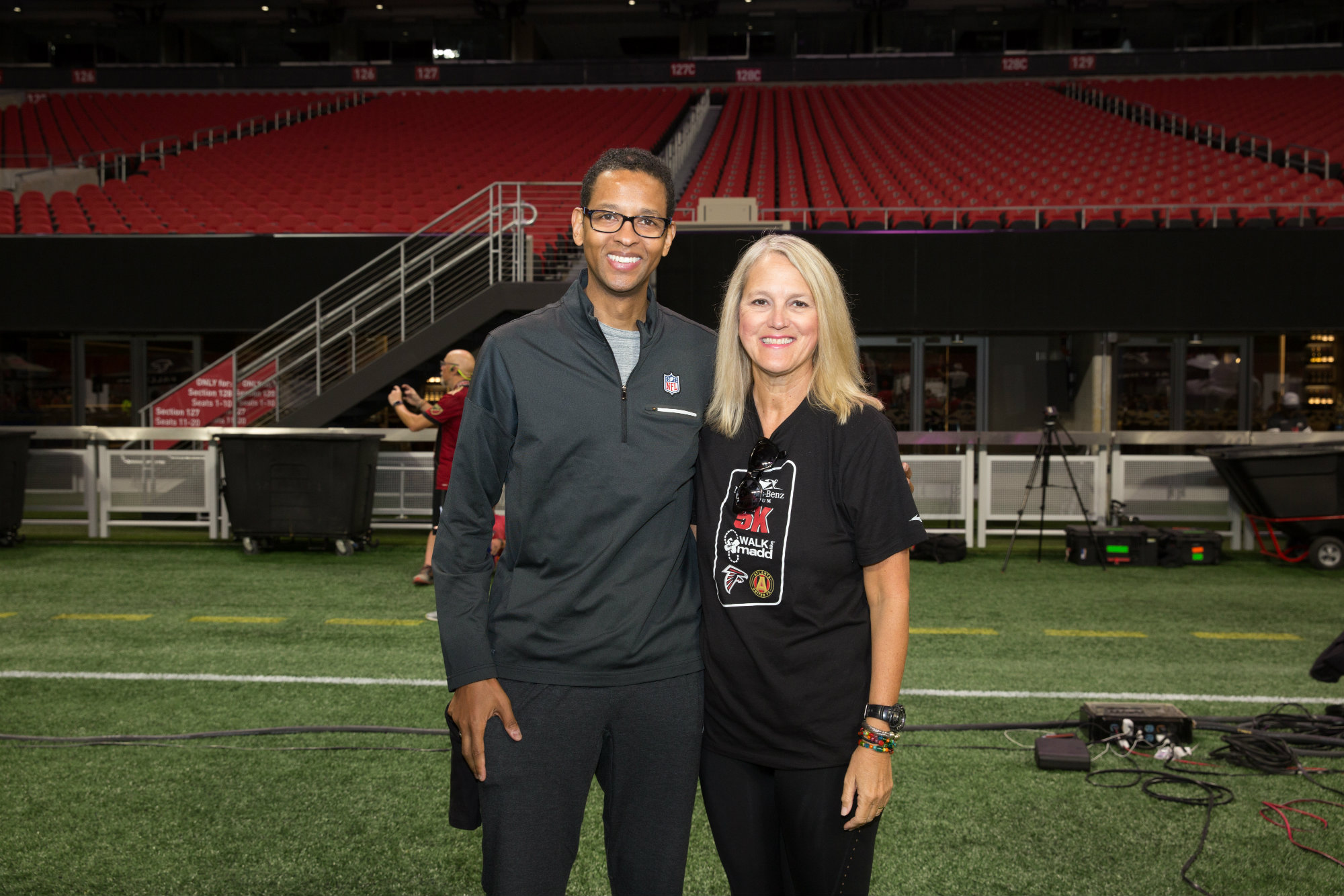
The picture is cheerful, as event photographs are contractually obliged to be. Behind it sits a serious piece of organizational design: a national brand, a professional league, a local affiliate, event volunteers, sponsors and participants pulling in the same direction for a morning. Coalition-building is often described as chemistry. Much of it is closer to stage management. Someone must ensure that the right people arrive, understand the scene and can hear their cue.
The second operating principleKeep testimony near the controls
In 2017, Weir moved from MADD to Everytown for Gun Safety, where she became senior managing director for organizing and engagement. Her remit included strategy for Moms Demand Action, Students Demand Action and the Everytown Survivor Network. The scale was different: nearly six million supporters and thousands of volunteers. The essential problem was familiar. How does an institution grow without turning the people most affected into scenery?
Her work there included new programs, corporate and professional partnerships, and the growth of a survivor network to 3,000 messengers across all 50 states. In 2021 she was elevated to chief mission officer, with responsibility for integrating trauma-informed practice into operations, messages and strategy. The title is slightly peculiar and therefore useful. A chief financial officer keeps the books close to every decision. A chief mission officer tries to do the same with purpose.
“People experiencing life-altering events require strong advocates who provide support, education, and community.”Debbie Weir, on the thread connecting her work
There is a quiet rebuke in that idea. Organizations like verbs: launch, disrupt, transform, win. People living with the consequences of public problems may need slower nouns: support, education, community. Weir's professional advantage is her comfort with both grammars. She can speak the language of national strategy while remembering that an individual rarely experiences a strategy. An individual experiences whether a call is answered, whether a volunteer is prepared, whether an institution makes room for a complicated story.
This is where her social-work training matters most. It does not make management sentimental. It makes management observant. A social worker is taught to see the person and the system at once: the immediate need, the surrounding institutions, the points where help is available and the gaps where it disappears. Running a national network asks for the same double vision, only with a larger spreadsheet.
The portfolio yearsA career becomes a set of levers
In March 2022, Weir became CEO of Cancer Support Community, the first social worker to lead the organization. Her appointment returned her to an institution built around direct support while drawing on everything she had learned about affiliate networks, national advocacy and operational scale. She entered with an explicit plan to listen across the organization: professionals, educators, researchers, advocates, partners and supporters. Listening, in her telling, was not a ceremonial tour before the real work. It was how the real work began.
After that executive chapter, her career changed shape. In March 2024, she founded Mission-Driven Consulting. Board and advisory roles accumulated alongside it. Safe Kids Worldwide lists her as a director. In February 2025, United Against Fentanyl appointed her to its advisory board, asking her to bring experience in strategy, grassroots engagement and coalition-building. In August 2025, the Cancer Vaccine Coalition named her chief impact officer, responsible for national strategy, stakeholder engagement and impact initiatives.
The sequence looks less like retirement from executive work than an unbundling of it. A chief executive holds many levers inside one institution. A consultant, director and adviser can pull selected levers across several. Governance here. Coalition design there. A new national strategy somewhere else. The authority may be less concentrated, but the pattern is unchanged: gather constituencies that possess different kinds of power and give them a way to act together.
Chief, where Weir is listed as a founding member, belongs in this portfolio as a professional network rather than as her central job. That distinction matters because online profiles have a habit of mistaking membership for management. Her operating identity is better described by the long arc: direct-service practitioner, builder, chief operator, national executive, organizer, consultant and board adviser.
The durable lessonAttention expires. Capacity compounds.
Public causes live under a peculiar tyranny. They must win attention, even though attention is fickle, competitive and poorly suited to the patient work of institutions. The vivid moment gets the headline. The volunteer database does not. A stirring speech may open a door; a competent regional structure keeps anyone from having to kick it open again next year.
Weir's achievements are therefore best read as acts of multiplication. More than 200 affiliates aligned around a national mission. Annual service reach more than doubled. Thousands of volunteers organized within a movement counted in millions. Three thousand messengers connected across all 50 states. None of those figures belongs to one person, and claiming them that way would offend the entire logic of coalition work. Leadership is visible in the conditions that allowed many people to produce them together.
Her career also complicates the usual caricature of the charismatic change-maker. Charisma can gather a room. The harder question is whether the room has a useful next step. Weir's recurring role has been to design that step, assign it, support it and connect it to the one after. This is not dull work, though it sometimes wears dull clothes. A well-built system is a promise that has learned how to travel.
Three decades in, Weir remains close to the junction where moral urgency meets institutional patience. The causes and titles change. The craft does not. Listen carefully. Keep affected people near the controls. Build a structure worthy of their trust. Then make sure it is ready again in 15 minutes.