The most important piece of campaign equipment is not the podium, the bus, or the red-white-and-blue sign. It is the clock. Campaigns have a deadline that refuses negotiation. A message either travels before Election Day or it becomes an anecdote told by the losing side. Precision Strategies was founded in 2013 by three people who had just lived under that clock: Stephanie Cutter, Jen O'Malley Dillon, and Teddy Goff, senior architects of Barack Obama's 2012 re-election. Their business insight was simple and slightly unsettling. The election ends. The contest for attention does not.
Today Precision is an integrated strategy and communications firm in Washington and New York. The label is tidy; the work is not. It advises a chief executive in a crisis, finds the people who might care about an issue, tests what could persuade them, buys the media that reaches them, recruits influencers, builds websites and videos, organizes supporters, and counts what those supporters did. Its clients include large companies, health organizations, sports and entertainment groups, nonprofits, coalitions, and political campaigns. The common customer is not a particular industry. It is an institution with a difficult audience and a consequential deadline.
The product is the loop
Traditional public relations has often behaved like a trumpet: make the message loud enough and hope the right people hear it. Precision behaves more like a thermostat. It senses, acts, measures the response, and adjusts. Research and data are not an appendix to the creative idea. They decide who should see it, where it should appear, and what happens next.
Consider GE. The industrial company wanted supporters it could reach directly on policy issues. Precision built an integrated audience database, surveyed subscribers about their interests, segmented the messages, and moved people along a ladder from information to advocacy. In 2018 and 2019, the program added 17,700 subscribers. It educated 2,850 members on priority issues and produced more than 8,590 letters to elected officials. The valuable object was not an ad. It was a company-owned constituency.
The same machinery can be aimed at a cause. For the Fan Fairness Coalition, Precision found music obsessives by targeting adults already searching for concerts and stars such as Taylor Swift, BTS, Harry Styles, and Bad Bunny. Paid and organic posts, plus influencers, gave those fans a route to write Congress. The campaign reached millions; hundreds of thousands mobilized. In May 2024, the Justice Department sued Live Nation and Ticketmaster. Precision does not get to claim that one campaign caused a federal antitrust case. It can claim something more precise: it helped turn private frustration into visible political pressure.
“Attention is not the result. It is the raw material.”The useful lesson inside Precision's model
First, the room disappeared
The cleanest story about what failed first arrived in 2020. The Democratic National Convention was supposed to happen in a convention hall. Then the pandemic made the room itself impossible. The old format did not merely underperform; it vanished. Precision helped produce the first virtual Democratic National Convention and later worked on President Biden's largely virtual inaugural celebration.
That constraint changed the question. Instead of asking how television could document an event in a room, producers had to ask how dozens of remote moments could become the event. Campaign experience mattered because campaigns are temporary organizations built to revise plans under hostile conditions. The thing worth copying is not a virtual convention. It is the habit of separating the desired action from the familiar format. If the room disappears, keep the purpose.
A blue firm buys a red one
Precision's next change of mind was organizational. Its Democratic lineage was an advantage in some rooms and an obvious limit in others. In March 2026, it acquired Firehouse Strategies, a public-affairs firm founded by veterans of Marco Rubio's 2016 presidential campaign. The combined operation has 125 people and access to more than 300 local operatives across all 50 states. Firehouse remains a conflict subsidiary while integration proceeds.

This is not a sudden outbreak of centrism. It is distribution. National messages encounter local accents, trusted messengers, different legislatures, and different suspicions. A 50-state network makes Precision less dependent on a Washington megaphone. It also gives corporate clients one door into political terrain that rarely divides as neatly as an org chart.
The financial terms of that acquisition were not published. Neither were the terms of Abry Partners' minority investment in 2023. Precision has no public rate card; bespoke counsel is sold by project and retainer. This matters because the model is labor-heavy. It competes with global networks such as Edelman and Weber Shandwick, Washington firms such as Avoq, SKDK, PLUS, Narrative Strategies, and FGS Global, and a long tail of specialist polling, crisis, creative, and media shops. Precision's wager is that one integrated team wastes less time translating between them.
Now the audience talks back in synthetic prose
The firm's newer products reveal where it thinks persuasion is moving. PULSE combines legislative tracking, stakeholder analysis, media and social monitoring, and competitors' advertising spend in one customized intelligence report. TerrAIn runs more than 500 prompts across ChatGPT, Claude, Gemini, Perplexity, and Copilot to see how a company or issue appears in AI answers. The pun is clumsy enough to remember. The service is not. Reputation once meant what reporters, search results, and social feeds said about you. It now includes what a machine confidently assembles when nobody from your company is in the room.
There is a sober limitation here. The feedback loop works when an organization has a specific outcome, permission to learn, enough time or money to test, and an audience that can plausibly act. It works badly when leadership wants applause without changing a decision, when the product contradicts the message, or when a client mistakes targeting for trust. Precision can locate an audience. It cannot manufacture credibility indefinitely.
Five things worth stealing
- Write down the action before you commission the content.
- Build a direct audience you can reach without renting the entire relationship from a platform.
- Test messages with the people who must move, not only the executives who approve them.
- Give local messengers room to sound local.
- Measure behavior - letters, sign-ups, donations, votes - alongside impressions.
The operator arrives
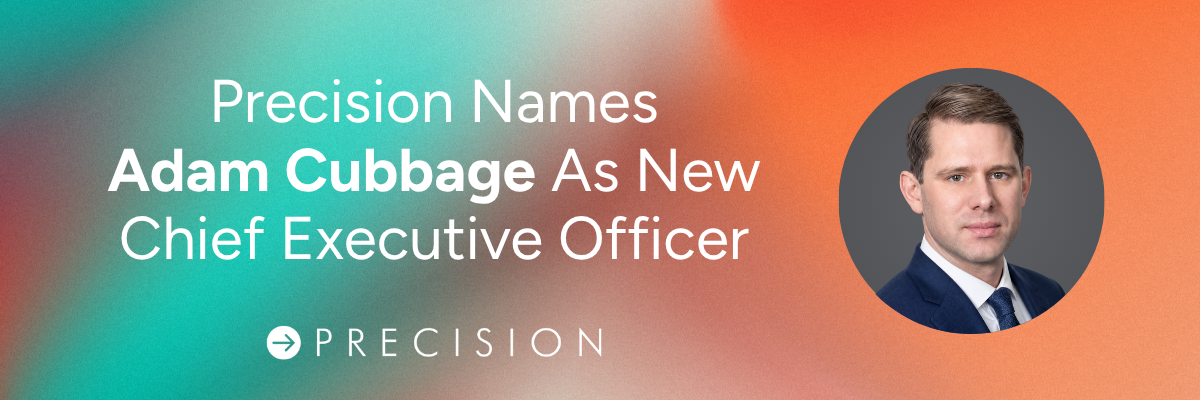
On September 15, 2026, Precision appointed Adam Cubbage its first chief executive. Cutter remains managing partner; Goff is chief growth officer and founding partner. Cubbage came from DGA Group, where he led the Americas, and from earlier crisis work at FTI Consulting. His assignment is less romantic than a campaign and more difficult to sustain: make urgency repeatable. Deepen corporate advisory, crisis, and litigation support. Integrate the acquisition. Develop people. Protect the quality of the work while the organization gets larger.
That is the paradox inside Precision. Campaigns are good at speed because they are temporary. Companies need speed to become a permanent capability. The firm has spent thirteen years selling the war room to clients. Now it has to prove the war room can grow up without turning into the conference room it was designed to beat.