There is a type of Washington career measured in titles, and another measured in connective tissue. Thomas Z. Freedman has accumulated enough of the former: press secretary, legislative director, special assistant to the president, senior White House adviser, campaign strategist, founder and chief executive. Yet another revealing unit is the link - between government and business, a policy and its implementation, a foundation and the people doing the work, even a Democrat and a Republican who have spent decades trying to defeat one another at the polls.
Freedman's public biography reads like a tour of the institutions that shape American domestic policy. He worked for Charles E. Schumer when the future Senate leader was a congressman from New York. He helped plan the policy and communications strategy for Bill Clinton's 1996 reelection campaign. In the White House, he moved from special assistant for policy planning to senior adviser to the president. Later came the Obama-Biden transition, the 2012 Obama campaign and, in between and beyond, the Washington firm that bears his name.
But this is not mainly a story about proximity to presidents. It is a story about what happens after a promise becomes policy and before policy becomes ordinary life. That middle distance is crowded, procedural and generally poor material for a campaign commercial. It is also where Freedman has made his career.
Before the memos, a year in the field
In 1985, after graduating with honors from Carleton College, Freedman received a traveling Thomas J. Watson Fellowship. He spent a year studying famine in Africa. The public record gives few diary-like details of that journey, but the subject matters. Famine is not a problem with a single lever. It sits where agriculture, conflict, logistics, markets, public administration and international relief collide. To study it is to study systems under pressure.
Freedman later studied law at the University of California, Berkeley, where he became editor-in-chief of the California Law Review. The two experiences form an instructive pair: one immersed him in a vast human problem, the other in the discipline of parsing institutions, authority and rules. His subsequent work has tended to live in the space between them.
His route into national politics ran through Schumer's congressional office, first handling the press and later legislation. By 1996, Freedman was chief of staff for strategy on the Clinton-Gore campaign, helping develop its policy and communications plan. Inside the administration, his files ranged across children and child care, education, food safety, housing, privacy, tobacco, wages and welfare. The Clinton Presidential Library's collection of his records contains 929 folders and roughly 36,000 pages. Policy, in this telling, arrives by the box.
The coalition with a payroll
A central example of Freedman's operating style followed the 1996 welfare law. President Clinton asked business leaders to encourage companies to hire people receiving public assistance. Freedman helped organize and co-founded the resulting Welfare to Work Partnership. It eventually included more than 20,000 companies, which the organization said hired more than 1 million Americans from public assistance.
Those numbers are large, but the structure is the interesting part. Government had changed policy. Employers controlled jobs. Local organizations understood barriers facing workers. A national coalition could recruit, translate and coordinate. No participant alone could accomplish the stated goal. The work was to align different forms of power without pretending they were identical.
In a 2001 essay, Freedman argued that Democrats should use private-sector capacity to advance public values instead of treating business only as an opponent. The sentence carries the optimism of its era, but also a practical condition: cooperation needs a public purpose. Nearly two decades later, proposing a national office for public-private partnerships, he supplied the guardrails more explicitly. Partnerships should be transparent, accountable to communities and guided by democratic decision-making. Private participation was a tool, not a substitute government.
A firm built in the seams
After the White House, Freedman became a visiting scholar at Resources for the Future, working on the American response to hunger in developing nations. In 2003, he and Karin Freedman co-founded Freedman Consulting. The firm marked its twentieth anniversary in 2023. Today, it works with foundations, nonprofit organizations and public-interest coalitions on strategy, policy analysis, ecosystem mapping, collaboration and coalition management.
The vocabulary can sound bloodless. “Ecosystem mapping” is unlikely to raise a pulse outside a conference room. Yet behind the phrase is a basic and often neglected question: who is already doing the work, who holds money or authority, who is missing and where will a new effort duplicate something useful? Strategy begins by resisting the flattering assumption that nobody thought of the problem until the consultant arrived.
- Watson Fellowship for a year-long study of African famine.
- Chief of staff for strategy on the Clinton-Gore reelection campaign.
- Co-founded the Welfare to Work Partnership.
- Joined Resources for the Future as a visiting scholar.
- Co-founded Freedman Consulting in Washington.
- Advised the Obama-Biden transition and Obama for America.
- Published new bipartisan survey findings with Jim McLaughlin.
Freedman's own writing ranges from proposals for the Domestic Policy Council to ending child hunger. His firm's recent portfolio moves through federal infrastructure implementation, climate resilience, technology policy and artificial intelligence for social impact. The subjects are varied; the method is recognizably consistent. Define the field. Find the participants. Give collaboration a shape. Decide what success can be measured.
Thirty years of friendly opposition
In 2025, this habit of crossing institutional lines acquired a more personal cast. Freedman teamed up with Republican pollster Jim McLaughlin for a national survey. They wrote that they had been friends for more than 30 years and political opponents in elections for just as long. McLaughlin had worked for Donald Trump's presidential campaigns; Freedman had planned strategy for Clinton and advised Obama. Their friendship did not erase the disagreement. It gave them a reason to investigate what the disagreement was hiding.
The survey reached 2,000 likely voters in March 2025. Ninety-four percent said it was important for Democrats and Republicans to come together to solve national problems. The more useful findings came when the questions became concrete. A worker-training tax credit drew support from 71 percent of Trump voters and 69 percent of Harris voters. Business incentives to expand child care won 66 percent and 68 percent, respectively. On requiring parental permission for children to use social media, the figures were 84 percent and 74 percent.
Where opponents nearly met
Support by 2024 presidential vote, March 2025 survey
There was a bleaker number. Fifty-one percent agreed that the country had become so polarized it could not be fixed. Freedman and McLaughlin did not claim their single survey supplied a cure. Their narrower observation was more persuasive: politicians may underestimate the public's capacity for specific, legible agreement. Voters can dislike the other side and still support the same child-care incentive.
It is tempting to treat bipartisanship as a personality trait, a matter of being agreeable over lunch. Freedman's career suggests a less decorative version. Cooperation is designed. It needs a bounded problem, a credible convenor, incentives that participants can explain and measures that keep sentiment tethered to results. Sometimes it also needs two old friends willing to put their rival campaign histories on the same byline.
The argument beneath the resume
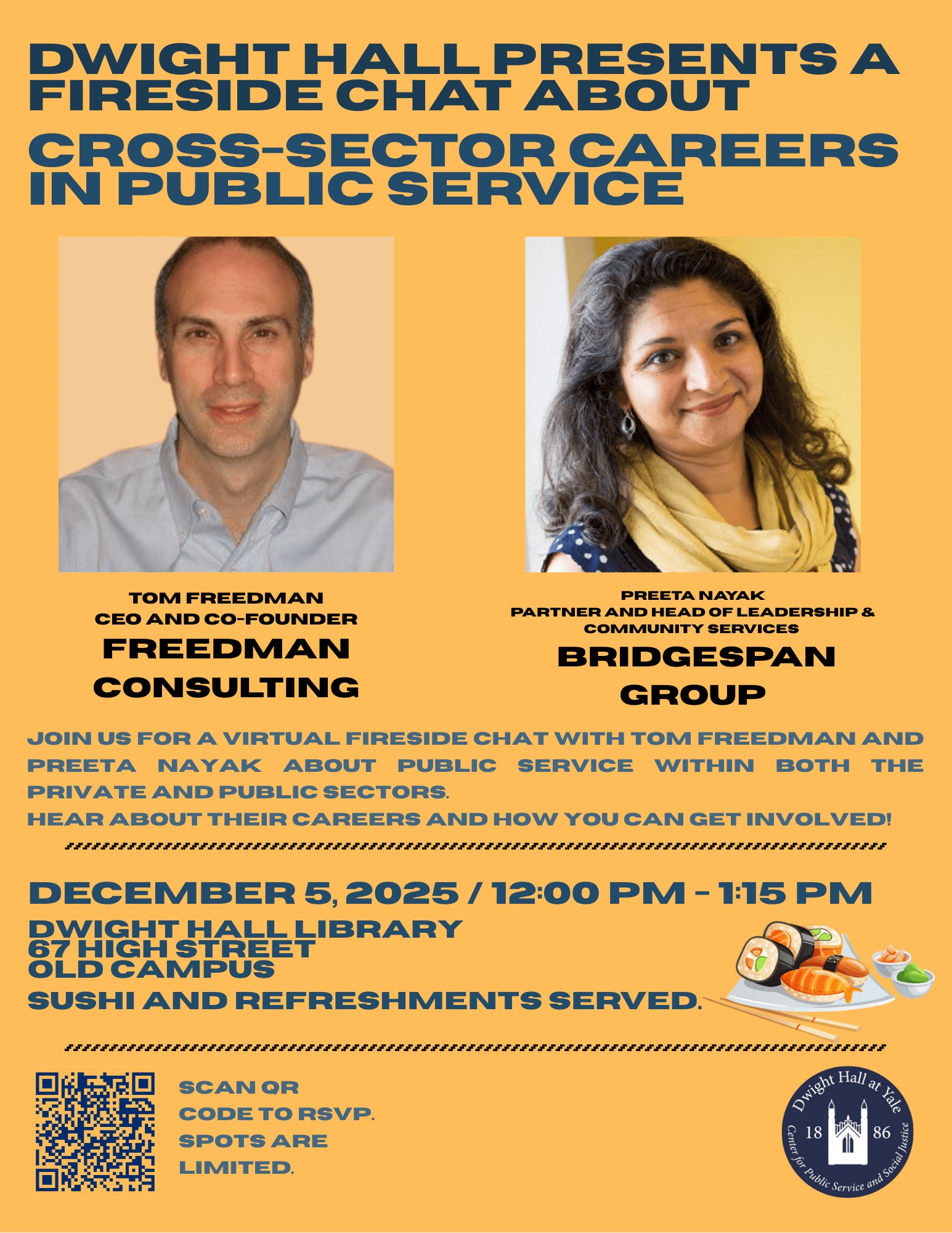
By late 2025, Freedman was at Yale's Dwight Hall with Preeta Nayak of the Bridgespan Group, discussing careers that move between public and private sectors. The setting fit. His own biography refuses to keep public service within the civil service. It includes campaigns, a nonprofit coalition, a research institution, presidential transitions, writing and consulting. The common measure is whether institutional knowledge can be made useful to a public goal.
There are fair reasons to be wary of work conducted across sector lines. Private actors bring private interests. Philanthropy is not elected. Consultants are usually more visible to their clients than to the public. Freedman's stated answer is not to ignore those tensions but to put public authority, transparency and accountability at the center. The arrangement earns legitimacy through its design and its results, not through the mere presence of impressive names around a table.
Washington celebrates the launch: the bill signing, the task force, the new fund with a handsome acronym. Freedman's professional territory begins the next morning. Someone has to map the field, translate across institutions, notice the missing partner and ask whether the coalition is producing anything besides another meeting. It is patient work. It may even be unfashionable. Then again, fashion has never hired a million people.