The hard part of selling artificial intelligence is rarely finding a dramatic noun. The market has plenty: agents, models, transformation, disruption. The hard part is making a company see its own Tuesday afternoon inside the technology. Which queue gets shorter? Which decision gets better? Which piece of work stops depending on a spreadsheet and somebody's memory? Annie O'Farrell's career has increasingly lived in that gap between technical possibility and an operating decision.
O'Farrell is the chief marketing officer of Vooban, the Quebec City applied AI and software company. Her job puts her beside engineers, data scientists and executives, but her public language is usually anchored elsewhere. She talks about productivity. She talks about business education. She talks about how the reason to care about AI changes when a company crosses a provincial border. This is the unglamorous craft underneath a technology boom: translating a moving category without letting the explanation float away from the work.
That craft did not begin with AI. O'Farrell completed an MBA in Marketing at Université Laval between 2011 and 2014. Her graduate work examined social media inside financial institutions, an early encounter with the problem of carrying new digital behavior into organizations where trust, process and institutional caution matter. Soon after, public records place her at Base Camp Connect, a Quebec company making rapidly deployable communications systems for emergency teams. She worked first as a marketing coordinator and later as marketing manager.
A useful product still needs a useful sentence
Emergency communications is an excellent school for technical clarity. The customer is not buying abstraction. A system has to work when ordinary networks fail, connect people who use different equipment and be deployable under pressure. A surviving SlideShare presentation from O'Farrell's account turns the subject into ten things an emergency manager should know. The format is telling. Start with the audience's situation. Break the system into decisions. Make the complexity portable.
By 2019, O'Farrell was appearing publicly as part of Vooban's team at a Beauce event on assessing business needs before adopting AI. The setting was less futuristic than the subject can sound. A local business audience came to hear about artificial intelligence and Industry 4.0, with the discussion organized around choosing technologies that solve an actual operating problem. O'Farrell stood alongside colleagues who could explain strategy and data science. Her lane was the bridge to the market.
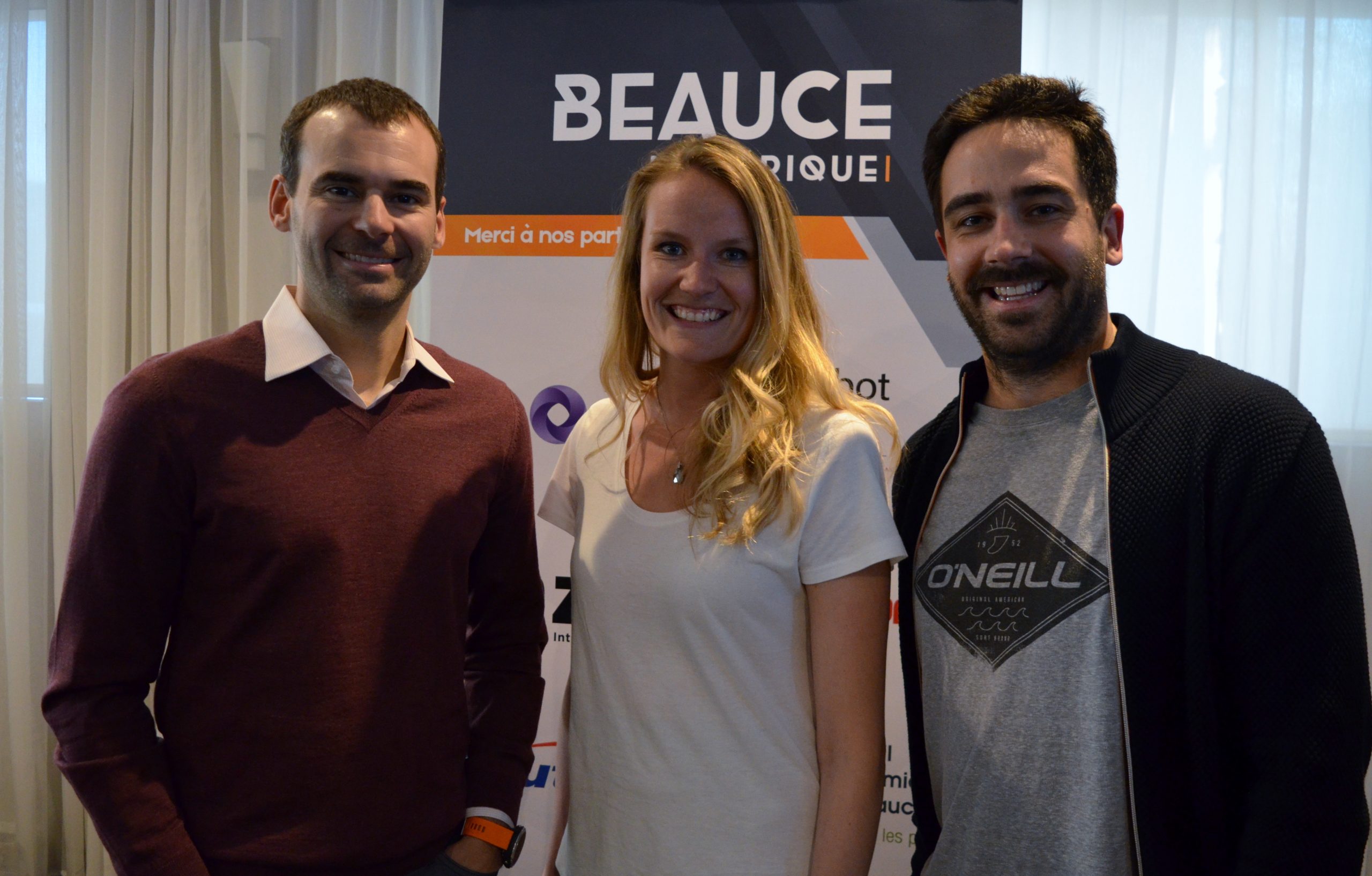
The photograph catches a useful moment in the chronology. Applied AI was already a commercial discipline, but it had not yet swallowed the entire technology conversation. The people explaining it had to earn attention through examples. There was less value in announcing that AI had arrived and more value in showing where it belonged. That burden shaped the kind of marketing O'Farrell would practice as Vooban's ambitions widened.
“There’s still a lot of educating to do on AI.”
The message changes at the border
In 2021, Vooban announced O'Farrell as CMO and a member of its executive committee. The promotion arrived ahead of a more expansive chapter. The company grew through acquisition, gained the backing of CDPQ and pushed toward Ontario and the United States. Growth created a marketing question that is easy to underestimate: if the product stays mostly the same, should the story?
O'Farrell's answer was grounded in the pressure each market feels. In Quebec, a shortage of workers can make automation and AI immediately relevant. She observed that the shortage is less pronounced in Ontario and the United States, so Vooban put more emphasis there on productivity. It is a small adjustment with a large strategic implication. A company does not enter a new market by translating its brochure word for word. It enters by learning which problem gives the technology meaning.
This is not merely a copy choice. It changes the case studies worth carrying, the events worth attending and the questions a sales team expects to hear. O'Farrell described Vooban using events outside Quebec to understand specific customer needs. CDPQ's network added meetings with decision-makers and appearances in France. Marketing became field research. Every room supplied another test of which explanation opened a serious conversation.
The approach also reveals a sober view of category creation. When customers are still learning what applied AI can and cannot do, education becomes part of distribution. Webinars, articles, panels and conferences are not an ornamental content layer. They create a common vocabulary before a proposal arrives. They help a buyer distinguish a useful first project from a fashionable detour.
Keep the capability stable. Localize the reason to care. Let the buyer's pressure point determine the opening sentence.
Marketing AI while AI remakes marketing
O'Farrell occupies an interesting double position. She markets artificial intelligence to companies while the same technology changes the work of marketing. In 2024, she joined a Université de Sherbrooke panel on AI, ecommerce and data. In 2025, she returned for a discussion about AI-driven disruption in marketing communications. These were not product demos disguised as thought leadership. The panels placed her among academics and practitioners confronting questions about creativity, data and the mechanics of reaching people.
Her appetite for concrete learning appears in a short public comment about a Quebec AI marketing event. She praised the evening and, elsewhere in that event's testimonials, the recurring value was practical cases people could use the next day. That preference fits the longer arc. A former colleague from an earlier role called her a “marketing lab on two feet,” describing someone curious enough to test new tools, analytical enough to judge them and calm enough to keep leading while the experiments ran.
Professional recommendations are biased witnesses, of course, but the details are more useful than generic praise. Curiosity. Method. Autonomy. Wit. The ability to keep cool. Those traits form a plausible operating system for a marketer in a category that changes every quarter. A rigid playbook ages quickly. Pure enthusiasm burns trust. The work rewards someone who can try the new thing, ask what it actually improves and translate the result without turning it into a prophecy.
From explaining the company to shaping the category
O'Farrell once marked Vooban's progress with a joke about recognition. When she started, she wrote, the company was only beginning its AI push and people still asked what Vooban did. By 2023, its executive vice-president was in a federal-level AI discussion with Prime Minister Justin Trudeau, researcher Yoshua Bengio and other industry figures. Her point was not that the explanation had become unnecessary. It was that years of explaining had changed who wanted to listen.
The company kept giving her new material. In 2025, Vooban announced divisions focused on agentic AI and cybersecurity. In 2026, it introduced Morphe, a system meant to capture employee knowledge through structured conversations before experience leaves an organization. O'Farrell served as the media contact for both announcements. Each development expands the vocabulary she must make legible: agents that perform work, security around models, organizational memory turned into a system that people and software can query.
The risk grows with the vocabulary. Agentic systems invite science-fiction metaphors. Knowledge capture invites the promise that nothing important will ever be forgotten. Cybersecurity invites absolute assurances no responsible company can make. A CMO in this position has to create interest while preserving the conditions and boundaries that make a technical claim credible. The useful sentence is again the harder sentence.
The quiet work of AI growth is building a bridge between what the system can do and what a buyer can defend.
The translator's advantage
There is a clean line through O'Farrell's career even though the products changed. Her MBA research asked how an emerging communications channel fits inside a cautious institution. Base Camp Connect asked how complex networks can be explained to people working under pressure. Vooban asks how data, software and AI turn into a project with an economic result. In every case, the technology is only half the assignment. The other half is institutional adoption.
That second half is where many technical companies become impatient. They want the market to understand as quickly as the builders do. But understanding arrives through repetition, local context and credible examples. O'Farrell's public work suggests a different rhythm: visit the market, hear the objection, adjust the frame, teach the category, then return with a better example. The process looks slow until a company starts getting invited into rooms it once had to explain its way into.
The transferable idea is simple enough to keep: the message is evidence of listening. Quebec and Ontario do not need different realities, but they may need different doors into the same one. A technical product does not become practical because a marketer removes every difficult word. It becomes practical when the explanation follows the buyer's decision from problem to proof.
For O'Farrell, that remains a live assignment. AI is still acquiring new nouns. Vooban is still adding products, disciplines and markets. The job is to keep the story close to the work - to the lost knowledge someone needs to preserve, the process someone needs to speed up, the waste someone wants to cut, and the decision someone has to make on Tuesday afternoon.