On April 27, 2015, Kosmos Energy announced that a well offshore Mauritania had found gas. Ten years later, in April 2025, the Greater Tortue Ahmeyim project exported its first cargo of liquefied natural gas. Andy Inglis was chairman and chief executive for both announcements. A decade is a long interval to squeeze into the space between two good headlines.
Inglis has a brisk phrase for the way countries and companies should approach investment: “those who move fast, win big”. He used it at African Energy Week in 2025. Set beside Tortue’s timetable, it offers an interesting introduction to his working life. Offshore energy rewards urgency, yet asks its participants to remain committed through years of engineering, financing and government decisions.
His career has travelled across that terrain for more than four decades. It includes the North Sea, Alaska, BP’s global exploration and production business, a difficult departure, and a return to corporate leadership at a smaller Dallas-based company. The recurring problem is practical: what has to happen after somebody discovers something valuable?
An education measured in oilfields
Inglis holds a master’s degree in engineering from Pembroke College, Cambridge. He joined BP in 1980 and worked on North Sea projects. His subsequent appointments make a useful map of an expanding education: manager of the Kuparuk field in Alaska in 1994; exploration and production chief of staff in London in 1996; leadership of deepwater Gulf of Mexico activities from 1997 to 1999.
Those are different kinds of responsibility. A field manager works with an existing operation. A chief of staff works close to the decisions governing many operations. Deepwater leadership adds another scale of technical and commercial complexity. The sequence matters because the eventual chief executive had held jobs much closer to individual assets.
Following the BP-Amoco merger, he became vice president of the US western gas business unit in 1999. In 2004, he became executive vice president and deputy chief executive of exploration and production. His responsibilities included growth areas stretching from Azerbaijan and Angola to Trinidad and the Asia-Pacific region. By February 2007, he led the exploration and production business and sat on BP’s board.
He also became a Chartered Mechanical Engineer and a fellow of both the Institution of Mechanical Engineers and the Royal Academy of Engineering. The qualifications sit comfortably beside the itinerary. Here was an executive whose professional vocabulary had been assembled around equipment, reservoirs and the organizational machinery needed to operate them.
The career break that belongs in the story
The BP chapter ended in 2010, during the reorganization following the Macondo oil spill. Inglis stepped down from the board at the end of October and left the company at year-end. BP divided its upstream business into separate exploration, development and production functions under incoming chief executive Bob Dudley. A single leadership role became three.
That departure belongs in any account of the career. It places a limit on the tidy story of an engineer rising smoothly through successive appointments. Thirty years at one employer ended amid a corporate reckoning over its operations and oversight. The next job came at a company with a different position in the industry.
In January 2011, Petrofac announced his appointment to lead its Energy Developments and Production Solutions businesses. Its proposition brought engineering, operations, training, well management and investment together for resource holders. Inglis subsequently led Integrated Energy Services. When he left, Petrofac said that business had tripled net profit in three years. That was his employer’s assessment of the period, and a substantial commercial claim.
Kosmos appointed him chairman and CEO effective March 1, 2014. Founding partner Brian Maxted moved from chief executive to chief exploration officer. The arrangement gave Maxted room to concentrate on finding resources while Inglis took overall corporate responsibility. The company’s next major discovery would put both disciplines to work.
“We don’t do simple things.”
Andy Inglis, speaking to BusinessWeek in 2009
Ten years between two announcements
Tortue gas discovery, April 2015
First GTA LNG cargo, April 2025
The Tortue-1 well delivered its news in April 2015. Kosmos reported 107 metres of net hydrocarbon pay, the productive intervals identified in the well. Inglis said the result exceeded the company’s expectations before drilling. Exploration had supplied evidence where previously there had been a proposition. Appraisal and development still lay ahead.
Greater Tortue Ahmeyim occupies the maritime border between Mauritania and Senegal, in water reaching depths of 2,850 metres. A resource in that location requires a chain of facilities before it becomes an export. The development connects deepwater wells to a floating production vessel, then sends processed gas onward for liquefaction near shore.
Inglis’s former employer returned to the story as a partner. BP operates GTA; Kosmos participates alongside the national oil companies of Mauritania and Senegal. The presence of two countries and several companies makes partnership a physical requirement of the project. Agreements have to support the equipment for the equipment to have a business.
First gas from the subsea system arrived on December 31, 2024. First LNG followed in February 2025. The first gross LNG cargo was exported that April. Each milestone describes a different stage: moving the gas, liquefying it, then sending a shipment into the market. A ribbon-cutting vocabulary can obscure how many distinct tasks precede the ribbon.
- 01Deepwater wellsGas beneath the seabed
- 02Floating productionProcessing offshore
- 03LiquefactionGas prepared for shipping
- 04LNG cargoExport to global markets
Simplified process diagram. First gas: December 2024. First LNG: February 2025. First export cargo: April 2025.
An inherited field, a current argument
Ghana provides another part of Inglis’s case for getting projects moving. Kosmos discovered Jubilee in 2007, and production began in late 2010, before his arrival. Its development history was already part of the company he inherited. TEN, the group of fields named for Tweneboa, Enyenra and Ntomme, began production in 2016 during his tenure.
Keeping that chronology straight makes his contribution easier to understand. He can point to Jubilee as evidence of what partnership achieved without being cast as its discoverer. His responsibility has included the continuing business around those assets: investment, production and the relationship between an offshore operation and the country onshore.
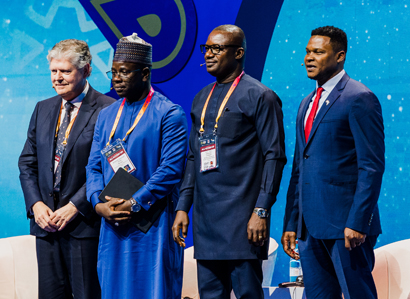
In Cape Town in October 2025, he joined Senegal’s energy minister Birame Souleye Diop, Ghana’s energy minister John Abdulai Jinapor and moderator NJ Ayuk for a discussion of investment. His emphasis was on urgency, trust and alignment. Predictable rules mattered, but so did the willingness of institutions and leaders to make decisions together.
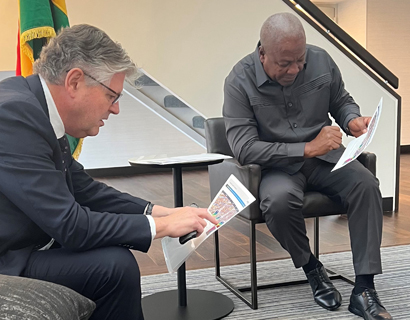
His May 2026 essay sharpened the argument around electricity reliability. A grid connection has limited value to an enterprise if power cannot be counted on when needed. He advocated domestic gas as part of a dependable energy mix, alongside renewables where appropriate. The argument comes from a gas producer with a direct commercial interest in the answer.
That interest makes the distinction between exports and domestic supply especially important. GTA’s LNG exports are operating. Gas for local power requires further development and infrastructure. Inglis acknowledged in the essay that GTA gas was not yet being used for domestic power generation. A cargo leaving the coast and electricity reaching a business are separate achievements.
The oil executive and the tractor
Another project from his tenure heads in an unexpected direction: agriculture. Kosmos launched its Innovation Center in Ghana in 2016, supporting entrepreneurs who could build commercially viable businesses. The first cohort brought together 44 young people. Two ventures received seed funding and technical assistance. An offshore producer had found a reason to pay attention to problems on farms.
One early venture, TroTro Tractor, connected farmers and tractor operators through a pay-as-you-go model. Another, Ghalani, developed agricultural supply-chain management software. These were specific attempts to solve commercial problems. A useful machine is rather more useful when a farmer can arrange to have it in the right field.
The program included market research, training, team formation, pitch competitions and incubation. DAI helped design and implement it. The work therefore belongs to the entrepreneurs, program staff and partners as well as the company supporting it. There is ample room in the story for people whose names never appear in an oil company’s leadership table.
By 2022, the Ghana center had become an independent nonprofit and announced a four-year, $16 million partnership with the Mastercard Foundation. Its independence is a consequential development: an initiative begun within a corporate relationship could work with a wider group of supporters. Inglis’s broader argument about local enterprise acquired an institution with its own leadership and decisions.
The next cargo still has to leave
On October 13, 2026, Inglis received the Mohammed S. Barkindo Lifetime Achievement Award at African Energy Week in Cape Town. It recognized a career spanning more than four decades and his work in African energy. An award can compress a long professional life into an evening. The operating calendar is less accommodating.
Kosmos’s August results had set out the immediate arithmetic. GTA averaged an annualized gross LNG-equivalent production rate of about 2.65 million tonnes in the second quarter, with nine gross LNG cargoes lifted. Company-wide net debt was approximately $2.56 billion under Kosmos’s non-GAAP definition. Inglis’s priorities included raising production, lowering costs, reducing debt and advancing development with limited capital.
Those numbers put boundaries around the ambition. A producing project still needs to control costs. A company pursuing development still has lenders and spending decisions. Domestic gas plans still need agreements and infrastructure. The vocabulary gets less ceremonial as the work gets closer: cargoes, wells, terms, pipelines, repayments.
The ten-year interval at Tortue remains a useful measure of the task. Inglis argues for decisions made at pace while leading a business whose commitments extend across years. His next chapter will be judged in the same practical units as the last one: energy delivered, obligations met, and the distance still left between a promising resource and its use.
Follow the conversation
More from Inglis, his colleagues and the projects discussed here.