David Bauer first encountered National Fuel as an accounting client. Years later, the Buffalo native would run it. That is a pleasingly circular career story, the sort a corporate anniversary dinner could dine out on for quite a while. In October 2026, however, Bauer supplied a more interesting ending: after spending much of his working life inside this integrated gas company, he announced a plan to change its shape.
The sequence was brisk. On October 1, National Fuel completed the acquisition of CenterPoint Energy’s Ohio gas utility. Thirteen days later, its board approved a plan to separate its upstream and gathering business into another publicly traded company. An executive formed by accounting, treasury work and pipeline operations was now asking a structural question: which businesses should continue to belong together?
Bauer is expected to remain president and chief executive of the regulated National Fuel business after the proposed separation. Justin Loweth, who leads Seneca Resources and National Fuel Gas Midstream, would head the new upstream company. The target is the second half of 2027, subject to approvals and other conditions. For now, the split is a plan. The interesting part is how Bauer arrived at it.
The client on the other side of the desk
His route began with an accounting degree from Boston College and a career in public accounting at PricewaterhouseCoopers and its predecessor. His professional biography places that chapter between 1991 and 2001. National Fuel was among his early clients. Before it became his employer, then, it was a business he had to examine from outside.
He joined National Fuel in 2001. By 2004, he was part of its executive team, taking on assistant treasurer and treasurer responsibilities across operating subsidiaries. Those are useful jobs for learning where a company’s ambitions meet its obligations. A well, a pipeline and a household gas connection may all concern the same fuel; financing them involves different schedules, exposures and rules.
The distinction matters in Bauer’s story. His climb was through the machinery of an existing enterprise. The record contains successive responsibilities across its businesses, rather than a sudden arrival in the corner office. By the time he became CEO, he had spent eighteen years working inside National Fuel, in addition to his earlier professional acquaintance with it.
First the finances, then the pipes
In July 2010, Bauer became treasurer and principal financial officer, with responsibility for accounting, tax and finance. The appointment put him at the intersection of investment decisions and their consequences. Capital allocation can sound like an activity conducted entirely with a spreadsheet. At a gas company, it eventually acquires a location, a construction schedule and a set of customers.
In February 2016, his remit expanded into operating leadership when he became president of National Fuel Gas Supply Corporation. The subsidiary runs interstate pipeline and storage operations. Bauer oversaw infrastructure modernization and expansion projects while continuing his financial responsibilities. His education in the business now included both the funding and the physical systems it paid for.
There is a practical explanation for why that combination would suit a future CEO. Gas needs a route to market. Storage helps reconcile the timing of supply and demand. Utility networks carry the service into customers’ lives. An integrated company asks its leadership to understand the connections among these activities, including the places where one business depends on another.
An inheritance with a very long memory
When Ronald Tanski announced his retirement in April 2019, the succession was presented as the result of years of preparation. Bauer took over on July 1. Tanski had spent more than forty years at National Fuel and remained a director. This was a handover between executives who already knew the institution, rather than an invitation to discover it at speed.
National Fuel itself had been incorporated in 1902. Its historical record includes a predecessor’s development of underground gas storage at Zoar Field in 1916 and the corporate separation of utility and interstate pipeline assets in 1974. Long before Bauer arrived, the business had been changing its organization to fit its circumstances. Age, in this case, came with a considerable amount of rearranged furniture.
The more recent changes were substantial, too. Seneca drilled its first operated Marcellus Shale well in 2009. National Fuel bought Shell’s integrated upstream and midstream assets in Pennsylvania in 2020, during Bauer’s tenure as CEO. In 2022, Seneca sold its California properties and became a producer focused solely on natural gas. The company he leads has an old name and an evolving portfolio.
What a finance career looks like underground
Bauer’s early CEO commentary emphasized restraint alongside investment. In August 2019, he described plans to reduce drilling activity while continuing pipeline expansion and utility modernization. The choices belonged to the same capital budget, but they responded to different conditions. An integrated business could make room for both a slower drilling program and continued spending elsewhere.
By fiscal 2023, utility modernization included replacing more than 160 miles of pipeline mains. Investment in those efforts had exceeded $415 million since 2019. These are less photogenic achievements than a new headquarters or a ringing stock-exchange bell. The work is mostly beneath the pavement, where it can be inconvenient during construction and largely invisible afterward.
That spending also connects Bauer’s financial background to an unavoidable public negotiation. Utilities seek to recover investment and operating costs through rates. National Fuel pursued rate proceedings in its service territories as modernization continued. A company must explain what it needs to spend; customers have equally immediate reasons to care about what they pay. Both sides have calculators.
Buffalo remains on the itinerary
Alongside his corporate positions, Bauer has maintained a set of local institutional connections. YMCA Buffalo Niagara lists him among its trustees. His public professional profile also lists service with Canisius University’s business advisory council and the Diocese of Buffalo’s investment committee. His company’s board biography identifies directorships at the American Gas Association and Invest Buffalo Niagara.
The mix places him in both an industry network and a regional one. Invest Buffalo Niagara works on business growth in Western New York. The YMCA operates in the communities where National Fuel has long had a presence. These affiliations are a concrete part of his public life, rather than a separate catalogue of executive hobbies.
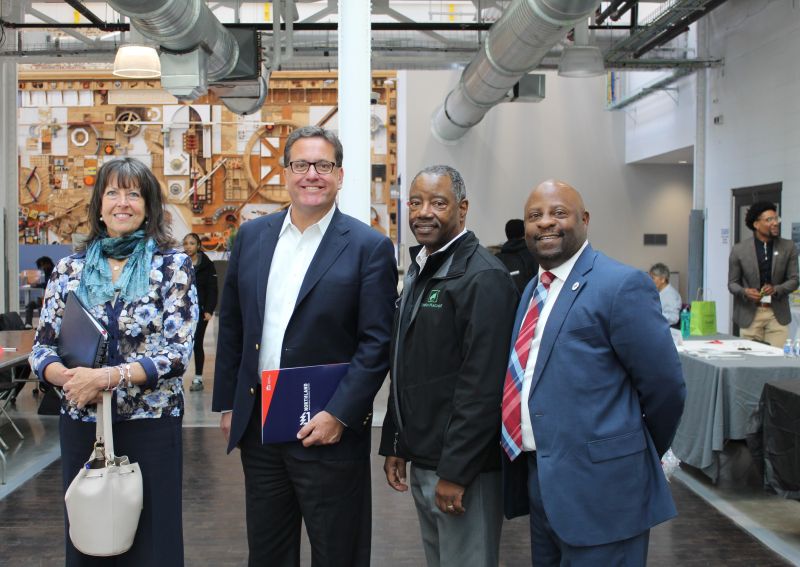
A 2023 visit to Northland Workforce Training Center offers a view of that regional circuit. Bauer appeared with utility president Donna DeCarolis, National Fuel and Northland board member Steve Finch, and Northland president Stephen Tucker. The setting was a workforce training institution in Buffalo. For a company whose physical operations depend on technical skills, it was a relevant place to turn up.
The everyday vocabulary of responsibility
Bauer’s public messages return to safety and community work. In a post marking National Pipeline Safety Day in 2025, he described an evolving Pipeline Safety Management System and a culture of acting on concerns. His compact formulation was “see something, say something, do something.” The final instruction gives the familiar phrase a practical destination.
“See something, say something, do something.”
David Bauer, on pipeline safety, 2025
That May, he also described more than 700 National Fuel and Seneca employees contributing approximately 2,300 volunteer hours during the companies’ fourth annual Days of Doing. The work covered 58 projects at 40 locations in New York and Pennsylvania. His list of partners included parks, gardens, a nature preserve and watershed organizations. The details gave his account a geography.
The company’s September 2026 responsibility update reported progress toward methane intensity targets across its business segments. Those figures concern emissions relative to activity, a distinction that matters when discussing environmental performance. Bauer’s job includes presenting that progress while continuing to advocate a future for natural gas. The operating choices and the argument about energy’s future remain connected.
Ohio changes the arithmetic
The Ohio acquisition brought roughly 335,000 customers in sixteen counties around Dayton and the greater Miami Valley into National Fuel. About 200 employees joined with them. Across its utility businesses, National Fuel now served approximately 1.1 million customers. The purchase doubled its utility rate base, enlarging the regulated side of the business.
For customers, the immediate message was deliberately uneventful: service would continue, with no action required. Billing cycles and payment methods would remain unchanged. A transaction can alter the proportions of a corporation while leaving a household’s next task exactly where it was. The executives announce a milestone; the customer would quite reasonably like the heating to work.
Bauer described the purchase as an advance in the strategy of growing regulated utility operations. Read alongside the proposed separation, the deal has another significance: the regulated business had gained scale before the board decided to send upstream and gathering toward a separate public listing. The two announcements belong together in understanding his current agenda.
Familiarity, with room to reconsider
The proposed structure would keep utilities, interstate pipelines and storage together at National Fuel. Production and gathering would stay linked within the new company. This is a selective rearrangement: each business would retain operational connections, while gaining a separate capital structure and a different group of comparable public companies.
The promised benefits still require execution. Financing arrangements, regulatory filings and final board approval lie ahead. Bauer’s task is to carry an established business through that process while it continues serving customers. A diagram can separate two companies in seconds. Organizations take rather longer.
Meanwhile, an older obligation continues. In June 2026, National Fuel raised its dividend for the fifty-sixth consecutive year. That record began long before Bauer became CEO. He now has to manage a proposed structural change within an institution accustomed to sending shareholders a growing payment. Continuity has a cash value here.
His career brings the question back to where it began: a close examination of a familiar business. The early accounting client became his employer, then his responsibility. After twenty-five years inside National Fuel, Bauer is proposing another version of it. Knowing a company thoroughly can equip an executive to preserve it. It can also equip him to decide where it should change.