Dennis Degner has a useful test for the size of a hometown: how long a wrong number can keep you on the telephone. He grew up on a farm in a Texas community so small that an accidental call might become an hour’s conversation with somebody familiar. There are less sociable ways to learn that everything is connected.
Today, Degner is president and chief executive officer of Range Resources, based in Fort Worth, with a business concentrated in Appalachia. His professional vocabulary includes drilling laterals, production costs and capital allocation. Yet the story he tells about becoming a leader begins with livestock, agricultural education and the responsibility of having something depend on you.
That background gives his career an unusual continuity. Long before he had to explain a natural gas business to shareholders, he had represented young agricultural students across the country. Long before the boardroom, there was the blue FFA jacket.
The blue jacket came first
In November 1991, a local Texas newspaper identified an 18-year-old Dennis Degner as first vice president of the Texas FFA association. He was heading to Kansas City as a delegate to the organization’s national convention. His parents, Morris and Irene Degner, lived in Malone. This was an early appearance in print for someone whose public responsibilities would eventually involve a company listed on the New York Stock Exchange.
The following year brought a larger constituency. Degner served as FFA’s national Western Region vice president in 1992-93. A 1993 Alabama convention program introduced him as a Hillsboro FFA member and Texas A&M sophomore studying agricultural engineering. It also recorded the work behind his American FFA Degree: a registered Angus cattle and market steer operation.
Those details matter because they make the leadership story concrete. Before an employer had assigned him a team, he had already sought office, represented an organization and prepared to address an audience outside his home state. His name appeared on a convention program as a visiting national officer. The assignments were public, and the engineering degree was still in progress.
FFA also supplied a personal connection that outlasted the term of office. Degner met his wife, Deb, through the organization; both held FFA offices. The agricultural chapter of his life therefore explains more than the subject printed on his diploma.
Five states, then one basin
Degner earned a bachelor’s degree in agricultural engineering at Texas A&M. His subsequent career took him into oil and gas, with positions at Halliburton, Sierra Engineering and EnCana before he joined Range in 2010. His technical and management experience spans Texas, Louisiana, Wyoming, Colorado and Pennsylvania. The map is a useful corrective to any idea that the CEO job arrived after a single narrow assignment.
At Range, his responsibilities grew from the operating business. He led in Appalachia, became senior vice president of operations in 2018 and was appointed chief operating officer in May 2019. That promotion followed a role overseeing both operations and marketing across the company. The combination matters: producing gas and finding an economic route to its buyer belong in the same conversation.
When Jeff Ventura announced his retirement in March 2023, Range chose Degner as his successor. The appointment took effect on May 10, and Degner also joined the board. Chairman Greg Maxwell presented the choice as a promotion from an established leadership team. Ventura singled out Degner’s technical skills and his contribution to the company’s operating approach and culture.
There was a specific inheritance. Ventura’s career at Range included the discovery and development of its Marcellus business. Degner had spent years helping run the operating area on which the company now depended. A succession announcement can make that transition sound instantaneous. In this case, the preparation had occupied much of the preceding thirteen years.
A discovery he inherited
The Marcellus origin story belongs to a team that was working before Degner arrived. In 2004, Range completed the Renz #1 well in Washington County, Pennsylvania. Geologist Bill Zagorski had seen possibilities in the shale after studying work in Texas’s Barnett formation. The initial exploration had targeted deeper rock. The eventual opportunity was above it.
That history helps explain the business Degner would later manage. Range’s account of the discovery describes unsuccessful deeper exploration, a decision to test the Marcellus and a later advance into horizontal wells. The successful Gulla 9H followed in 2007. Getting the geology right was only the beginning of learning how to develop it economically.
By the time Degner became CEO, the assignment had changed. He was running an established shale operation with years of wells, infrastructure and operating experience behind it. The interesting question was how much more could be done with those accumulated advantages. An early discovery opens a door; the people who follow must work out how often they can pass through it and at what cost.
The acquisition he didn’t need
At the 2024 DUG Appalachia conference, Degner offered a brief explanation for Range’s absence from the industry’s acquisition rush: “We didn’t have to.” In a business where buying another company produces an announcement of reassuring size, it was an economical answer.
He explained that Range already held more than thirty years of core Marcellus drilling inventory at its operating pace. Adding somebody else’s acreage raised a practical question: when would that newly purchased inventory actually be developed? A location waiting decades for its turn has to compete with the locations already on the schedule.
The acreage’s shape also influenced his argument. Contiguous holdings allow longer horizontal sections, known as laterals, and more use of existing infrastructure. In the account of his conference discussion, typical early laterals were measured at roughly 2,000 to 3,000 feet. By 2024, the company’s average exceeded 14,000 feet. A map of neighboring parcels could therefore matter as much as the temptation of a transaction.
“We didn’t have to.”
Dennis Degner on Range’s decision to sit out the acquisition rush, 2024
This is a revealing way for an operator to discuss corporate strategy. The explanation comes back to the development queue and the physical layout of the land. Shareholders hear a capital allocation decision; underneath it sits a question about where a drilling crew will work, and how efficiently.
What he asks of a team
Degner was discussing management publicly well before becoming CEO. When he received the Pittsburgh Business Times’ Energy Executive of the Year recognition in 2015, he described an approach built around challenge, clear direction and support. Employees should know the assignment and have the resources to carry it out. They should also know management shares the effort.
His warning about integrity was unusually direct: “The second that we start to sacrifice integrity is the second we start to erode the team and we start to erode results.” It connects conduct to operating performance without treating the two as separate subjects. People have to trust the way a business works before they can reliably work together inside it.
The same 2015 discussion placed his ambitions on a longer clock. He saw the region’s gas business as a possible source of careers for his daughter and, eventually, another generation. The statement was a hope about the industry’s durability. Read alongside his later inventory argument, it shows a recurring interest in how long an opportunity can last.
The next customer needs electricity
The demand conversation has since acquired a new vocabulary: data centers, artificial intelligence and digital infrastructure. Range now markets its Appalachian gas to that prospective growth, emphasizing its inventory and transportation access. Degner’s public case rests on the ability to supply growing power needs while continuing to reach customers farther away.
In 2025, at another DUG Appalachia appearance, he stressed the infrastructure required to serve additional demand. That qualification is essential to understanding his outlook. Gas in the ground, a pipeline route and a power customer are different parts of a project. Enthusiasm about computing does not make the connections between them appear automatically.
The latest released quarterly figures give the operating story a current scale. For the second quarter of 2026, Range reported average production of 2.30 billion cubic feet equivalent per day, with natural gas accounting for about 67%. The company reported $235 million of cash flow from operating activities, $78 million spent repurchasing shares and $24 million paid in dividends. These are company results under his leadership, produced by an organization rather than a solitary executive.
Q2 2026 average production
Q2 2026
Range’s environmental reporting adds another set of measures. Its 2025-2026 sustainability disclosures report a 24% reduction in methane emissions intensity since 2023 and roughly complete recycling of the produced water generated by its operations for more than a decade. Its reported net-zero Scope 1 and 2 position combines direct reductions with verified carbon credits. That distinction belongs beside the claim.
The same reporting records more than 3,600 employee volunteer hours and grants to 539 local nonprofit organizations. For a chief executive whose early experience involved agricultural organizations, these are tangible points of contact between an industrial business and the places where its people work.
The conversation carries on
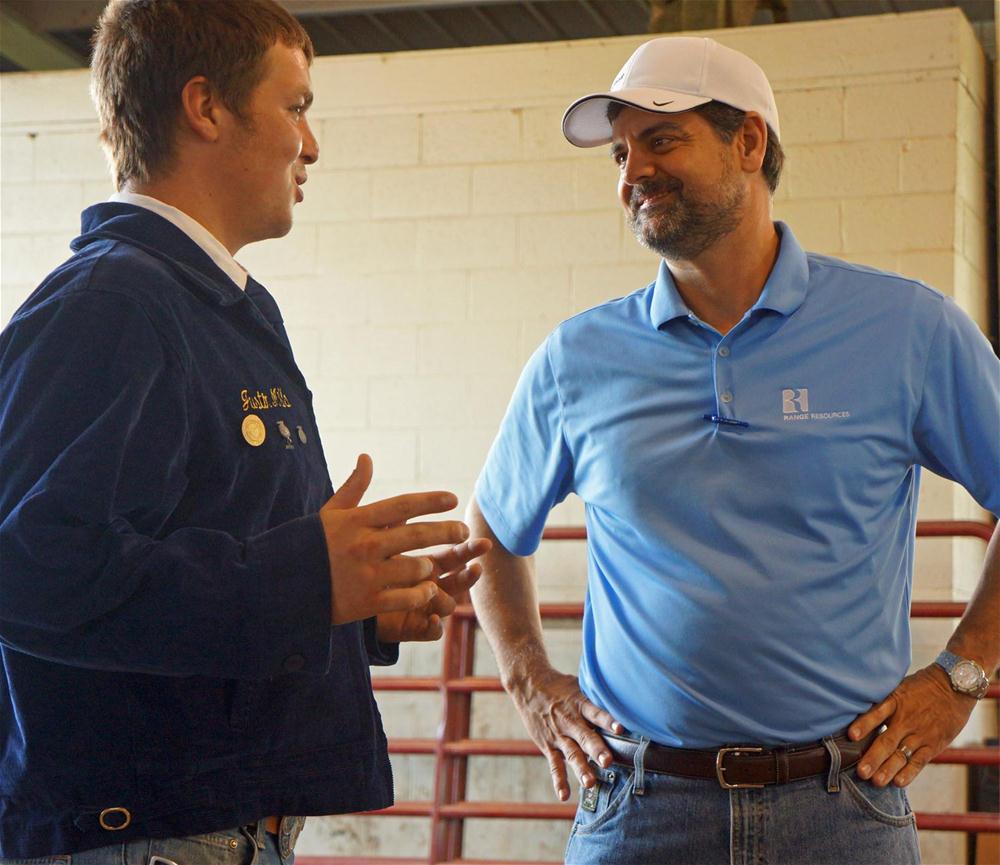
There is a small continuity in Degner’s public LinkedIn activity: a post about meeting FFA students and teachers from his hometown during their state convention. Decades after his own national term, the organization still appears in his working life.
His story is easiest to follow through those repeated encounters. A Texas student represented his peers, trained as an engineer, moved through field and management assignments and eventually took responsibility for the whole company. The scale changed. The need to explain a decision to other people remained.
As of October 22, 2026, the next formal update is close: Range has scheduled third-quarter results for October 27 and its conference call for October 28. Investors will listen for the production plan, the spending choices and the route to the next customer. The farm kid will once again have an audience, and a practical assignment to explain.
Read & watch
- Dennis Degner on LinkedIn
- Range Resources: leadership
- Texas FFA: national officers
- The 2015 leadership interview
- The 2023 CEO succession announcement
- Degner on drilling inventory and acquisitions
- Second-quarter 2026 results
- Range’s sustainability disclosures
From Range’s video library
Company channels