A gas well has a geographical problem. It cannot move. Its customers can be hundreds of miles away, and the price at the other end of a pipeline may bear little resemblance to the price at its front door. Antero Resources has spent years working on that distance. The interesting part of this gas producer is what happens after the drilling.
- Antero produces natural gas, natural gas liquids and oil in Appalachia.
- Transport contracts and liquids sales give it several routes to revenue.
- A $2.8 billion acquisition in 2026 enlarged its West Virginia business.
- Reserved capacity buys access. Empty capacity still sends a bill.
01 / The well is just the beginning
Natural gas is the familiar product: fuel for heating, industry and electricity. But Antero also extracts ethane, propane, butane and other natural gas liquids, or NGLs. These become petrochemical feedstocks and fuels. Oil is a smaller part of the mix. A liquids-rich reservoir gives the company several products to sell from the same development program.
The buyers are businesses: energy companies, industrial end users and refineries. Antero also supplies natural gas to LNG facilities, where other operators liquefy it for shipping overseas. It occupies the production end of that chain. A household cannot sign up for an Antero utility account; a commercial buyer can buy its hydrocarbons.
Its business model is straightforward until the invoice arrives. Sell production, then pay royalties, drilling costs, processing charges and transportation fees. The difference between a quoted benchmark and the money left after delivery matters enormously. Antero's transport portfolio and marketing arrangements are part of the product's economics, as consequential as the rock.

02 / A company learns to travel
Paul Rady and Glen Warren founded Antero in 2002. Their earlier company, Pennaco Energy, had been sold to Marathon. Antero's first Barnett Shale business went to XTO in 2005 for more than $1 billion, including assumed debt. This was a team already practiced at building a resource business and selling it.
The Appalachian commitment came later. In 2008, Antero acquired 115,000 Marcellus acres from Dominion. In 2012, it sold Arkoma and Piceance assets to redirect capital toward the Marcellus and Utica. Warburg Pincus, an early backer, describes that narrowing of focus in its investment history. Antero completed a $1.8 billion IPO in 2013.
Then came the plumbing. Antero formed Antero Midstream Partners in 2012 to support infrastructure development. Today, separately listed Antero Midstream provides gathering, compression and water infrastructure, with processing access supported by partnerships. Resources produces the molecules; Midstream helps move and handle them. Keeping the two companies straight is essential to understanding both the strategy and its mistakes.
03 / The empty seat still costs money
Booking transport ahead of production sounds sensible. The trouble starts when the reserved space exceeds the gas available to fill it. Antero's 2019 annual report recorded $252 million of firm transportation costs in its marketing segment, associated with excess capacity. Its marketing activities produced a $258 million operating loss that year.
The company responded by releasing capacity to others. In autumn 2019, it reported agreements covering 250 million cubic feet a day from September through March 2020. It expected those agreements to reduce net marketing expenses by $15 million. The competitive advantage needed a utilization plan. Buying the ticket had been easier than filling the seat.
Reserved capacity buys access. Empty capacity still sends a bill.
Another reversal involved water. In September 2019, Antero Midstream idled its Clearwater wastewater facility. Its 2019 impairments tied to the facility totaled roughly $463 million, including goodwill and customer relationships. Resources shifted wastewater toward localized blending, reuse and injection. It reported water fees, including trucking, averaging $6 per barrel after idling, versus $10.13 in the first half. Cheaper alternatives changed the operating decision.
04 / Bigger, but in familiar ground
Under CEO Michael Kennedy, Antero closed its HG Energy upstream acquisition on February 3, 2026. The announced price was $2.8 billion in cash, plus assumption of the commodity hedge book, subject to adjustments. The assets included about 385,000 net Marcellus acres. Separately, Midstream acquired HG's midstream business for $1.1 billion.
Resources financed its purchase with a combination including a $1.5 billion term loan and proceeds from $750 million of senior notes. It also agreed to sell its Ohio Utica upstream assets for $800 million. The direction was clear: concentrate more capital in West Virginia, where the company already knew the ground and infrastructure.
Bcfe converts gas, liquids and oil into a natural-gas-equivalent measure; it is not pure gas volume.

Kennedy said, “Our production base increased by more than 20% from a year ago”. Second-quarter cash operating costs fell 11% to $2.38 per thousand cubic feet equivalent. Those are reported results. The July production outlook of 4.15 to 4.2 billion cubic feet equivalent per day for 2026 was guidance, with the usual dependence on prices, operations and execution.
05 / The lesson travels better than the gas
Other Appalachian producers, including EQT and Range Resources, also compete on resource quality, efficiency and market access. Antero's particular combination is liquids-rich production, transport commitments and close midstream coordination. The lesson for another business owner is practical: price the whole route to the customer, measure unused capacity, and reconsider infrastructure when a cheaper method appears.
That approach needs enough volume, financing and demand to support fixed commitments. Weak commodity prices, narrower regional price differences or disruptions can undo its economics. More drilling does not automatically cure an expensive contract. Antero's own history supplies the warning alongside the example.
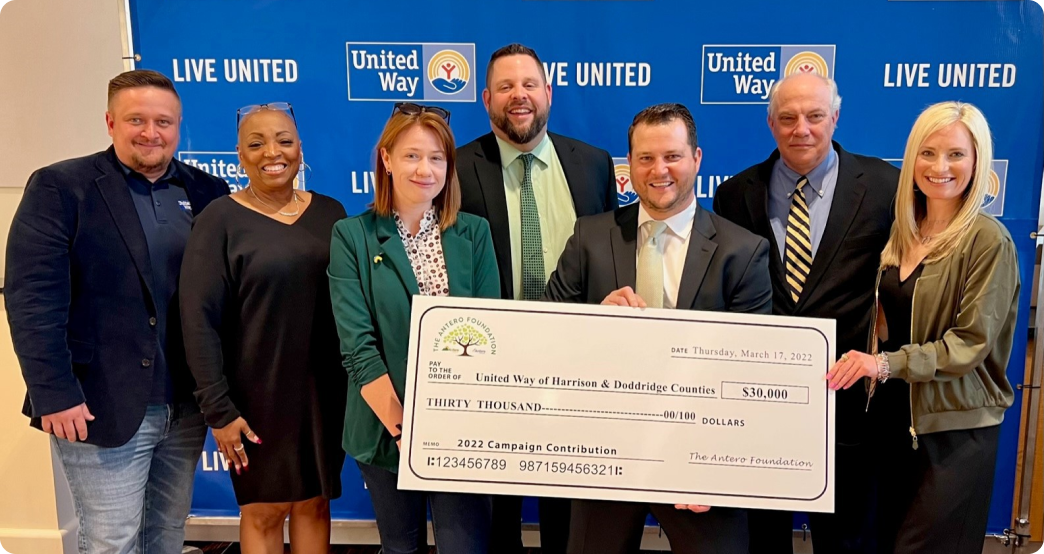
The geography also includes neighbors. Antero and Midstream established their foundation in 2020; combined foundation and corporate giving reached $2.25 million in 2025. The companies' 2023 WVU engineering donation was $4 million. In August 2026, Antero announced a five-year WVU jersey partnership. These are tangible local commitments around a business whose customers can be far away. The well stays put. Everything around it has to connect.