At a Phillips 66 station, the transaction takes a few minutes. A nozzle clicks. A receipt appears. Somewhere behind that ordinary exchange sits a much longer journey: a processing plant, a pipeline, a storage tank, a refinery, perhaps a ship. The sign is the part we recognize. The connections are where much of the business happens.
- Phillips 66 makes fuels, moves energy and sells industrial materials.
- Its $2.2 billion EPIC NGL purchase bought access between production basins and Gulf Coast markets.
- Rodeo shows why operating a converted refinery and earning a return are separate tests.
That distinction helps explain a company making apparently contradictory decisions. Phillips 66 has converted a California refinery to renewable fuels, stopped fuel production at another, and bought more infrastructure carrying hydrocarbons. Read those moves together and a consistent question emerges: which assets put a useful product within reach of a paying customer?
The sign is the last stop
First, untangle the family tree. Frank and L. E. Phillips founded Phillips Petroleum in Oklahoma in 1917. Phillips merged with Conoco in 2002. In 2012, ConocoPhillips separated its downstream operations into the independent Phillips 66. The familiar name is old; the present corporate arrangement is considerably younger.
Today’s business refines crude into gasoline, diesel and aviation fuel. It gathers and processes natural gas, separates natural gas liquids into usable components, and moves products through pipelines and terminals. It also owns half of Chevron Phillips Chemical, the petrochemicals and plastics venture shared with Chevron. Lubricants, polypropylene and specialty petroleum coke extend the product list beyond the filling station.
Customers include energy producers needing an outlet, distributors needing reliable supply, manufacturers buying materials, and drivers buying fuel. The marketing network includes Phillips 66, Conoco and 76 in America, plus JET in Britain. A branded forecourt does not automatically belong to the company. Brand licensing and retail joint ventures are part of the arrangement.
An 885-mile reason to spend $2.2 billion
Consider EPIC NGL. In April 2025, Phillips 66 completed its approximately $2.2 billion cash purchase. The package included an approximately 885-mile natural gas liquids pipeline, two fractionators near Corpus Christi, and roughly 350 miles of distribution pipelines. Fractionators perform the industrial sorting job: separating mixed liquids into individual products that customers can use.
Eagle Ford
fractionation
Exports
~885 miles of NGL pipeline in the acquired system. Schematic, not a geographic map.
The assets link production in the Delaware, Midland and Eagle Ford basins with Gulf Coast processing, refiners, petrochemical companies and export markets. The purchase strengthened connections to Phillips 66’s existing system, including its Sweeny Hub. Here, the product being sold is partly a route: somewhere for producers’ output to go.
Phillips 66 earns money through several mechanisms: manufacturing and marketing margins, transportation and processing services, and joint-venture earnings. Marathon Petroleum and Valero offer alternative refining and fuel networks; Enterprise Products Partners and Targa compete in overlapping NGL businesses. Phillips 66’s competitive argument rests on connecting its own operations across those boundaries. The value depends on the particular basin, destination and customer.
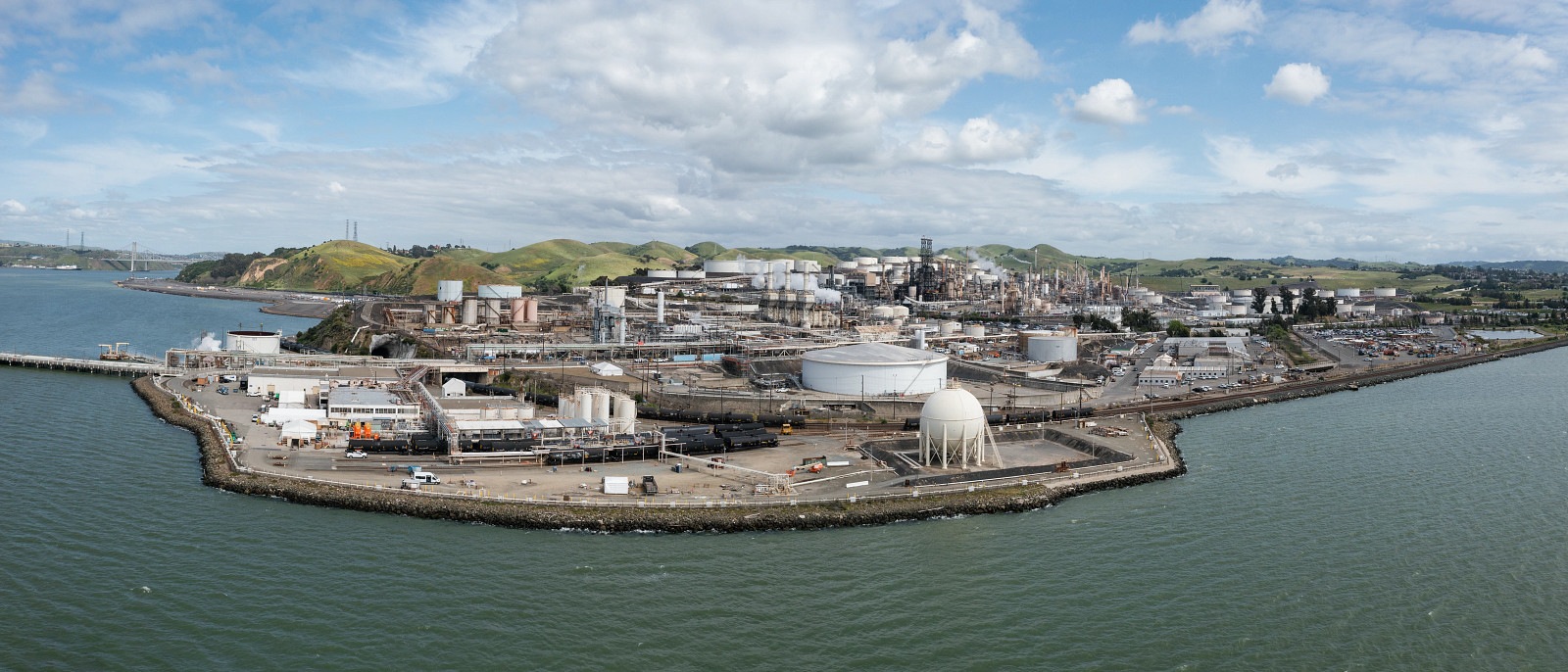
Same waterfront. Different ingredients.
At Rodeo, California, the company chose to change what went into the plant. Waste oils, fats, greases and vegetable oils replaced crude as feedstocks for renewable transportation fuels. The conversion reused hydrocracking equipment and added pretreatment facilities. Existing logistics helped make a new business possible at an established industrial site.
The spending estimate changed along the way. At the May 2022 investment decision, Phillips 66 expected the project to cost approximately $850 million. By its third-quarter 2023 update, the budget was approximately $1.25 billion. Those are dated company estimates, rather than a claim about a final audited construction bill.
Approximately $400 million higher between the two estimates.
“People want to lower the carbon intensity of their fuels and to maintain their quality of life.”Jolie Rhinehart · Rodeo vice president · April 2024
Rodeo reached approximately 50,000 barrels a day of renewable-feedstock processing rates in the second quarter of 2024. But the broader Renewable Fuels segment lost $198 million before tax in 2024 and $380 million in 2025. The company attributed the first deterioration primarily to Rodeo ramp-up costs; the next year brought higher feedstock costs and unfavorable inventory effects.
The second quarter of 2026 brought $544 million of segment pre-tax income. Higher regulatory credits and favorable mark-to-market effects helped. These figures include more than Rodeo, and a profitable quarter does not establish the conversion’s lifetime return. The sequence illustrates the commercial difficulty: throughput can improve while input prices, credit values and accounting movements change the result.
A refinery closes. A route opens.
Los Angeles received a different answer. Phillips 66 announced the refinery’s closure in October 2024, citing uncertain long-term sustainability and market dynamics. Fuel production ended in the fourth quarter of 2025. The announcement covered a facility employing roughly 600 employees and 300 contractors. Closing industrial equipment carries consequences far beyond a portfolio slide.
It also carries bills. An October 2025 update identified approximately $70 million of expected groundwater-related environmental expenses and a $30 million asset-retirement charge associated with transportation assets. The company continued planning to supply California through other sources. Customer demand remained even as management questioned one production location’s long-term viability.
In August 2026, Phillips 66, Kinder Morgan and HF Sinclair approved investment in Western Gateway. The proposed 1,300-mile pipeline system would create another supply path toward Arizona and California. Its design combines new construction with existing assets and pipeline reversals. It is a planned route, rather than capacity customers can already use.
Copy the map before the machinery
The transferable idea is to examine the handoffs. A manufacturer can ask where supply gets stranded, where buyers lack dependable delivery, and which existing equipment can serve another market. Phillips 66’s expertise lies in making those connections work through processing technology, commercial operations and physical infrastructure.

The conditions matter. This approach requires capital, permits, engineering capability and customers close enough to serve economically. Renewable fuels add exposure to feedstock availability and policy incentives. Phillips 66’s stated safety-first culture addresses another unavoidable requirement: the system has to operate reliably. Owning more connections increases the opportunities, but also the equipment, obligations and risks that must be managed.