In December 2025, a piece of equipment in Wynnewood, Oklahoma, went back to its old job. Three years earlier, CVR Energy had finished converting the refinery’s hydrocracker to make renewable diesel. Now it was returning the unit to petroleum processing. The company had spent $179 million on the original conversion. The interesting detail is that a return journey had been contemplated from the beginning.
- CVR makes transportation fuels and, through CVR Partners, nitrogen fertilizer.
- Its advantage rests partly on location, feedstock choices and neighboring industrial assets.
- The renewable diesel reversal shows how quickly policy-sensitive economics can change an investment’s purpose.
A refinery is an awkward place to change your mind. Equipment is expensive, shutdowns interrupt production, and the chemistry has to work at industrial scale. Yet CVR’s experience raises a useful question for anyone allocating money: what is an asset worth when its first assignment stops making sense?
A century of equipment. A younger company.
CVR Energy was incorporated in 2006, but the Coffeyville refinery began operating in 1906. Its modern corporate history runs through Farmland Industries’ bankruptcy, a 2004 asset purchase and a 2005 acquisition by an entity backed by Goldman Sachs and Kelso funds. The public offering followed in October 2007. This was a business assembled around existing machinery, with all the possibilities and obligations that implies.
Today, the company operates refineries in Coffeyville, Kansas, and Wynnewood, Oklahoma. Together, their nameplate capacity is 206,500 barrels a day. They buy crude, process it and sell gasoline, diesel and other products. CVR is an independent refiner: it does not have an upstream oil exploration and production business cushioning the other end of the transaction.
Its customers are largely businesses buying and distributing physical products. Truck loading racks and bulk sales connect fuel to regional markets. Pipelines, storage tanks and crude-gathering operations help connect the refineries to supply. A motorist may use the output without ever encountering the CVR name.
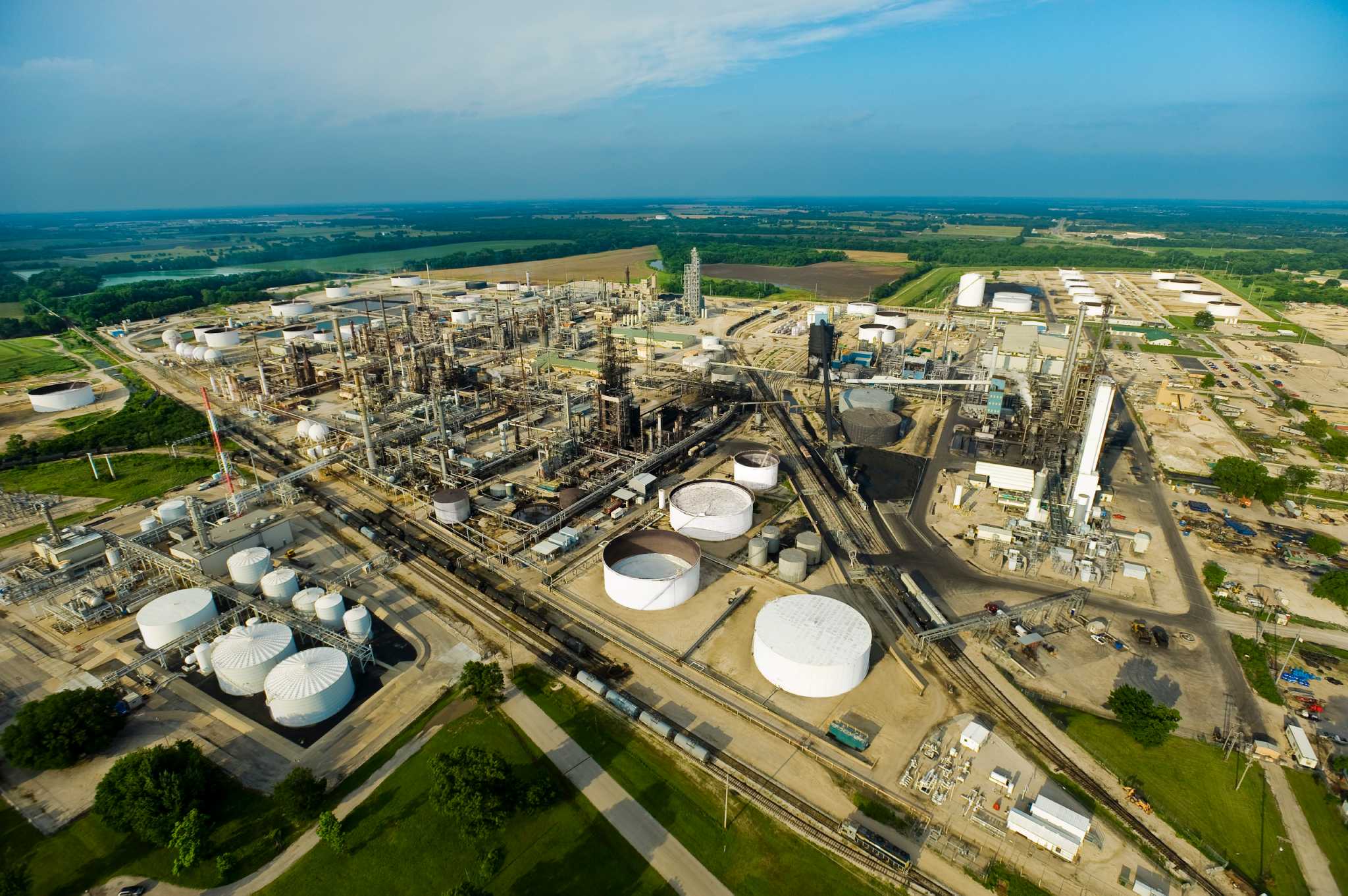
The useful thing next door
At Coffeyville, the neighboring fertilizer plant makes the portfolio more interesting. Petroleum refining produces petroleum coke. The fertilizer operation gasifies that material to obtain hydrogen, which reacts with nitrogen to make ammonia. Much of the ammonia becomes urea ammonium nitrate, or UAN, a liquid fertilizer. A refinery byproduct enters a supply chain that ends in a field.
- 01Refine crudePetroleum coke is produced
- 02Gasify cokeObtain hydrogen for ammonia
- 03Make fertilizerAmmonia and liquid UAN
CVR Partners describes Coffeyville as North America’s only fertilizer facility using petroleum coke gasification. Its East Dubuque, Illinois, plant uses natural gas instead. That plant sits above the Mississippi River with access for loading certain products, giving the fertilizer business another route to market.
The distinction matters commercially. Fertilizer retailers and distributors need nitrogen products near agricultural customers, particularly in the Southern Plains and Corn Belt. Feedstock prices, transport costs, seasonal demand and storage availability all affect what a producer can earn. These are markets in which the distance between two places belongs in the profit calculation.
CVR Energy owns the partnership’s general partner and approximately 37% of its common units. Control and economic ownership are different quantities here. Investors buying CVR Energy receive exposure to both refining and fertilizer; they are not buying all the fertilizer partnership’s economics.
The conversion had a second setting
In December 2020, CVR approved the Wynnewood renewable diesel project with an estimated capital cost of $110 million. Existing equipment and available hydrogen offered a way to enter renewable fuels without constructing an entirely new refinery. Topsoe supplied its HydroFlex technology for the conversion.
The investment case included more than selling diesel. Renewable Identification Numbers, or RINs, are compliance credits under the federal Renewable Fuel Standard. Producing qualifying fuel could generate those credits and reduce CVR’s net exposure to buying them. Tax benefits and low-carbon fuel programs also mattered. The project joined an industrial process to a policy-dependent revenue calculation.
Conversion cost only. These figures do not measure lifetime project profit or the cost of reversing the unit.
Completed in April 2022, the conversion cost $179 million and provided approximately 100 million gallons of annual renewable diesel capacity. The original estimate had risen substantially. Meanwhile, CVR’s investor materials explicitly preserved the possibility of returning the unit to hydrocarbon processing if margins warranted it.
By late 2025, management cited unfavorable renewable economics, feedstock optimization and logistical constraints in deciding to reverse course. The traditional blender’s tax credit had expired at the end of 2024; company materials also flagged uncertainty around its replacement. The disclosed explanation centers on economics and the refinery’s alternative use.
The accounting consequences were substantial: $93 million of accelerated depreciation in 2025. That expense is not a disclosed cash bill for the reversal, nor does it establish the project’s lifetime loss. It records a shortened expected use for affected assets. Changing direction still carries a price.
The bills outside the spreadsheet
Refinery economics also include obligations to people living nearby. In 2023, federal regulators announced a Coffeyville settlement worth more than $23 million addressing Clean Air Act and prior consent-decree violations. It included a $13.25 million penalty, pollution-control measures and an environmental project. The company’s stated values include safety, environmental care and integrity; that enforcement history belongs beside those commitments.
“If it’s not safe, then we don’t do it.”
CVR Energy / published Mission & Values
The business remains cyclical. CVR recorded $7.162 billion in 2025 sales and $27 million in net income attributable to stockholders. In July 2026, under new chief executive Dane Neumann, it reported second-quarter crude utilization of 98% and ammonia plant utilization of 99%. Busy plants are valuable, but utilization alone cannot determine the margin on what they sell.
The transferable lesson is to evaluate alternative uses before committing capital. That requires compatible equipment, workable logistics and the ability to finance a change. Where conversion is irreversible, or the second market is equally unattractive, flexibility offers little protection. At Wynnewood, the route back existed. CVR eventually took it.