In May 2020, with the oil business confronting a storage problem, an analyst asked whether a pipeline being reversed could also serve as storage. Chris Chandler took the question. The work required to reverse it, he explained, made the line unsuitable for that purpose. There were terminals at either end that could be used, his colleague Jeremy Goebel added. The distinction was small enough to disappear in a market headline and large enough to matter to anyone responsible for moving the oil.
The exchange offers a useful introduction to Chandler: answering a question about what a real piece of infrastructure can actually do. Energy has an abundant supply of sweeping declarations. His public career offers something more tangible: refineries, transportation systems, engineering teams and the awkward business of connecting an expanding supply to a willing buyer. The answer depends on the equipment. The equipment is under no obligation to admire the strategy.
On October 6, 2026, that career brought him back to Phillips 66 as strategic advisor to the CEO. He is scheduled to become executive vice president of Refining on January 1, 2027, succeeding Rich Harbison. The intervening months are reserved for engaging with leaders and teams across the company. For a returning executive with decades of experience, the first assignment is unusually sensible: reacquaint yourself with the place before taking charge.
An engineer’s education, on both sides of the gate
Chandler was born in Woodbury, New Jersey, and graduated from UCLA in 1994 with a mechanical engineering degree. His career began at the Los Angeles refinery. The early assignments included project engineering, continuous improvement and operations engineering. These jobs put the mechanics of an industrial business close at hand: the project, the process, the work of making something run better. His later career would widen the frame considerably.
By 2004, he was operations manager of the Wilmington plant at the Los Angeles refinery. In 2007, he became manager of the Alliance refinery near New Orleans. In 2010, he took charge of the Los Angeles refinery for ConocoPhillips. His experience also included the Wood River refinery and a Houston headquarters assignment in competitive analysis. The itinerary moved between individual facilities and the larger question of how a business compares with its rivals.
There was a public side to that work, too. In August 2012, Chandler appeared among the speakers commenting at a Los Angeles Board of Harbor Commissioners meeting. The list included labor representatives, business leaders, residents and community organizations. A refinery manager’s working world extended beyond the fence. The equipment might sit inside an industrial site, but conversations about the surrounding infrastructure belonged to a much larger room.
- 1994UCLA mechanical engineering
- 2007 / 2010Alliance / Los Angeles refinery manager
- 2018 / 2019Joins Plains / becomes COO
- 2026 / 2027Phillips 66 return / scheduled Refining role
The shale boom needed a route to market
In 2014, Chandler moved into natural gas liquids and then midstream commercial and business development at Phillips 66. The change placed him in the middle of a practical consequence of the shale boom. More production required more ways to get material to customers. In a 2015 industry address, he described the mismatch between new producing regions and existing transportation links. A successful well created another question: how would its output reach a market?
He discussed pipelines, trucks and rail as parts of that answer, with particular attention to the flexibility of a rail network already in place. He also connected refinery demand with exports. His reasoning followed the barrel beyond the production announcement and toward its eventual destination. It was a commercial view with an operating engineer’s insistence on the route between the two. A map can be an inconveniently literal document.
“I like to look at actual data rather than forward-looking trends because it’s real information.”
Chris Chandler · 2015
Chandler made that observation in 2015, when he was explaining the changes already taking place in American energy logistics. It is a compact description of his stated preference for evidence. His speaking engagements also took him to International Petroleum Week in London, where his topics included unconventional production in 2015 and the United States’ position as an LPG exporter in 2016. The local problems of moving material had become an international conversation.
From the strategy office to the operating system
After serving as general manager of corporate strategy at Phillips 66, Chandler joined Plains All American in May 2018 as senior vice president of strategic planning and acquisitions. On March 1, 2019, he became executive vice president and chief operating officer. His Canadian operating responsibilities continued, and he added responsibility for United States operations and engineering. The promotion put the operating organizations on both sides of the border within his remit.
The appointment came as Plains broadened its leadership team. Willie Chiang was CEO; Jeremy Goebel was promoted to executive vice president, Commercial, at the same time. Chandler’s position sat where engineering, physical operations and commercial decisions meet. The distinction matters. An acquisition can be announced on one day; making the acquired assets work with an existing system requires a different sequence of decisions, involving people who must keep the business running throughout.
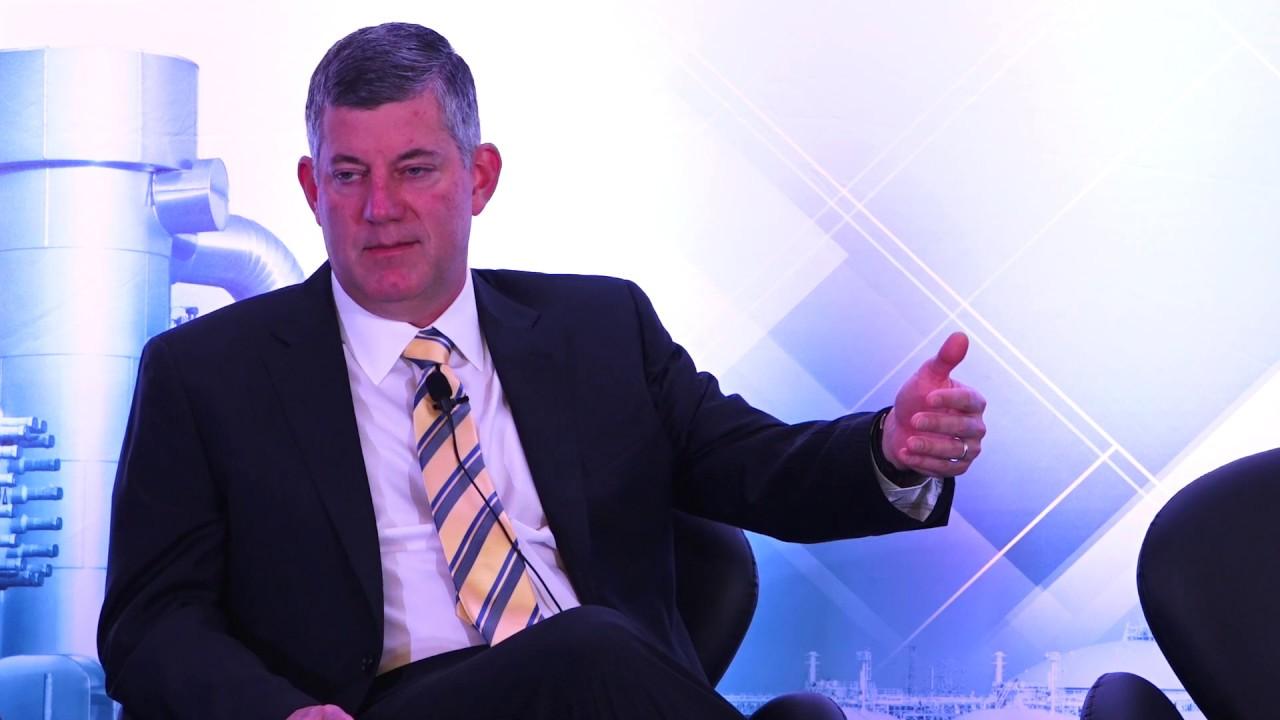
At the 2020 ADI Forum, Chandler joined ADI Analytics founder and CEO Uday Turaga for a conversation about midstream’s future. Their discussion ranged across career development, workforce gaps, consolidation, joint ventures and technological change. Those topics describe a business whose constraints are organizational as well as physical. The next connection may require a construction crew, a commercial agreement, a new colleague or all three. His move from strategy into operations gave him responsibility for that combination.
The work hidden inside “efficiency”
In February 2023, an earnings-call question about spending brought another answer in Chandler’s characteristic operating vocabulary. He discussed completion of the Link to Lester project, additional well connections and Permian station work. The purposes included keeping oil flowing reliably and giving the system more flexibility. He distinguished these investments from major new projects. Much of the work concerned getting existing infrastructure ready for the volumes producers expected to deliver.
Station work does not offer quite the same drama as drawing a new pipeline across a map. It does offer a revealing view of the job. A network can need attention at particular points rather than an entirely new route. Chandler’s explanation connected the capital budget to those specific needs. For the listener, the interesting detail was the scale of the decision: a broad production outlook translated into a list of things that needed doing.
Environmental performance was another part of his public brief at Plains. In 2022, the company reported lower total Scope 1 and Scope 2 emissions in each of the preceding four years. Chandler spoke about efficiency and conservation, alongside the continuing role of energy infrastructure. These were company results and objectives, shared across an organization. His role was to help turn such priorities into operating decisions rather than leave them as aspirations in a presentation.
“We seek opportunities to reduce emissions and improve energy efficiency, while ensuring the safety and reliability of our assets.”
Chris Chandler · Plains 2021 Sustainability Report
That statement appeared in Plains’ 2021 sustainability report. It puts several obligations in the same sentence, which is where an operations executive has to keep them. Emissions, energy use, safety and reliability interact within the same facilities. The work involves choices about an operating system already serving customers. Chandler’s formulation is measured: improve the performance of the assets while continuing to run them safely and reliably.
A different set of connections in Houston
Alongside the corporate career, Chandler took on a sustained role at Memorial Assistance Ministries in Houston. His LinkedIn profile records board service from 2016 to 2021 and the chairmanship from 2019 to 2021. The organization helps people through education, employment support and other practical assistance. Here the destination was a family’s greater stability, and the links involved skills, work and access to resources. The scale was different; the need for functioning institutions was equally concrete.
In October 2018, Chandler and his wife, Fiona, chaired MAM’s annual luncheon, and he served as emcee. The gathering raised nearly $500,000. Guests heard about the organization’s work helping nearly 2,000 people affected by Hurricane Harvey and met a client who had used its employment program to secure an engineering job. It was a particularly apt example for a room being hosted by an engineer: training and support arriving at an actual job.
As board chairman in 2019, Chandler helped welcome Sonja Gee as MAM’s incoming president and CEO. Martha Macris was retiring after years leading the organization. Chandler emphasized the alignment between Gee’s experience and the mission, while recognizing Macris’s service. The episode adds a useful dimension to a career often described through industrial assets. He was also involved in the quieter institutional work of selecting leadership and sustaining an organization through a handover.
His involvement continued through MAM’s capital campaign, co-chaired with Bill Mearse. In 2026, the organization celebrated the opening of its Hamill Education & Workforce Training Center, part of a $22 million initiative. The 21,000-square-foot facility was designed to expand education and training programs by 50 percent. MAM described the capacity in terms of the people it could serve. For a campaign co-chair, a completed building supplies a pleasingly solid answer to the question of what the fundraising was for.
A return with a listening period
Chandler left Plains in October 2026, with Dean Liollio succeeding him as chief operating officer effective October 2. Phillips 66 announced his return on October 5. By then, his experience encompassed refinery leadership, corporate strategy, midstream development and responsibility for operations across the United States and Canada. The return brings those assignments into the same story. He is coming back to refining after years spent working on the systems that connect production, processing and markets.
The scheduled January handover gives the ending a date without pretending it has already happened. Harbison remains the refining leader through the end of 2026. Chandler’s immediate role is to spend time with the business and its teams. He has described the years away as broadening his perspective. That is the practical attraction of a return: the earlier experience is still there, joined by work done elsewhere. There is time, first, to see how the connections have changed.
Continue the conversation
- Phillips 66: October 2026 appointment ↗
- Chris Chandler on LinkedIn ↗
- UCLA: engineering and early career ↗
- 2015: pipelines, rail and exports ↗
- Watch: the ADI Forum interview ↗
- MAM: the Hamill center opening ↗
- Plains: 2019 COO appointment ↗
- Plains: 2020 earnings-call transcript ↗
- Plains: 2023 earnings-call transcript ↗
- MAM: the 2018 luncheon ↗
- MAM: the 2019 leadership transition ↗
- Plains: 2021 sustainability report ↗
- Port of Los Angeles: August 2012 meeting ↗
- Plains: October 2026 COO succession ↗
- Phillips 66 company website ↗
- Phillips 66 on LinkedIn ↗
- Phillips 66 on X ↗
- Phillips 66 on Facebook ↗