Robert Isom starts the day with an airline’s operational statistics. That was his answer when asked about the first thing he checks on his phone. It is a revealing morning ritual for someone responsible for a business most of us judge by one very personal statistic: whether our own flight leaves on time.
There is an appealing orderliness to the habit. Before the speeches and meetings, find out what the machinery is doing. Yet an airline can run its schedule, sell billions of dollars in tickets and still disappoint the people who own it, work for it or travel on it. Isom’s years at American Airlines have become an extended examination of how those things connect.
His education offers an unusually good introduction. At Notre Dame he studied mechanical engineering and English. One degree concerns how things hold together; the other gives ample opportunity to consider why people do not. An airline provides continuing education in both.
Two degrees, several airlines, one long apprenticeship
Isom grew up outside Detroit. When he talks about the University of Michigan, where he earned his MBA in 1991, he describes a culture of practicality and dependability. He associates the place with people who build things and finish the work. That is his account of his background, and it fits the career that followed.
He started at Procter & Gamble before entering aviation at Northwest Airlines in 1991. His subsequent jobs took him through America West and GMAC, with responsibilities spanning finance, commercial activity, international business, strategy and operations. He arrived at senior airline leadership by moving across the business rather than spending an entire career inside a single specialty.
By 2007 he was chief operating officer at US Airways. The assignment was practical and visible: improve operating performance and reliability. When US Airways merged with American in 2013, he took the same job at the combined airline. In 2016 he became president, adding responsibility for revenue to his oversight of the operation.
- 1991Northwest
Airline career begins - 2007US Airways
Chief operating officer - 2013American
Chief operating officer - 2016American
President - 2022American
Chief executive
This was a long apprenticeship in an industry whose company names kept changing around him. By the time American announced his succession to Doug Parker in December 2021, the two executives had worked together for two decades. The appointment came out of an established succession process. Isom became CEO and joined the board on March 31, 2022.
The merger after the merger
The signature on a merger agreement is a wonderfully tidy event. Combining the organizations is less photogenic. American and US Airways announced their deal on Valentine’s Day in 2013; the resulting marriage required years of attention to equipment, procedures and people accustomed to doing things differently.
Isom later described a business that, in some respects, was still operating as three airlines, because unfinished integration from the earlier America West-US Airways combination had followed it into the next transaction. The difficulty lay in bringing separate operating systems and philosophies together. A single brand on an airplane did not settle all the arguments underneath it.
That experience matters to his story because it places him inside the work of consolidation. Parker pursued the combination; Isom helped make the resulting operation function. In an airline, the grand strategic decision eventually reaches somebody who must translate it into a workable day.
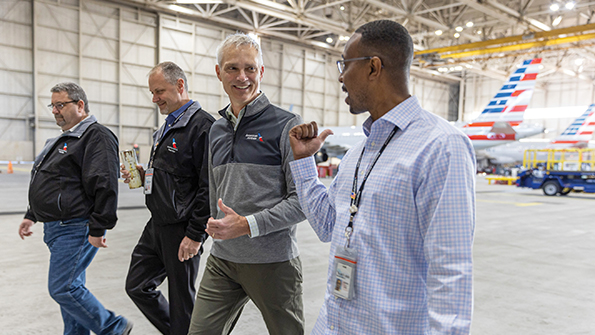
The photograph from the beginning of his CEO tenure is a useful companion to that history: Isom in a hangar, walking with employees, an American tail behind them. It shows the setting in which his reputation developed. The suit can wait; there is an operation to discuss.
A very expensive lesson in listening
The presidency had put commercial decisions alongside operational ones. The CEO job made the consequences inseparable. In 2024, American’s sales and distribution strategy supplied a painful demonstration.
The airline had pushed customers toward direct and newer distribution channels while changing its relationships with corporate buyers and travel agencies. It also announced plans to make eligibility for earning AAdvantage miles depend on where customers booked. For a frequent traveler following an employer’s booking rules, the prospect introduced an unwelcome complication.
By late May, Isom was acknowledging execution errors. Chief commercial officer Vasu Raja was leaving. American dropped the proposed distinction in mileage earning based on booking channel. The airline then began restoring access and rebuilding support for corporate accounts and travel agencies.
On the July earnings call, Isom put the first-half revenue impact at about $750 million. Management expected a similar effect in the second half. This was an estimate of revenue forgone, a distinction worth preserving when the numbers are large enough to become their own headline.
“We’re listening to feedback. We’re learning and adapting.”
Robert Isom, May 2024
The repair involved account managers, sales support and easier access to fares. These are unglamorous instruments. They are also how a company signals to an irritated customer that it has understood the complaint. A travel manager does not need a stirring declaration about the future of retailing nearly as much as a booking process that works.
The episode changed the terms on which Isom’s operating credentials could be judged. Detail mattered in selling the flight as much as in dispatching it. A process that looked efficient from inside the airline could still make life harder for the customer outside it.
People do not arrive with an operating manual
Employees present another test of the same problem. American’s board biography credits Isom’s leadership with completing new collective bargaining agreements across its major represented workgroups. Those agreements were substantive business events, with lasting consequences for pay, working conditions and costs.
In September 2024, flight attendants ratified a five-year contract. Their union said 95 percent of eligible members voted and 87 percent voted yes. It valued the additions to the existing agreement at $4.2 billion. These were negotiated gains achieved by employees and their representatives, alongside an agreement American’s management had to deliver.
The contract did not close the question of confidence in leadership. On February 9, 2026, the Association of Professional Flight Attendants’ board unanimously voted no confidence in Isom. The union cited financial performance, operational failures and accountability. Those were its stated objections, and the distinction between a signed agreement and an enduring relationship had become hard to miss.
For a leader whose work has repeatedly involved joining organizations together, the juxtaposition is telling. Reaching terms is an achievement with a date. Maintaining trust requires another day’s work after that date, and another after that.
The gap between a full airplane and a good business
Isom has also had to manage the less visible weight carried by the company: debt. American ended 2024 having reduced total debt by more than $15 billion from its mid-2021 peak, reaching that target a year ahead of schedule. It was a measurable improvement in the balance sheet, even as other parts of the business needed repair.
Investment continued. In March 2024, American announced orders for 260 aircraft from Airbus, Boeing and Embraer. The package included 85 Airbus A321neos, 85 Boeing 737 MAX 10s and 90 Embraer E175s. Fleet planning works on a timescale that makes the next quarterly earnings call look rather impatient.
By July 2026, Isom was describing a commercial agenda built around the customer experience, the global network, premium revenue and loyalty. The reported second-quarter results showed why he could point to progress and why the task remained difficult.
Reported revenue rose 16.3% from a year earlier. Revenue and net income measure different things; the distance between them is where the business gets demanding.
American reported that higher fuel expense added more than $2.2 billion compared with the same quarter a year earlier. Stronger demand and commercial execution offset nearly half of that increase. More money coming through the door did not translate neatly into money left over.
There was an operational detail in the results that suited Isom’s career particularly well. Changes to the timing of flight connections at Dallas-Fort Worth helped reduce system misconnections by nearly 25 percent year over year, American reported. For a passenger, that improvement means a better chance of making the next flight. For the company, it connects scheduling decisions to customer satisfaction and financial performance.
The job waiting tomorrow morning
His professional connections extend beyond American. Isom chaired oneworld’s governing board for a three-year term, with Luis Gallego taking over on September 1, 2026. The alliance role placed him among leaders managing the relationships that allow separate airlines to offer passengers a connected international journey.
There is a smaller, more companionable picture of him in his reading and listening habits. In 2023 he described a running playlist stretching from the Rolling Stones to Olivia Rodrigo and an interest in Freakonomics Radio. His reading list included histories and biographies. The English degree, apparently, had not been left entirely in a filing cabinet.
Asked about his legacy early in his CEO tenure, he resisted the invitation to compose one. His concern was the work immediately in front of him and the foundation for future growth. That is a modest way to describe a job with so many competing constituencies.
It is also a claim that can be checked. Customers can judge the connection. Employees can judge whether they are heard. Investors can inspect what remains after the expenses. Tomorrow morning, Isom will have another set of numbers to look at. The difficult part is getting all those people to recognize progress in the same ones.
Continue the conversation
Follow the work, revisit the decisions, or hear Isom in his own words.