An airline can be held up by lunch. In 2018, Joanna Geraghty was visiting catering facilities as JetBlue moved to a new supplier in three of its focus cities. She wanted to understand the traffic, the delivery trucks and which aircraft received their supplies overnight. Somewhere between the loading dock and the departure gate, a corporate decision would become a passenger’s wait. Geraghty went to see the distance for herself.
There is something usefully unglamorous about this episode. Aviation sells horizons. Its executives inherit truck schedules. Geraghty’s career has repeatedly brought her into the space between the promise and its delivery, where a small inconvenience for one department can become a large problem for another. Long before becoming JetBlue’s chief executive, she was learning the airline through the people expected to make it work.
She took over on February 12, 2024, becoming the first woman to lead a major U.S. airline. The appointment was a public milestone after years of internal progression. Her assignment was less ceremonial: return JetBlue to sustained profitability while preserving the service and character that gave customers a reason to choose it. An airline cannot pay its bills with affection, though it would certainly simplify the accounts.
The lawyer meets the departure gate
Geraghty first encountered aviation through the legal profession. Representing airlines and aircraft manufacturers exposed her to the consequences of things going wrong, from baggage disputes to passenger litigation. A lawyer gets an unusually concentrated view of disappointment. What interested her was the operation behind the dispute: the business that had produced the problem and the people trying to resolve it.
By 2005 she was a partner at Holland & Knight. That year she joined JetBlue as director of litigation and regulatory affairs. The airline was young; she would remain long enough to become part of its institutional memory. Legal work gave her a way to test an attractive proposal against the rules and the practical demands of carrying it out.
The promotions broadened her field of view. In 2010 she became executive vice president and chief people officer. In 2014 she moved to customer experience, overseeing airports, customer support and inflight service. In 2018 she became president and chief operating officer. Employees, passengers and daily execution had each become her responsibility before the whole company did.
- 2005Legal affairs
- 2010People
- 2014Customers
- 2018Operations
- 2024Chief executive
A progression through the people and systems behind the flight.
A sociology degree with a very large field study
At the College of the Holy Cross, Geraghty studied sociology, graduating in 1994. She was interested in people’s motivations and the backgrounds that shaped them. A year at the University of Sussex in Brighton gave her greater independence and an appetite for international work. Syracuse followed: a law degree and a master’s in international relations, both completed in 1997.
Her account of college also includes a difficult mathematics class and daily visits to the professor for help. It is a modest story to retain after reaching an executive office. Its appeal is the absence of a miraculous solution: she needed help, asked for it and kept returning. The international ambition and the stubbornly local problem of a challenging class belonged to the same education.
Syracuse later recognized her with its Arents Award, its highest alumni honor. The recognition arrived after a career that had made practical use of both degrees. International relations and law are reasonable preparation for a business that crosses borders, negotiates rules and brings strangers into close quarters. Sociology may be equally handy once everyone starts negotiating the overhead bins.
“Leadership to me is up close and personal.”
Joanna Geraghty
The question hiding inside a uniform
One of the issues Geraghty encountered in operations concerned employees covering tattoos. Ground and technical staff described the discomfort of wearing long sleeves and trousers on a hot ramp. Their concern led her into a review of the tattoo policy. A rule about appearance had become a question about the conditions in which people did their jobs.
Her earlier working life had included picking strawberries, preparing a salad bar, answering reception calls and working in a flower shop. These were jobs with different tasks and different people to understand. In discussing leadership, she connected that range of experience to the ability to see problems across roles. The executive inspecting the catering arrangements had once worked on the service side of other counters.
There is a straightforward managerial lesson here, although following it takes time. The person administering a policy and the person living with it possess different information. Getting them into the same conversation can change the question. At an airline, where employees and customers meet all day, those conversations also influence how a brand behaves when nobody from headquarters is watching.
The company she has to make add up
In July 2024, JetBlue introduced JetForward. Its four priorities joined reliable service, a more focused East Coast leisure network, products and loyalty benefits customers valued, and tighter financial discipline. The choices included leaving routes that failed the company’s financial requirements and redirecting resources toward established markets. Geography was becoming an exercise in concentration.
Geraghty had colleagues with distinct parts to play. President Marty St. George explained the commercial and network changes; chief financial officer Ursula Hurley set out the spending discipline and financial ambitions. The original plan targeted $800 million to $900 million in incremental earnings before interest and taxes in 2027. The plan also involved deferring roughly $3 billion of aircraft capital spending. These were commitments about a future business, with execution still to come.
The 2024 review supplied some early results: on-time performance improved by six percentage points year over year, and the airline reported $395 million from revenue initiatives against a $300 million target. JetBlue also reported that it had redeployed around a fifth of its previous network. Improvement was coming through a mixture of service work, selling differently and choosing where to fly.
During the second quarter of 2025, JetBlue produced a positive operating margin and reported another three-point year-over-year improvement in on-time performance. Those were useful signs, rather than a finished turnaround. A profitable quarter and sustained annual profitability describe different achievements. Geraghty’s task demanded that the better days become a business that could support itself across the year.
year over year
year over year
Reported changes for different periods. These are percentage-point improvements, not on-time arrival rates.
More places to go, more reasons to pay
Blue Sky, announced with United in May 2025, offered another answer to JetBlue’s size. The collaboration linked opportunities to earn and redeem loyalty currency and provided for booking across the airlines’ websites and apps. It also included access for United to JFK slots from as early as 2027. The two carriers would continue to market and price their networks independently.
For Geraghty, the proposition was reach: customers attached to JetBlue could gain options beyond its own map. A smaller airline could make its loyalty program useful for more journeys without flying every journey itself. The arrangement also required trade-offs in a city where airport access is a valuable part of the business. Partnerships have to earn their place alongside the flights.
Meanwhile, JetBlue was expanding the ways passengers could spend more with it. In September 2026, it unveiled BlueFirst, a domestic first-class product with two-by-two seating, larger entertainment screens and seatback ordering. The product belongs to a wider premium strategy, alongside Mint and the BlueHouse lounges. Geraghty’s customer-service background was now being tested through a more varied set of price points.
Bookings opened on October 15. The first BlueFirst revenue flight was scheduled for December 8 between Boston and Fort Lauderdale, with other routes to follow. As of this profile’s publication, the cabin’s debut remained ahead. Its success would have to be earned in actual trips, at actual fares, after the announcement had stopped being news.
$2.7 billion Q2 2026 operating revenue
At least $1.00 EPS JetBlue’s target for 2028
Revenue is a reported result. Earnings per share is a future target; the two figures measure different things.Humanity, with the accounts still open
In July 2026, JetBlue reported second-quarter operating revenue of $2.7 billion and 10.9% growth in revenue per available seat mile. It also introduced a target of at least $1 in earnings per share for 2028. The same outlook still anticipated a negative adjusted operating margin for full-year 2026. There was measurable progress and an unfinished financial job in the same release.
Geraghty’s interests extend beyond the airline. She chairs the board of Concern Worldwide U.S., whose work addresses extreme poverty, and serves on the JetBlue Foundation board. She joined the L3Harris Technologies board in 2022 and chairs its compensation committee. These roles put humanitarian governance, aviation education and corporate oversight alongside her daily operating responsibilities.
The industry recognized her with the 2023 Tony Jannus Award, before she became CEO. Recognition and responsibility have continued on parallel tracks. In August 2026, two Icahn-affiliated directors left JetBlue’s board under the ownership terms of its agreement with Icahn Enterprises. The turnaround was taking place under the attention of passengers, employees, directors and investors, each keeping a different score.
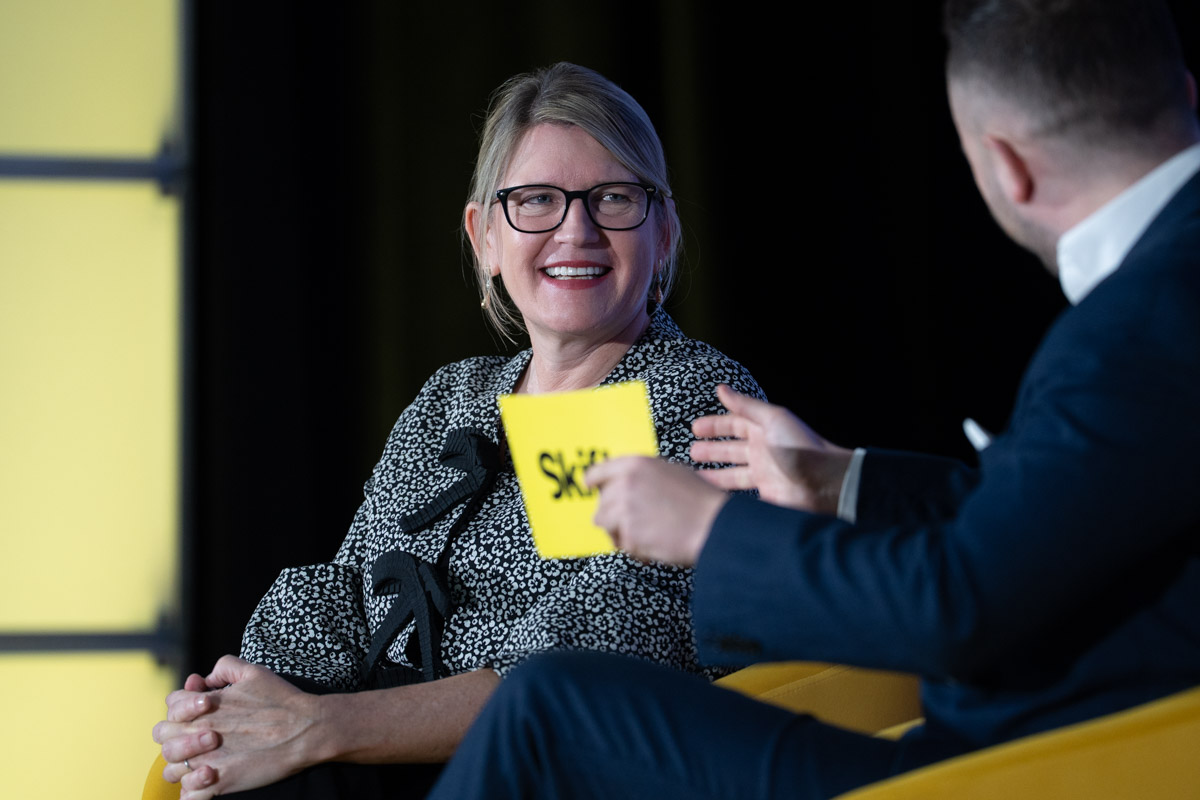
At an April 2026 appearance in Washington, Geraghty described handing out water to passengers caught in long security lines at JFK. She argued that human connection had become more valuable as technology spread through daily life. “Humanity has become the new luxury,” she said. It was an expansive claim with a very ordinary example attached: somebody in a queue needed a drink.
That combination has followed her through JetBlue. The aspiration is large; the immediate task often fits in a hand, on a truck or inside a conversation with an employee. Geraghty now has to make those small acts coexist with difficult commercial choices. The lunch still has to reach the aircraft. The aircraft still has to leave. And the airline has to earn the next trip.